Pet Sitter Backup List: What to Include and Who to Name

A pet sitter backup list is a one-page record that tells a second caregiver everything the first one would know: your pets’ routines, medical needs, vet contacts, home access and who to call. It matters most when you can’t make the call yourself. If you live alone, the list only helps if someone knows to open it, so the strongest plan pairs a complete list with a way to alert your backup people when you stop responding. That is the job our check-in service does, and this guide shows you how to build both halves.
TL;DR
- A backup list has five parts: pet details, medical and vet information, daily routine, home access, and a ranked list of caregivers.
- Name at least two backup caregivers, plus a decision-maker, and confirm each one is still willing and able to help.
- Keep a printed copy where it can be found, share a digital copy with your contacts, and update it whenever food, medication or contacts change.
- If you live alone, a list nobody knows to look for can’t help your pets. Pair it with a wallet card and an automated check-in that notifies your contacts if you don’t respond.
Table of Contents
- Why a list isn’t enough on its own
- What to put on your pet sitter backup list
- Who belongs on the backup list
- A sample backup list layout
- Where to keep it and who gets a copy
- The gap every printed list leaves
- Closing the gap with an automated check-in
- Set up your backup plan in an afternoon
- Our perspective
- Try the check-in with your own list
- FAQ
- Sources
Why a list isn’t enough on its own
Most advice on this topic is written for owners going on vacation. You hand the sitter a sheet, name a neighbor as backup, and leave. That works because you are reachable and the sitter knows to show up.
The harder case is the one you can’t schedule: a fall, a sudden hospital stay, a medical event at home. Then the sitter isn’t expecting a visit, and your backup contacts may not know anything is wrong. The ASPCA’s pet planning guidance points to this gap. It suggests a wallet Pet Alert Card that identifies the pets at home and lists two emergency contacts, plus a clearly visible Emergency Contact Sheet in your home.
So think of your backup list as two documents doing two jobs. One tells caregivers how to care for your pets. The other makes sure someone finds out they are needed. We’ll cover both.

What to put on your pet sitter backup list
An American Animal Hospital Association (AAHA) article, Preparing for the Unexpected: Essential Pet Sitter Instructions, published April 24, 2025, gives the most complete checklist. Here it is, organized so you can fill it in one pet at a time.
Each pet’s profile
Write one block per pet. Include:
- Name, age and breed
- Personality, including how the pet reacts to strangers, other animals and children
- Fears and behavioral triggers (thunder, the doorbell, men in hats)
- Activity level and favorite hiding places, which matters most for cats
- Microchip number and the registry company
- A recent photo
The hiding places and triggers are the details people forget. A frightened cat that can’t be found is a problem on day one, and a caregiver who doesn’t know the dog panics at the vacuum cleaner can avoid the trouble.
Food and daily routine
Be literal. “Feed once a day” invites guessing. Instead write:
- Food brand and type, the amount per meal and meal times
- Treats allowed, and any foods to avoid
- Walk and exercise routines, and where the pet may or may not go outdoors
- Rooms or furniture that are off limits
- Litter-box routine and where supplies are kept
The Humane Society of Mason County also recommends recording where food, medications, leashes, litter and other supplies are stored, so nobody has to search your cupboards while the pet waits.
Medical details and medications
This is the section a caregiver can least afford to guess on. AAHA recommends listing medical conditions, the symptoms to watch for, and the timing and method of every medication. Write how each pill is given, not just when. “Half a tablet hidden in a spoon of canned food” is something a stranger can follow.

Add insurance details if you have a policy, and keep a copy of medical records in your pet first-aid kit. Best Friends Animal Society likewise recommends copies of vaccination records and medication schedules stored where they are easy to reach.
Veterinary contacts and treatment permission
List:
- Your regular veterinarian’s name, location and phone number
- The closest 24-hour emergency clinic
- Any specialist who treats a chronic condition
- What the caregiver may do right away, and who has authority to approve treatment
The Mason County humane society’s guidance names an authorized primary decision-maker in the care sheet. Ask your vet clinic how they document who may approve care on your behalf. Many clinics have a process, and the answer belongs on your list.
Home access and household details
AAHA advises giving the sitter home-access and security information, including alarm codes and how to arm or disarm the system, plus Wi-Fi details. The Mason County guidance adds that you should arrange a key, garage code or other access method in advance. If your immediate caregiver shouldn’t hold your access details, a decision-maker can coordinate entry, including with an apartment manager where that is authorized.
If you live in an apartment, tell your building manager now who may be asking for entry on your behalf. Doing this once saves hours later. For a fuller walkthrough, see our guide on how to prepare your home for pet caregivers.
Who belongs on the backup list
A backup list is only as good as the people on it. Here is how to choose them.
Name more than one person
The Humane Society of the United States recommends finding at least two responsible friends or relatives who agree to be temporary emergency caregivers, and giving them keys, feeding and care instructions and your vet’s name. The Mason County humane society suggests naming someone who can step in immediately, even for a day or two, and having several options in case one is unavailable.
The reason is simple. Your primary person will be away, asleep with the phone off, or ill on the day you need them.
Separate emergency care from long-term care
The ASPCA recommends choosing an emergency caregiver separately from any permanent caregiver. The person who can check on your cat tomorrow morning, like a neighbor or friend nearby, may not be the person who can adopt or foster your dog for months. Your list should say which is which.
Prefer local when speed matters
Best Friends recommends local emergency contacts who can respond quickly and help access the home and the pet. A relative three states away can still serve as the decision-maker, but connect them to a local helper. We explain how to split these jobs in Pet Caregiver Roles: Five Assignments for Your Emergency Packet.
Confirm they are willing, and keep confirming
Ask each person directly. Show them the list, tell them where the key is, and let them say no. The ASPCA advises periodically checking that your chosen caregiver remains willing and able. A person who agreed three years ago may have moved or changed jobs.
A simple way to do this is to put a reminder on your calendar twice a year. Ask each person: “Can you still do this, and is your phone number the same?”
If you have no family nearby
Many solo owners worry that they don’t have enough people. Start with neighbors, friends from your building, a faith community or a volunteer group, and ask one person for one defined job. Our guide for solo owners without family backup walks through how to secure care in the 24 to 72 hours that matter most, and 2 to 4 pet emergency contacts solo owners should name explains how many people are enough.
A sample backup list layout
Use this structure as a one-page template. You can build it in a notes app, a word processor or on paper.
| Section | What goes in it |
|---|---|
| Owner information | Your name, phone, address, and a note that pets are home |
| Decision-maker | Name, phone, email, and what they may approve |
| Backup caregivers | Two or more names ranked in order, with phone and email |
| Pet profiles | Name, age, breed, temperament, triggers, hiding places, microchip |
| Feeding and routine | Food, amounts, times, treats, walks, litter |
| Medications | Name, dose, time, how to give it |
| Veterinary contacts | Regular vet, 24-hour clinic, specialists, insurance |
| Home access | Key location, alarm and door codes, building manager |
| Supply locations | Food, leash, carrier, litter, first-aid kit, records |
If you want a printable version, our pet care handoff checklist is a one-page format built for solo owners.
Where to keep it and who gets a copy
The ASPCA says to keep the pet portfolio in a safe but accessible place with your important papers, and to give copies to everyone in your pet’s circle of care. Practical choices:
- A printed copy near the food or supplies. The Mason County humane society suggests printing the care sheet near pet food or supplies and telling caregivers where it is.
- A digital copy for your contacts. The same source recommends a shareable electronic file when diet or medication details change often.
- A copy with your vet. The Alexandria Welfare League suggests considering placing this information with your veterinarian’s records.
- A wallet card and a door notice. The Alexandria guidance recommends both, so responders know animals are at home if you become ill or injured.
Keep the supplies themselves in one grouped spot too. A labeled bin or a felt storage basket for pet toys beside your printed sheet means a caregiver can grab the leash, the spare collar and the toys in one place.
How often to update
Update the list whenever something changes: a new medication, a diet switch, a new vet, a new phone number, a changed door code. Otherwise, review it twice a year. An out-of-date list can be worse than none, because a caregiver will follow it.
The gap every printed list leaves
The checklist above works if a caregiver knows to read it. Here is where it breaks for people who live alone:
- Nobody is expecting you, so nobody notices you’ve stopped answering.
- Your contacts may know you have pets but not where the list is.
- The person who finds out first may not have your instructions at all.
FEMA’s Disaster Preparedness Guide for Older Adults advises creating and practicing a support-network plan, and making sure at least one trusted person has a home key, knows where emergency supplies are, and knows how to administer medicine. It also notes that not all shelters accept pets, so you should plan alternatives, such as asking loved ones or friends outside your immediate area to help with animals.
That is exactly the right idea. The difficulty is the trigger: what makes your support network act?
Closing the gap with an automated check-in
A scheduled check-in turns “I hope someone notices” into a defined process. With MyPetsSafetyNet, you set the schedule and we contact you by SMS, phone call or email. If you don’t respond, an escalation workflow runs on the countdown intervals you chose, and your emergency contacts are notified with your full pet care details. Those contacts can then check on you and your pets.
Three things matter here for people who live alone or have a disability:
- It works with any phone. No smartphone is required, because check-ins arrive by text message or call.
- Your list travels with the alert. Pet profiles and care instructions are stored in your account, so a contact doesn’t have to hunt for a sheet. You can also generate a pet care instruction card.
- You control the timing. The countdown intervals are customizable, so a daily check-in and a longer interval for a planned trip can both fit your life.
The service covers up to 5 pets and up to 3 emergency contacts. For help choosing who those contacts should be, read why check-ins enforce 2 to 4 emergency contacts. If privacy is a concern, see our guide on pet emergency privacy for solo and disabled owners without a smartphone.
For pets, it fills a gap that general personal safety tools don’t. We built it around pet care, with instructions going directly to the caregivers you’ve named.
Set up your backup plan in an afternoon
You can finish the whole job in one sitting:
- Write the pet profiles using the template above. Allow 20 to 30 minutes per pet.
- Gather records: vaccinations, medication schedule, microchip number, insurance.
- Call your backup people. Ask, confirm and tell them where the key is.
- Tell your vet who your decision-maker is and ask how they record that.
- Print the list and place it with the pet supplies. Fill out a wallet card.
- Set up your check-in so your contacts receive the list if you don’t respond.
- Put two review dates on your calendar.
If you also use a dog walker or regular sitter, add them as a contact. Our dog walker emergency contact guide has templates, and the pet sitter communication plan covers what to settle before you travel. If a hospital stay is your main concern, start with who takes care of your pets if you are hospitalized.
Our perspective
We built MyPetsSafetyNet around one question: what happens to your pets if something happens to you and you live alone?
A backup list is the right starting point, and we encourage everyone to write one. But a list answers “how do I care for this pet?” It doesn’t answer “how will anyone know I need help?” Those are separate problems, and solo owners, older adults and people with disabilities usually have the second one.
That’s why we focus on the moment of silence. If you miss a check-in, the people you chose hear about it, and they get your pet care details at the same time. You don’t need a smartphone, and setup takes less than 10 minutes. We think peace of mind comes from knowing the plan runs even when you can’t.
MyPetsSafetyNet
Try the check-in with your own list
Once your list is written, you can put it to work. MyPetsSafetyNet is $6.99 per month on the Monthly plan, and it begins with a 7-day free trial that doesn’t require a credit card.
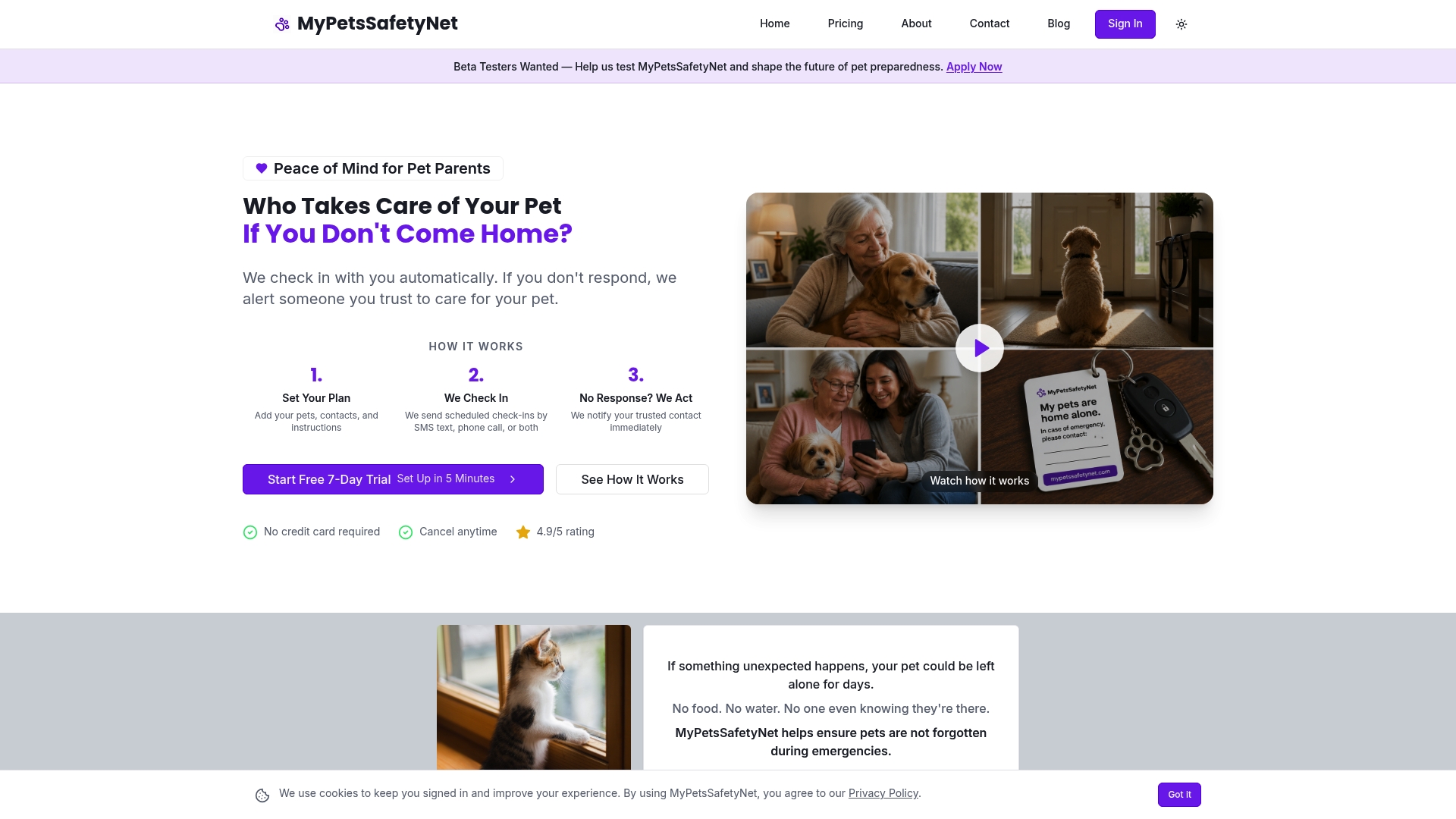
Enter your pets, add your emergency contacts, choose your check-in times and see how the escalation works. You can read the refund policy at any time.
FAQ
What should I include on a pet sitter checklist?
Include each pet’s profile, feeding amounts and times, medications with how to give them, vet and 24-hour emergency clinic contacts, home access details, and the locations of supplies. Add your own contact details, a decision-maker, and at least one backup caregiver. AAHA’s guidance covers all of these.
How many backup caregivers should I name?
Name at least two. The Humane Society of the United States recommends two responsible friends or relatives as temporary emergency caregivers. If you live alone, add a decision-maker who can coordinate access and approvals, and connect any distant person to a local helper.
Should my backup list include my house key or door codes?
Yes, but decide who holds them. Home-access information such as alarm codes and Wi-Fi details helps a sitter work. If your first caregiver shouldn’t hold access details, a decision-maker can coordinate entry, including through an apartment manager.
How do I make sure someone reads my list if I’m unable to speak?
Carry a wallet card that says you have pets at home and lists two emergency contacts, and keep a visible contact sheet at home. Then add an automated check-in so your contacts are notified, with your pet care details, if you stop responding.
Sources
- Preparing for the Unexpected: Essential Pet Sitter Instructions (AAHA)
- Making a Plan for Your Pet (ASPCA)
- Pet Emergency and Disaster Preparedness (Best Friends Animal Society)
- Planning for Pet Care (Humane Society of Mason County)
- Providing for your pet’s future without you (Humane Society of the United States)
- FEMA Disaster Preparedness Guide for Older Adults (Ready.gov)
- Planning for Your Pets (Alexandria Welfare League)