Name One Decision Maker: Coordinate Multiple Caregivers for Home Pets

Name one person as your pet’s authorized decision-maker before anything else, because that single choice prevents the delays and disagreements that hurt pets during emergencies. Right after that, build a simple written profile for each animal and a repeatable handoff checklist. Everything else, from scheduling to backup sitters, works better once those two pieces are in place.
TL;DR:
- Clearly designate one authorized decision-maker and create written permission and contact details, including veterinary authority, for emergency medical decisions.
- Build separate, detailed profiles for each pet with specific routines, medications, behavior triggers, and supply locations, updating and dating each profile regularly.
- Line up and trial backup caregivers who live nearby, verifying their understanding of routines and access methods through short test visits.
- Implement a simple, reliable handoff checklist for caregivers to ensure consistency and avoid forgetting critical tasks during shift or handoff changes.
- Use automated wellness check-ins that confirm your status on a schedule, and escalate to emergency contacts if you miss a check-in, ensuring someone always notices issues.
Table of Contents
- Which coordination scenario matches your household?
- Assign roles and name one authorized decision-maker
- Build one profile per pet, not one for the household
- Design handoffs that don’t depend on memory
- Manage keys, access, and home security for caregivers
- Document medications, vet contacts, and behavior triggers
- Onboarding sitters and spotting red flags early
- Decide payment and emergency cost authorization in advance
- Line up and test backup caregivers before you need them
- How automated wellness checks support a multi-caregiver plan
- Why this plan matters more than people expect
- MyPetsSafetyNet: automate the check so nothing depends on luck
- FAQ
- Sources
Which coordination scenario matches your household?
Most multi-caregiver setups fall into a handful of patterns, and each one carries a different risk if you don’t plan for it.
- Split shifts (morning person, evening person): the main risk is duplicated or skipped meals and meds. Fix it with a shared checklist marked off in real time.
- Weekend swaps (regular caregiver hands off to a relative or neighbor): the risk is the fill-in not knowing routines. Fix it with a written per-pet profile, not a verbal recap.
- Sitter handoffs (professional sitter rotates with family): the risk is inconsistent authority, so sitters may hesitate during a medical issue. Fix it with one named decision-maker everyone defers to.
- Shared custody between households (co-parenting a pet after a breakup or move): the risk is conflicting routines and vet records split across homes. Fix it with a single shared profile both households update.
A family splitting dog walks between siblings has very different needs than two households alternating custody of a cat, but both fail the same way: nobody agreed in advance who makes the call when something goes wrong.
Assign roles and name one authorized decision-maker
Coordinating chores is not the same as governance. Feeding, walking, and litter duty can rotate among several people, but only one person should hold final authority over medical decisions when you’re unreachable. The American Veterinary Medical Association recommends appointing this person as an authorized agent and putting the arrangement in writing rather than leaving it as an understanding among friends.
A proper authorization document should cover:
- Agent identity and contact information, including a backup phone number.
- Financial limits and payment arrangements, so the agent knows how much they can approve without checking with you first.
- Veterinary authorization, naming your regular vet and giving the agent legal standing to approve treatment.
One detail changes outcomes more than any other: according to the AVMA, distinct roles prevent confusion. This means a local access person for physical tasks is kept separate from the named medical decision-maker for veterinary choices. Share signed copies with the agent, your regular vet, the nearest emergency clinic, and every other caregiver so no one is caught without proof of authority at the worst possible moment.
Build one profile per pet, not one for the household
When you have more than one animal, a single household instruction sheet gets confusing fast. Each pet needs its own short profile that any caregiver can pick up and follow without calling you first.
A workable profile includes:
- Feeding: food brand, amount, and schedule.
- Medications and allergies: exact doses and anything to avoid.
- Exercise and confinement needs: how much activity, and where the pet should and shouldn’t go.
- Behavior flags: anything a new caregiver needs to know before approaching.
- A current photo for identification if the pet gets lost.
- Supply locations: where food, leashes, and medication are kept.
Best Friends Animal Society organizes exactly this kind of information into a standard worksheet, covering vaccination records, medication schedules, vet contacts, and supply locations in one place for each pet. Keep separate profiles rather than merging animals into one document. Our pet feeding schedule templates offer copy-ready blocks if you’d rather not build the layout yourself.
Store a printed copy in the home, a backup in a shared cloud folder, and update it whenever a dose or routine changes.
Pro Tip: Date every profile update, even a small one, so caregivers always know they’re looking at the current version.
Design handoffs that don’t depend on memory
Verbal handoffs fail because people forget details under time pressure, especially during a quick five-minute transfer between caregivers. A short written checklist, reviewed at every handoff, closes that gap.
A working handoff checklist covers:
- What was just done: feeding time, medication given, walk completed.
- What’s due next: next meal, next dose, next outing.
- Behavior notes: anything unusual the next caregiver should watch for.
- Confirmation of completion: a checkbox or initial, not just a text message that might get missed.
For tools, a shared calendar app works well for predictable schedules, a task app with reminders suits caregivers juggling multiple pets or homes, and a laminated checklist taped near supplies works when Wi-Fi or app access isn’t reliable. Whatever format you choose, set a clear rule: tasks get marked complete immediately, not at the end of the day, and anything unusual gets flagged to the whole group right away rather than left for the next person to discover.
Manage keys, access, and home security for caregivers
Letting multiple people into your home calls for a system, not a spare key handed out casually.
- Physical key exchange is simple but hard to revoke quickly if a relationship or arrangement changes.
- Lockboxes let you change the code without collecting a key back, which suits occasional sitters.
- Smart locks with temporary codes give you the most control, including time-limited access and a log of who entered and when.
Whichever method you choose, set a defined access window tied to the caregiving schedule and revoke or change it once that window closes. Label supply locations clearly, food bin, leash hook, medication drawer, so a caregiver who’s never been inside before can find what they need without texting you for directions. Our guide on emergency document essentials covers how to pair access instructions with your written authorization so both live in one place.
Document medications, vet contacts, and behavior triggers
Medication mistakes and missed warnings are two of the most preventable problems in multi-caregiver setups, and both come down to what’s written versus what’s remembered.
For each medication, record the exact dose, timing, administration method (with food, hidden in a treat, etc.), and where it’s stored. Include your regular veterinarian’s name and number along with the nearest emergency clinic, since a caregiver searching for this information during a crisis wastes time you don’t have. Best Friends Animal Society provides a worksheet that organizes vaccination records alongside medication schedules and vet contacts, which is worth adapting into your own pet profiles. For pets who may need mobile or in-home veterinary visits rather than a clinic trip, this guide to in-home vet care explains when that option makes sense.
Behavior notes matter just as much as medical ones:
- Known triggers (loud noises, strangers, other animals).
- Safe handling instructions for anxious or reactive pets.
- Escape risks, such as a cat that bolts toward open doors.
Caregivers who get this information in writing, rather than secondhand, make fewer handling mistakes during stressful moments.
Onboarding sitters and spotting red flags early
A short meet-and-greet before you hire anyone reveals more than a phone call ever will. Watch how the sitter interacts with your pet, walk them through the actual routine, and test whether they can use the access method you’ve set up without confusion.
Ask directly about:
- Experience with your pet’s species, breed, or specific needs.
- Emergency procedures, including what they’d do if your pet got sick on their watch.
- References from other clients.
- Insurance or bonding, and whether they have a backup plan if they can’t make a scheduled visit.
The American Kennel Club lists clear warning signs worth treating as deal breakers: a sitter who refuses an in-person meeting, can’t provide references, or won’t put terms in writing. AKC guidance also notes that in-home care suits some pets better than boarding, so match the setup to your pet’s temperament rather than your own convenience.
Pro Tip: Run a short trial visit, even a single hour, before committing to a recurring schedule.

Decide payment and emergency cost authorization in advance
Unclear payment arrangements stall emergency care more often than people expect, because clinics often won’t proceed without confirmation that someone can pay. The AVMA’s financial guidance recommends deciding this ahead of time rather than sorting it out mid-crisis.
Workable options include:
- A prepaid card set aside specifically for pet emergencies.
- A designated payer who covers costs upfront and gets reimbursed later.
- Pet insurance, if your policy allows a caregiver to initiate a claim.
- A documented spending limit written into your authorization form, so your decision-maker knows what they can approve without calling you.
Confirm with your regular vet and a nearby emergency clinic that they’ll accept your chosen arrangement, since not every practice handles third-party authorizations the same way.
Line up and test backup caregivers before you need them
A backup caregiver who’s never actually been in your home is a backup in name only. Treat backups the same way you’d treat a primary caregiver: vet them, trial them, and keep checking in.
- Choose backups who live nearby, are reliable under short notice, and are willing to learn your pet’s specific routine rather than improvise.
- Run a trial visit: have them meet your pet, test the access method, follow the written instructions once, and confirm your pet responds normally to them.
- Reconfirm periodically, updating contact details and availability whenever circumstances change, since a backup from a year ago may have moved or changed jobs.
Our piece on naming emergency contacts walks through how many backups solo pet owners typically need and where to store that contact list so it’s findable in a hurry.
How automated wellness checks support a multi-caregiver plan
Even a well-documented plan has one weak point: it depends on someone noticing you’ve gone quiet. An automated wellness check-in service closes that gap by watching for you when your caregivers can’t.
- Scheduled check-ins confirm you’re okay on a timer you set, by text, call, or email.
- Escalation workflows notify your named emergency contacts automatically if you miss a check-in, instead of leaving it to chance that someone calls around.
- Pet details travel with the alert, so whoever responds already has feeding, medication, and vet information in hand rather than starting from zero.
Setting one up works best once you’ve already built your per-pet profiles and caregiver contact list, since the service is only as useful as the information behind it. Link your authorized decision-maker and backups to the escalation list, and the automated check becomes the piece that notices a problem before a missed feeding turns into a missed day.
Why this plan matters more than people expect
Pets depend entirely on someone noticing when something’s wrong, and most emergency plans fail quietly, not dramatically. A caregiver assumes someone else has it covered, a backup moves without updating their number, or a written authorization sits in a drawer nobody told the vet about. The gap is rarely a lack of caring; it’s a lack of a system that works when you’re not there to manage it yourself.
- Name one authorized decision-maker.
- Create a written profile for each pet.
- Line up and test backup caregivers.
- Document payment authority in advance.
- Vet and onboard sitters properly.
- Set up regular wellness checks so gaps get noticed automatically.
— MyPetsSafetyNet
MyPetsSafetyNet: automate the check so nothing depends on luck
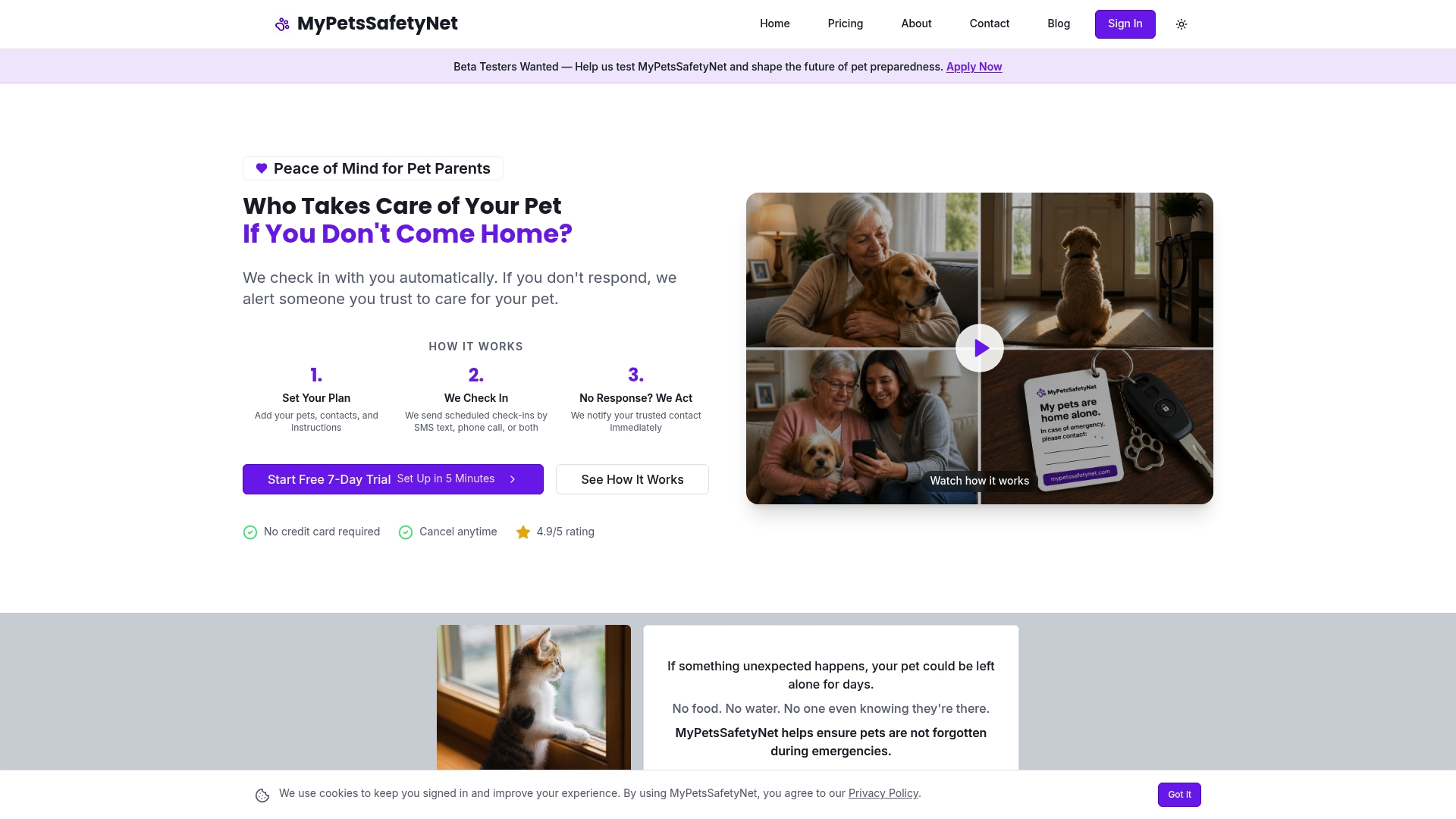
We built our wellness check-in service for exactly the gap a caregiver plan can’t close on its own: the moment no one notices you’ve gone quiet. Our check-ins reach you by SMS, call, or email on a schedule you set, no smartphone required, and if you miss one, we escalate automatically to the emergency contacts you’ve named, sending them the pet care details they need to act right away.
- Scheduled check-ins on customizable countdown intervals, so the timing fits your routine.
- Escalation to named contacts, up to three emergency contacts and five pet profiles.
- SMS and call support that works without a smartphone or app, detailed on our SMS consent page.
| What it solves | How it helps |
|---|---|
| No one notices you’ve gone silent | Scheduled check-ins catch it automatically |
| Caregivers lack pet details in a crisis | Alerts include your stored pet profiles |
| Setup feels like a chore | Takes under 10 minutes to configure |
Setup takes less than 10 minutes, and you can build a free pet care card first at Mypetssafetynet to see how the profiles work. When you’re ready for the automated check-ins and escalation, our Monthly plan has a low monthly fee with a 7-day free trial and no credit card required.
FAQ
Is $100 a day good for dog sitting?
Dog sitting rates vary widely by location, service type, and whether it’s in-home or overnight care, so there’s no single rate that applies everywhere. Compare quotes from a few local sitters or boarding providers for your specific needs rather than judging one price against a national average.
What are the red flags in a pet sitter?
According to the American Kennel Club, major warning signs include a sitter refusing to meet beforehand, lacking references, having no clear emergency procedure, and avoiding written terms. Unclear payment or cancellation policies and no proof of experience are also worth treating as deal breakers.
Is it cheaper to board or hire a sitter?
Costs depend heavily on your pet’s needs and your local market, since boarding and in-home sitting price differently depending on services included. The AKC notes that in-home care can reduce stress for some pets, which is worth weighing alongside price when you compare options.
Is $40 a day good for dog sitting?
As with higher rates, Prices may vary depending on your region and what’s included, such as multiple visits or overnight stays. Request a few local quotes and compare what each sitter provides before deciding if a price is fair for your situation.
How many backup caregivers should I name?
Most pet owners benefit from naming at least one local backup who can respond quickly, plus a non-local contact for added coverage, rather than relying on a single person. Keeping a short, confirmed list works better than a long one nobody has actually agreed to.
Sources
- Ensuring your pet is protected when you’re away | American Veterinary Medical Association
- Pet Emergency and Disaster Preparedness | Best Friends Animal Society
- How to Plan for Your Dog’s Care When You Leave Town – American Kennel Club