Pet Caregiver Roles: Five Assignments for Your Emergency Packet

Every pet owner arranging backup care needs to assign five essential roles: someone to access your home and check in, a short-term caregiver for daily needs, an emergency decision-maker for medical calls, a transport or evacuation contact, and someone holding your pet’s records and authorization. The fastest way to put this in place is to fill out a caregiver packet today, with keys, vet details, medications, and signed authorization, so nobody hesitates when it matters. Guidance from the AVMA, Ready, and the ASPCA shapes each of these roles.
TL;DR:
- Name one decision maker in a signed veterinary authorization, set any spending limit, and leave payment instructions; you remain responsible for the resulting bills.
- Write down exact food portions and medication times, and require caregivers to log each dose so treatment is not missed or repeated.
- Arrange a destination that accepts pets and a backup, then pack three to seven days of food, seven days of water, and any needed medication.
- Keep paper and digital copies of vaccination and medical records, microchip details, insurance information, and the signed veterinary authorization where caregivers can access them.
- Assign separate people to initial checks, daily care, and decisions if care becomes long term; document triggers and name a successor and backup.
Table of Contents
- What should a caregiver do the moment they arrive?
- What daily care tasks fall to a short-term caregiver?
- Who decides on emergency veterinary care, and who pays for it?
- When should a caregiver evacuate your pet, and how?
- What records and identification does a caregiver need on hand?
- How do you coordinate several caregivers without creating confusion?
- What belongs in a caregiver packet you can hand over today?
- What do most pet owners get wrong about backup care planning?
- Putting your caregiver plan into motion with automated check-ins
- FAQ
- Sources
What should a caregiver do the moment they arrive?
The first few minutes set the tone for everything that follows. A caregiver walking into your home for the first time needs to work fast, but calmly, and know exactly where to look.
- Secure all doors and windows before letting any animal move freely, since a startled pet can slip out fast.
- Locate and account for every pet in the home, checking usual hiding spots first.
- Check each animal for visible injury, distress, or signs it needs immediate veterinary attention.
- Find the stored keys, carrier, emergency kit, and medications without having to search room by room.
You can remove most of that guesswork ahead of time. Mark exactly where spare keys, garage codes, or landlord contact numbers live, and write it into the caregiver packet rather than trusting anyone to remember it under pressure.
What daily care tasks fall to a short-term caregiver?
Once a caregiver has confirmed your pets are safe, the job shifts to keeping their routine as normal as possible. That routine is the single biggest thing standing between a calm transition and a stressed, sick animal.
- Follow the written feeding schedule, including exact portion sizes and where food and bowls are stored.
- Administer medications at the labeled dose and time, logging each one so nothing gets repeated or skipped.
- Keep up exercise and bathroom routines on the pet’s normal timing, not a convenient one.
- Offer familiar toys, bedding, or a quiet space to reduce stress during the disruption.
A caregiver working from clear, written instructions moves faster and second-guesses less. That’s the entire point of preparing the packet before you need it.
Who decides on emergency veterinary care, and who pays for it?
A caregiver standing at a vet’s front desk needs two things fast: the authority to say yes to treatment, and a way to pay for it. Without both, care gets delayed while someone tries to reach you.
- Name one authorized decision-maker in writing and specify any spending limit or consent boundary they can act within.
- Provide a signed veterinary authorization letter naming that person.
- Leave a payment method on file with your regular vet, or give the caregiver clear payment instructions.
- Include your pet insurance details and your veterinarian’s direct contact information.
You remain financially responsible for your pet’s veterinary care even when someone else authorizes treatment, according to the AVMA. Prearranging authorization and payment removes the single most common delay in emergency vet visits.
When should a caregiver evacuate your pet, and how?
Not every emergency calls for moving your pet, but when it does, the caregiver needs to already know the plan rather than improvise one.
- Shelter in place if the home is safe and the disruption is short, such as a brief power outage.
- Evacuate immediately if there’s a fire, flood, gas leak, or an official evacuation order for your area.
- Use a secure carrier or harness for transport, and keep anxious pets restrained in the back seat rather than loose in the vehicle.
- Speak in a calm, low voice during transport since animals pick up on stress quickly.
Ready.gov recommends prearranging a pet-accepting destination, plus a backup, before disaster strikes, since shelters and hotels fill fast. An evacuation kit should hold three to seven days of food, at least seven days of water, and up to two weeks of medication where applicable, matching the checklist Ready.gov outlines for pet owners.
What records and identification does a caregiver need on hand?
A caregiver who shows up at a vet clinic or animal shelter without paperwork loses time explaining who they are and who the pet belongs to. Carrying the right documents skips that step entirely.
- Microchip registration number and the registry’s contact information.
- Current vaccination and medical records, including any ongoing conditions.
- Recent photos of the pet together with you, useful for proving ownership if animals are separated during a disaster.
- A written note confirming the caregiver’s authority to act on your behalf.
Store both paper and digital copies. A folder in the home works for the paper set, while a shared cloud folder or an emailed copy to your designated caregiver means the information is accessible even if the physical packet is unreachable.
How do you coordinate several caregivers without creating confusion?
Backup care usually involves more than one person, and that only works smoothly when each person’s job is spelled out separately. The ASPCA distinguishes temporary emergency care from longer-term guardianship, and treating those as two different roles avoids a lot of wasted time.
- Assign one person as the immediate checker, the one who responds first and assesses the situation.
- Assign a second person as the short-term caregiver handling daily needs for days or weeks.
- Name a successor decision-maker who takes over if the emergency becomes long-term, plus at least one backup for that role.
- Write a letter of instruction naming each person and their job, and consider a pet trust if you want a legally enforceable long-term arrangement.
Pro Tip: State exactly what triggers each role, such as a missed wellness check, hospitalization, or incapacity, so nobody has to guess when to step in.
A decision-maker and caregiver structure that’s written down ahead of time removes the back-and-forth that otherwise happens in the first confusing hour of an emergency.

What belongs in a caregiver packet you can hand over today?
A caregiver packet only works if it’s complete and easy to find. Build it in two pieces: a compact card for a wallet or keychain, and a fuller packet kept at home.
- Wallet card: your name, emergency contacts, pet names, and your vet’s phone number.
- Home packet: feeding schedule, medication log, vaccination records, microchip number, insurance details, vet authorization letter, and evacuation kit location.
- Keep a digital copy in a shared cloud folder or sent directly to each caregiver’s email.
- Walk each caregiver through the home once, show them where the kit and records are kept, and confirm every backup can reach the others.
| Packet item | Where it lives |
|---|---|
| Wallet card | Caregiver’s wallet or keychain |
| Feeding and medication schedule | Home packet, kitchen or entryway |
| Vaccination and microchip records | Home packet and cloud folder |
| Vet authorization letter | Home packet and caregiver’s copy |
| Evacuation kit | Labeled, near the main exit |
A printable caregiver packet template saves you from building one from scratch, and a practiced handoff, walked through once with each caregiver, catches gaps before an actual emergency does.
What do most pet owners get wrong about backup care planning?

We’ve seen the same gaps come up again and again while helping pet owners coordinate caregiver notifications: no spare key arrangement, no payment method on file, and no single person clearly authorized to decide. Each gap adds delay exactly when a pet needs help fastest.
The fix is rarely complicated. Confirm access works, confirm a payment method is on file at your vet, and confirm one named person holds decision authority. Running through those three checks now closes most of the openings that cause real delays later.
— MyPetsSafetyNet
Putting your caregiver plan into motion with automated check-ins
Writing a caregiver packet solves half the problem. The other half is making sure someone actually gets alerted the moment you can’t respond, which is exactly where our wellness check-in service fits.
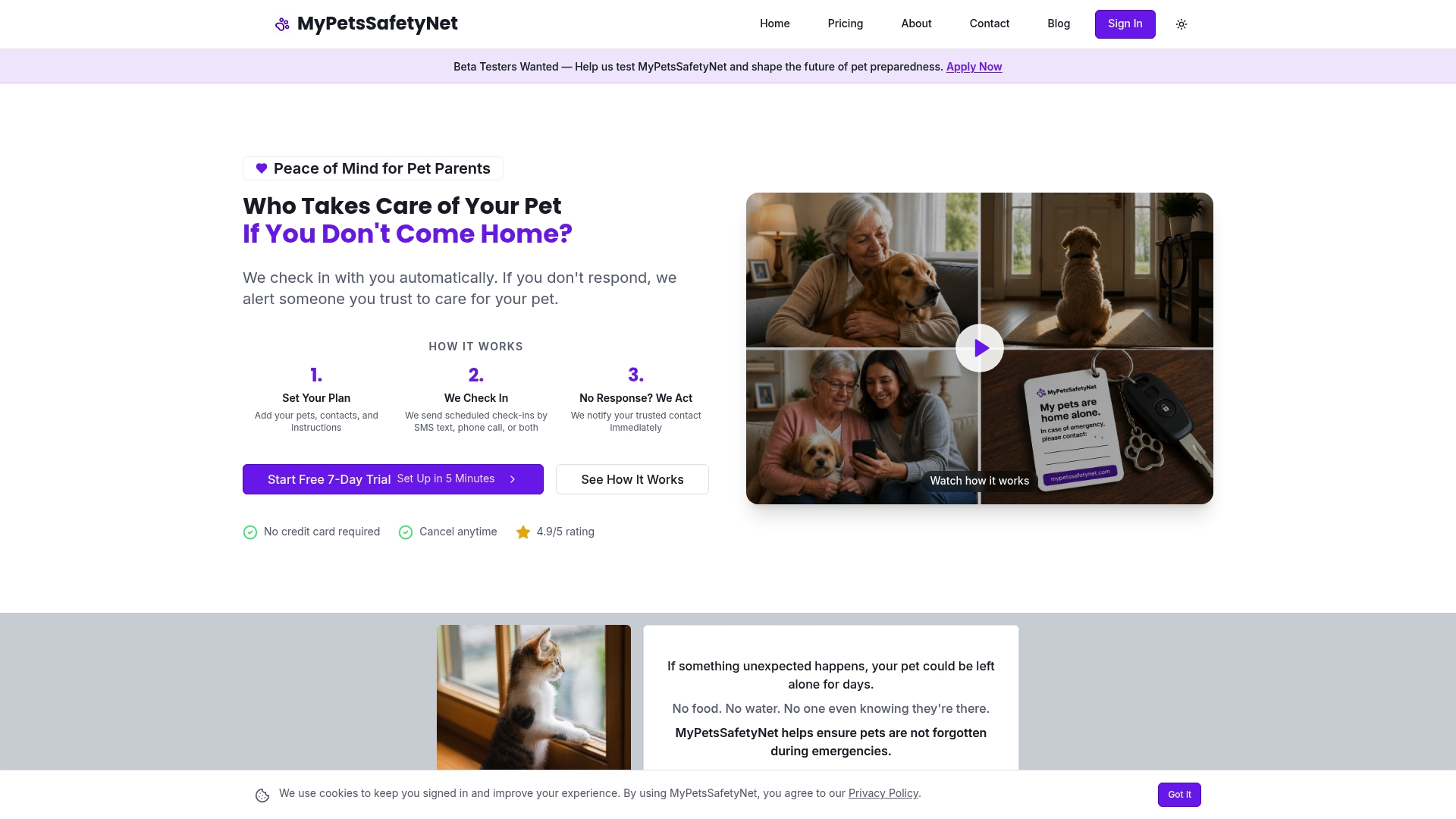
Our service sends scheduled SMS, phone, or email check-ins on a countdown you set, and if you miss one, your emergency contacts are notified automatically, along with the pet care details you have stored: feeding schedule, medications, vet contact, and authorization notes. The pet card generator supports multiple pets and emergency contacts, so the packet you build lives in one place instead of scattered papers. Setup is quick and works with any phone, no smartphone required.
Build your free pet card now, or start a 7 day free trial on our Monthly plan at $6.99 per month, no credit card required.
FAQ
What is the main role of a backup pet caregiver?
A backup caregiver’s main role is to access your home safely, confirm your pets are accounted for and uninjured, follow your written feeding and medication instructions, and contact your named decision-maker or vet if anything requires more than basic care.
Who is legally responsible for vet bills during an emergency?
You remain financially responsible for your pet’s veterinary expenses even when a caregiver authorizes treatment on your behalf, according to the AVMA. Prearranging a payment method or written spending limit avoids delays at the clinic.
How much food and water should an evacuation kit include?
An evacuation kit should include a supply of pet food, water, and medication sufficient for several days, based on guidance from Ready.gov.
What should I do if my pet may have eaten something toxic?
Contact the ASPCA Animal Poison Control Center at (888) 426-4435 right away, then follow up with your regular veterinarian or the nearest emergency clinic, since ASPCA emergency-care guidance treats phone-in first aid as a temporary step only.
Do I need a separate caregiver for short-term and long-term care?
Yes. The ASPCA recommends naming a separate short-term caregiver for immediate needs and a successor decision-maker for longer-term guardianship, since combining both into one person often slows down the response.
Can a lost-pet sign help during an evacuation mix-up?
A clearly placed, weatherproof sign can help neighbors spot and report a pet that’s gotten loose during a chaotic evacuation. YardSigns.com prints custom, fast-turnaround signs that caregivers can keep on hand as part of a reunion kit.
Sources
- AVMA — Who’s in charge of your animal’s care while you’re away?
- Ready
- ASPCA — Emergency care for your pet