Solo Owners: Secure Pet Care in 24–72 Hours Without Family Backup

If you have no family backup, your fastest and most reliable next step is to line up a local caregiver, a neighbor or a same-day paid sitter, and put together a visible emergency card. You can get both done quickly: call or text a candidate today, write down your pet’s medical details and feeding routine, and leave a spare key somewhere that person can reach. Longer-term legal options, like pet trusts, come next.
TL;DR:
- Establish two reliable caregivers, one local and one backup, and create a detailed Pet Emergency Card with medical history and key access information.
- Set up a physical and digital backup system, including a signed vet authorization form, to enable quick emergency care within 24 to 72 hours.
- Consider a pet trust for long-term legal protection, funding it with enough to cover ongoing medical needs and appointing clear management roles.
- Use automated wellness check-ins and emergency alerts to ensure someone notices if you become unexpectedly unavailable.
- Prepare a go-bag with essential supplies, documentation, and identification to allow any caregiver immediate access to your pet’s needs.
Table of Contents
- Top immediate options when you have no one to rely on
- Build an emergency backup plan you can set up in 24 to 72 hours
- Legal and long-term arrangements: wills, pet trusts, and written instructions
- If you truly have no family: community and paid options
- Prepare supplies, records, and ID that make any backup plan work
- How MyPetsSafetyNet helps solo owners with no family backup
- Why solo owners should treat pet backup like any other safety task
- Your backup plan, automated: get started today
- FAQ
- Sources
Top immediate options when you have no one to rely on
When you’re starting from zero, speed and reliability matter more than finding the perfect solution. Here’s how your options stack up, roughly in order of how fast you can set them up.
A neighbor or buddy arrangement is usually your quickest win. Ask directly, offer a spare key, and propose something reciprocal, like watering their plants or walking their dog in return. Paid same-day sitters and mobile pet care services come next: check for ID, ask for references, and confirm they have a plan if your pet needs emergency vet care. Boarding facilities and vet clinics that offer boarding are a solid fallback when you need a drop-off fast rather than someone making house calls. Local rescue groups and emergency foster networks can sometimes help, though you should ask what they can realistically commit to before counting on them.
- Neighbors: fastest to arrange, works best with a written agreement and a spare key.
- Paid sitters or mobile pet care: verify identification and ask what they do in a medical emergency.
- Boarding or vet boarding: good for urgent, short stays when no one can come to your home.
- Rescue or foster networks: useful as a backstop, but confirm their actual capacity before relying on them.
If you live alone, a “Pet Inside” sticker on your door or a wallet card listing your pets tells first responders someone needs to check your home. This single step can prevent a pet from being left alone for days if something happens to you unexpectedly, a scenario detailed further in what happens if you’re hospitalized.
Build an emergency backup plan you can set up in 24 to 72 hours
A reliable plan doesn’t need weeks to build. You can move from nothing to a workable setup in a few days if you follow these steps in order.
- Identify two caregivers: one who lives nearby for quick access, and one alternate in case the first is unavailable. Get a clear “yes” from both, not just a vague agreement.
- Put together a Pet Emergency Card or Pet Portfolio with your pet’s medical history, microchip number, vet contact, and where to find spare keys.
- Sign a veterinary treatment authorization form and set up a payment plan or prepaid card, since clinics often won’t treat a pet without this on file, according to AVMA guidance on pet care while you’re away.
- Add your alternate caregiver’s contact information to your pet’s microchip registry, and share digital copies of medical records with both caregivers.
- Run a test. Have your primary caregiver come over once, walk through feeding instructions, and show them where supplies are stored.
This checklist works best when it’s physical, not just mental:
- A printed Pet Portfolio near your front door.
- A digital folder with the same documents, shared with both caregivers.
- A signed vet authorization form kept with your vet and a copy in your go-bag.
For a ready-made template covering what to include, see pet care emergency document essentials, and for help deciding who to name, this guide to emergency contacts walks through the selection process.
Legal and long-term arrangements: wills, pet trusts, and written instructions
Short-term caregivers solve the immediate problem, but you also need something that holds up legally if you’re incapacitated for longer or something happens permanently. A pet trust is generally the stronger tool here. Unlike a will, which can be delayed by probate, a pet trust can take effect immediately and be structured to fund and enforce the exact care instructions you write, according to the ASPCA’s pet trust primer. That immediacy matters most for pets who need consistent daily care or ongoing medical treatment.
Setting one up involves naming a trustee to manage the money, a caregiver to handle daily care, and a successor caregiver in case your first choice can’t continue. You fund the trust with an amount that covers food, routine vet visits, medications, and an emergency reserve, and you name a remainder beneficiary for any money left over.
- A letter of instruction is simpler and cheaper, but it isn’t legally binding.
- A limited power of attorney can authorize someone to make decisions temporarily, though it typically expires or requires renewal.
- A pet trust costs more to set up but gives caregivers legal standing to use the funds as intended.
If your situation is straightforward, start by talking to an estate attorney or reviewing your state’s pet trust statute, and estimate what a year of care actually costs before you decide how much to set aside.
If you truly have no family: community and paid options

When family isn’t an option, your plan rests on a mix of neighbors, paid professionals, and organizations that can step in on short notice. None of these are perfect alone, but combined, they cover most gaps.
A neighborhood buddy system works best when it’s written down, not just assumed. Put the agreement on paper, specify what each of you provides, and confirm it every six to twelve months so no one is caught off guard, per ASPCA disaster preparedness guidance. For paid help, ask any sitter or mobile caregiver for ID, references, and a clear answer on what they do if your pet needs emergency care. Boarding facilities and vet clinics that board animals are useful for urgent stays, but confirm payment and pickup details in advance so there’s no confusion later.
- Formalize a buddy agreement in writing and revisit it twice a year.
- Require ID and references from any paid sitter before handing over a key.
- Confirm boarding payment and pickup terms before an emergency, not during one.
Rescue groups, sanctuaries, and foster networks can sometimes take a pet temporarily, but ask exactly what they can promise before you count on them; capacity varies and many organizations can’t guarantee availability on short notice. Shelters should be your last resort. They have limited space, and many adoption agreements restrict rehoming anyway, so pre-arranged foster care or sanctuary placement is almost always a better outcome than last-minute surrender, according to the ASPCA’s planning guidance. Boarding a pet somewhere unfamiliar is also harder on them than staying in a home environment, which is part of why a comfortable, well-prepared foster setup tends to work better than an institutional one.
Pro Tip: Call your top two backup options today and ask them to confirm in writing, even a text message counts, so you’re not guessing who’ll actually show up.
Prepare supplies, records, and ID that make any backup plan work
Whoever ends up caring for your pet needs more than good intentions. They need supplies and information in one place, ready to grab.
Pack a go-bag with 7 to 10 days of food, any medications with clear dosing instructions, a carrier, sanitation supplies, a recent photo, and a leash or collar, a standard recommended by the AVMA’s emergency preparedness booklet. Include a comfort item too, like a favorite blanket, since a stressed pet settles faster with something familiar.
- Vaccination records and your vet’s contact information.
- Microchip number and registry login so a caregiver can update it if needed.
- Proof of ownership in case a caregiver needs to make decisions on your behalf.
Keep a physical wallet card, a printed folder by your door, and a cloud folder with the same documents and shared passwords. Update your microchip registry with an alternate emergency contact, not just your own number, so reunification doesn’t stall if you’re unreachable. A ready-to-use version of these records is laid out in feeding schedule documentation you can hand to any caregiver.
How MyPetsSafetyNet helps solo owners with no family backup
A buddy system and a well-packed go-bag solve a lot, but they depend on someone noticing something is wrong in the first place. MyPetsSafetyNet closes that gap with automated wellness check-ins sent by text, call, or email on a schedule you set. If you miss a check-in, the system escalates and notifies your named emergency contacts with the exact care details they need, no smartphone required on your end.
This pairs naturally with the caregivers you’ve already lined up. Instead of hoping a neighbor happens to notice you’ve gone quiet, your contacts get a direct alert with your pet’s care instructions attached.
- Create a pet profile with care instructions for your pets.
- Name emergency contacts who get notified automatically.
- Generate a free pet emergency card in minutes at Mypetssafetynet.
Setup takes less than 10 minutes, and you can test the whole flow before committing to anything.
Why solo owners should treat pet backup like any other safety task
Most people put this off not because they don’t care, but because it feels like one more thing to figure out. It isn’t complicated: pick one caregiver today and hand them your pet’s care card within 24 hours. That single step moves you from exposed to covered.
— MyPetsSafetyNet
Your backup plan, automated: get started today
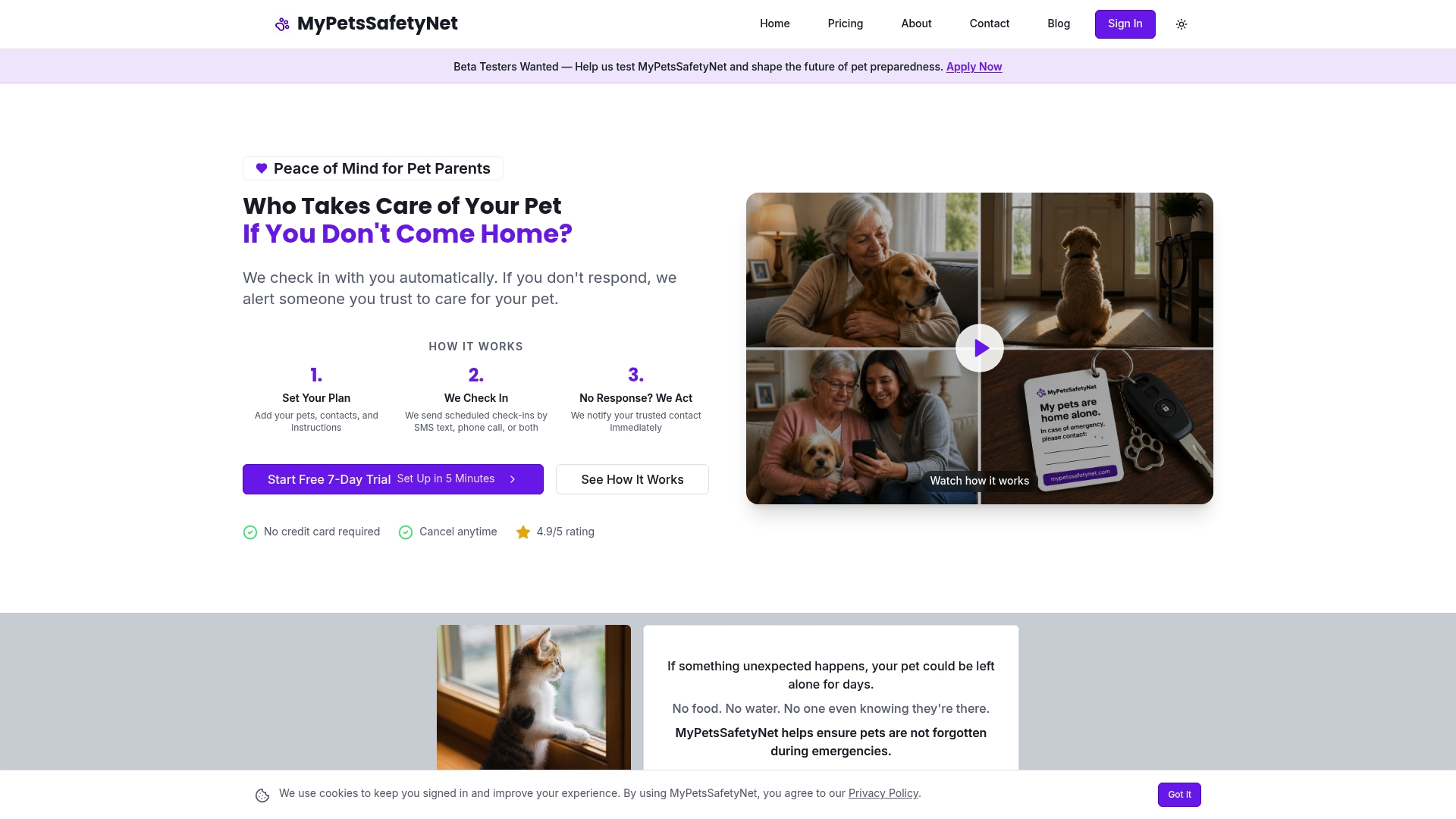
A neighbor can forget. A sitter can be unreachable. MyPetsSafetyNet adds a layer that doesn’t depend on anyone remembering to check on you, scheduled wellness check-ins that automatically alert your named contacts with your pet’s care details if you ever miss one.
- Try the free pet emergency card at Mypetssafetynet.
- Start a 7-day free trial, no credit card required, and see the full plan at $6.99 a month.
FAQ
What to do with cats when shelters are full?
Contact local rescue groups and foster networks before a shelter, since many shelters have limited intake capacity, especially for cats. Ask your vet’s office too, as some keep lists of foster contacts or temporary boarding options for exactly this situation.
How to get a dog back from an ex?
This depends on how ownership was documented, such as adoption papers, purchase records, or microchip registration in your name. A microchip registry update and proof of ownership can help establish your claim, and a conversation with a legal professional is the next step if an informal resolution doesn’t work.
What is the 3-3-3 rule for pet adoption?
Definitions vary, but a common version describes the adjustment period for newly adopted pets: roughly 3 days to decompress, 3 weeks to learn routines, and 3 months to feel fully settled. It’s a general guideline, not a strict timeline, and every pet adjusts differently.
Why is it so hard to surrender a dog?
Shelters often operate at capacity, and many have waitlists or restrictions on accepting owner surrenders, which is why planning ahead with a caregiver or foster network matters so much. Pre-arranging care, through a buddy system, a pet trust, or a foster connection, avoids putting your pet into that bottleneck during an emergency.
What if I have no backup caregiver at all right now?
Start with a same-day paid sitter or mobile pet care service while you work on a longer-term arrangement, and ask neighbors directly rather than assuming no one is available. An automated check-in service can also notify contacts you add later, even if your list starts with just one person.