How to Prepare Your Home for Pet Caregivers in an Emergency

If you live alone and something happens to you, the person who comes to help your pets needs three things: a way into your home, a clear idea of what each pet needs, and a reason to know they should come at all. Preparing your home means setting up all three ahead of time, calmly and in an afternoon or two, so a friend, neighbor or relative can step in without guessing.
This guide covers the practical steps: the walk-through, key and building access, the kit, labels and written instructions, identification, who to brief, and how often to review. If you also have a professional in-home caregiver coming for yourself, the same preparation works. Just add your pets’ routines to the information packet you give them.
TL;DR
- Walk through your home as a stranger would, and fix anything that would stop someone from finding your pets, their food or their medications.
- Give your emergency caregiver a reliable way in: a spare key held by someone you trust, a lockbox, or permission from building management.
- Keep a kit with at least two weeks of food, medications, records and photos in one known spot, and label where everyday supplies live.
- Write care instructions, name a decision-maker and confirm every caregiver has agreed to the role.
- Make sure someone is actually alerted. A plan only works if your contacts find out you need help. Review it whenever something changes.
Table of Contents
- Start with a walk-through as a stranger
- Arrange access to your home
- Put together the kit and keep it in one place
- Label supplies and write down the routine
- Make your pets and your wishes visible to others
- Choose the people and brief each one
- Our perspective: a prepared home still needs an alert
- Make sure someone is notified
- Keep the plan current
- FAQ
- Sources
Start with a walk-through as a stranger
Stand at your front door and pretend you have never been inside. Can you tell how many pets live there? Could you find the food, the leash, the carrier and the medications in under two minutes? Is anything blocking the route from the door to where your pets usually stay?
Safety-minded home-care guides that rank for this topic all begin the same way, with a walk-through of the space, and that works just as well for pet care. Make a short list as you go:
- Entry route: clear clutter near the door, hallway and wherever your pets sleep.
- Pet locations: note where each pet hides, rests or eats. A cat who vanishes under a bed is common, and a caregiver should know to look there.
- Hazards: put away anything a stressed pet could chew or knock over, and make sure doors to rooms you don’t want opened are marked.
- Escape risks: tell the caregiver about doors, gates or windows where a nervous pet could slip out.
- Supplies: confirm food, litter, bags, leashes and carriers are in the same places every time.
Pets may also act in unexpected or uncharacteristic ways after a major disruption in their lives, according to the FDA. A caregiver who has been told that your shy dog may hide or refuse food on the first day will not be alarmed by it.
If you live in an apartment, access and building rules add a layer. Our guide to an apartment pet access plan walks through it for solo and disabled owners.
Arrange access to your home
The most carefully written instructions are useless if the caregiver is standing outside a locked door. Decide now how they will get in.
Good options include:
- A spare key held by a family member, friend or trusted neighbor. Guidance from a health education guide on planning ahead for pets suggests exactly this, or getting building management’s permission for your caretaker to enter.
- A nearby contact with a key who can locate your pets and the kit. Oklahoma State University’s extension service recommends a neighbor or nearby emergency contact for this reason.
- A lockbox or gate code shared only with named people. If you use a smart doorbell or monitoring system, Ring’s guidance on responder information says to keep door, gate or lockbox details current and record how many pets you have and what kind, so responders can act appropriately.
Write down who holds each key and test it once. A key that doesn’t fit, or a neighbor who has moved, is the most common way a plan quietly fails.
Put together the kit and keep it in one place
A pet emergency kit is the single most useful thing in your home for a caregiver. Keep it near the door or in a spot you’ve named in your instructions, and make sure every caregiver knows where it is.
The FDA suggests including food, water, medications, medical and vaccination records, insurance details and pet photos. Best Friends Animal Society recommends a two-week supply of food, medications and supplies, with copies of records and your vet’s contact information. Human Rescue Alliance also lists treats, a leash, toys, a carrier, current microchip information and daily-care directions.
Here is a checklist you can use:
| Item | What to include | Where to keep it |
|---|---|---|
| Food and water | At least two weeks of your pet’s usual food, bowls, a can opener if needed | Sealed container in the kit |
| Medications | Full supply, dosing instructions, prescription details | With the kit, plus a copy on your instruction card |
| Records | Vaccination records, medical history, microchip number | Waterproof folder |
| Handling gear | Leash, collar with ID, carrier, harness | Next to the kit |
| Comfort items | Toys, a blanket, litter and scoop | Next to the kit |
| Photos | Recent, clear photos of each pet | Folder, plus on caregivers’ phones |
| Contacts | Vet, emergency clinic, caregivers, decision-maker | Folder and posted copy |
If you have more than one animal, give each its own labeled bag or section. Our guide to a multi-pet care plan shows how to keep each pet’s needs separate so nothing gets mixed up.
Label supplies and write down the routine
Someone who is stressed and in an unfamiliar home will not remember a phone call from last month. Write it down, and label the house.
The American Animal Hospital Association advises labeling where food, dishes, medications, litter, leashes, collars, toys and cleaning supplies are kept. It also recommends telling the caregiver about off-limits areas, supervision needs and symptoms that need immediate action.
The ASPCA recommends an accessible pet portfolio: habits, food preferences, medical conditions and medications, veterinary information and records, and how each pet behaves around other animals, people and children. Share copies with everyone in your pet’s circle of care.
A solid instruction sheet answers these questions for each pet:
- What and how much does the pet eat, and when?
- What medications does the pet take, at what dose and time, and how are they given?
- Where does the pet sleep, hide or like to rest?
- Does the pet fear anything: strangers, men, children, other animals, the vacuum, thunder?
- What is the walking or litter routine?
- Which signs mean call the vet right away?
- Who is the vet, and which emergency clinic is closest?
Add the decision-making details
The American Veterinary Medical Association recommends naming an authorized emergency decision-maker and sharing your vet and emergency-clinic contacts, medical conditions, treatment limits, insurance details, financial limits and aftercare wishes. The FDA adds that care instructions may include signed veterinary authorization and financial limits. If a pet needs treatment, the caregiver then knows what they’re allowed to approve.
If several people will be involved, our post on naming one decision-maker for multiple caregivers explains how to avoid conflicting instructions.
Make your pets and your wishes visible to others
Sometimes the first people through the door are first responders, not friends. A few small signals help them understand there are animals inside and who to call.
- Identification: keep collars and ID tags current. The FDA suggests considering microchipping and keeping registry contact details up to date. The AVMA adds that you should add an authorized agent as an alternate registry contact when possible.
- Window or door notices: the Humane Society of the United States suggests removable “in case of emergency” notices listing the number and types of pets, and emergency contacts’ names and numbers inside the front and back doors. It advises avoiding permanent stickers, which can become outdated.
- Wallet card: the ASPCA recommends carrying a card listing your designated emergency pet caregivers, so authorities know whom to notify if you can’t speak for yourself.
- Kit location: Oklahoma State suggests a sign or sticker showing the pets, emergency contact details and where the kit is.
Keep the notices simple and update them whenever a pet joins or leaves your household.
Choose the people and brief each one
A prepared home still needs prepared people. Here is what the research from animal welfare groups agrees on:
- Identify at least two responsible friends or relatives who agree to be temporary emergency caregivers, says the ASPCA.
- Talk with each person and confirm they are willing and able before anything happens, as the Humane Society of the United States stresses.
- Include a nearby contact and an out-of-area contact, and make sure they know your pets’ locations, how to handle them and how to reach the kit, per Oklahoma State.
- If a teenager is a helper, name a responsible adult backup in the written instructions and confirm both know they’re listed, advises the American Humane Society.
Here is a simple way to split the roles:
| Person | What they need to know |
|---|---|
| Nearby caregiver | Pet locations, how to handle each pet, where the key and kit are |
| Backup caregiver | Same instructions, plus who the first caregiver is |
| Decision-maker | Vet contacts, treatment and spending limits, aftercare wishes |
| Out-of-area contact | Who the other contacts are, so they can coordinate by phone |
Our article on five caregiver roles for your emergency packet goes deeper on each assignment, and our guide to how many emergency contacts to name helps you settle on a number.
Think about the long term too
Emergency care is temporary. Best Friends Animal Society suggests naming a permanent caregiver and recording your wishes in a will or trust. If nobody is available, it advises leaving detailed instructions on how to responsibly find a new home for your pets. An estate planning attorney in your state can tell you how to set this up properly.
Our perspective: a prepared home still needs an alert
We built MyPetsSafetyNet around one gap we kept seeing. Many people do the hard part well. They choose caregivers, write instructions and pack a kit. But if you live alone, nobody may know something has happened to you until days later.
That is why we believe preparation has two halves. The first is everything in this guide: access, kit, labels and instructions. The second is making sure the right people find out quickly that they need to act. Our service is designed to check in with you on a schedule you choose, by text message, phone call or email. If you don’t respond, it escalates to your emergency contacts and gives them your pet care details.
We designed it to work with any phone, so you don’t need a smartphone. We focus on pets because your caregivers need your pets’ instructions, not a generic alert. We think that is the most dependable way to turn a prepared home into real help.
MyPetsSafetyNet
Make sure someone is notified
Even the best-prepared home can’t call anyone. Caregivers with a key and a binder don’t know to come unless they hear something is wrong. If you live alone, have a health condition or a disability, this is the step that connects everything else.

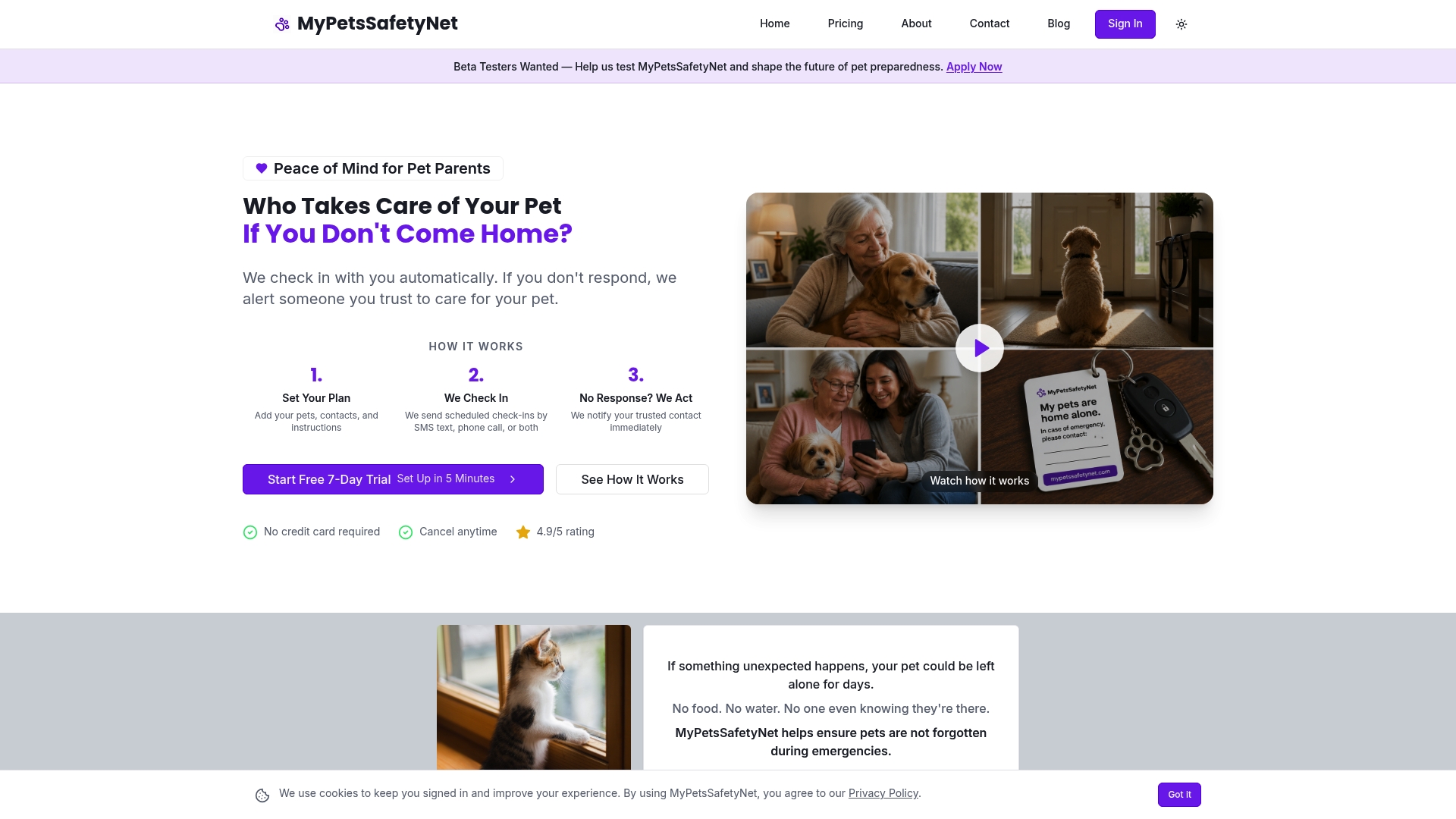
MyPetsSafetyNet is an automated wellness check-in for pet owners. You set a schedule and a countdown, and we message you by SMS, phone call or email. If you don’t respond, we start an escalation and notify your emergency contacts with your full pet care details. You can store up to 5 pets and 3 emergency contacts, and you can generate a pet care instruction card. Setup is designed to take less than 10 minutes.
The plan is $6.99 per month on our pricing page, and it begins with a 7-day free trial with no credit card required.
If you want to see how contacts fit into this, read about why unreachable emergency contacts matter or our guide to the emergency contacts solo owners should name. If you’re facing a planned hospital stay, what happens to your pets if you’re hospitalized covers the next steps. For a wider overview, see our emergency pet care plan guide.
Keep the plan current
A plan that was right last year may not work today. The ASPCA recommends reviewing periodically to confirm caregivers are still willing and able. A Los Angeles senior services guide suggests reviewing the plan whenever a pet’s routine, medication, contacts, access method, address or equipment changes, then testing it with the caregiver and fixing confusing labels or blocked routes.
Use this quick review list:
- Do your caregivers still live nearby and still say yes?
- Does the spare key or lockbox code still work?
- Are medications and doses on the sheet the current ones?
- Have food, medications and records in the kit been refreshed?
- Do the notices on your doors match the pets you have now?
- Are photos recent, and are microchip details up to date?
- Does your decision-maker still have your vet’s current number?
A good habit is to tie the review to something you already do, like a vet visit, a change of seasons or a move. Ask one caregiver to walk through the instructions out loud. Wherever they hesitate, rewrite.
FAQ
What is the first thing I should do to prepare my home for an emergency pet caregiver?
Solve access first. Choose who will hold a spare key, or arrange a lockbox or building-management permission. Then walk through your home as a stranger and note anything that would confuse them. Those two steps make every other preparation usable.
How much food and medication should I leave ready?
Animal welfare groups such as Best Friends Animal Society and Human Rescue Alliance recommend at least two weeks of food, medications and supplies. Keep the medication schedule and veterinary contacts with it. Ask your vet whether your pet’s medications can be refilled early so the kit stays stocked.
Should I put a sticker on my door to show I have pets?
Yes, a notice helps first responders, but the Humane Society of the United States recommends removable notices rather than permanent stickers so they don’t become outdated. List the number and types of pets, and add your emergency contacts’ names and numbers.
How many caregivers do I need?
The ASPCA recommends at least two responsible friends or relatives who have agreed to the role. Add a nearby contact and an out-of-area contact if you can, and name one decision-maker so instructions don’t conflict.
How will my caregivers know to come if I can’t call anyone?
A key and a written plan don’t send an alert on their own. You need a check-in that notifies your contacts when you don’t respond. Our service does this by text, phone call or email and sends your pet care details to your emergency contacts.
Sources
- Take Care of Your Pets Before Disaster Strikes, FDA
- Quick Guide to Planning Ahead for Your Pets, Triage Health
- Pet Emergency Preparedness, Oklahoma State University Extension
- Adding information for emergency responders in the Ring app
- Pet Emergency and Disaster Preparedness, Best Friends Animal Society
- Plan for Pets, Human Rescue Alliance
- Preparing for the Unexpected: Essential Pet Sitter Instructions, AAHA
- Making a Plan for Your Pet, ASPCA
- Ensuring your pet is protected when you’re away, AVMA
- Providing for your pet’s future without you, Humane Society of the United States
- Pet Sitter & Boarding 101, American Humane Society
- Estate Planning for Pets, Best Friends Animal Society
- Pet Care Backup Plan for Older Adults, Los Angeles