10 Minute Dog Walker Emergency Contacts With Templates for Solo Owners

Name at least one nearby temporary caregiver who can reach your home the same day, plus a separate long-term contact who can take over if you can’t return soon. Give both written veterinary authorization and full pet care details in advance. Then set up an automated wellness check that alerts them the moment you miss a check-in, because a plan only works if someone finds out in time.
TL;DR:
- Having both a nearby caregiver and a long-term contact is essential, with the former handling immediate needs and the latter taking over if you cannot return home for weeks.
- All emergency contacts must have signed veterinary authorization, clear authority, and payment arrangements documented and shared with the vet and caregivers in advance.
- Automated wellness checks ensure timely notifications, escalating reminders to contacts with detailed access and pet information if you miss scheduled check-ins.
- Updating microchip registration, vaccination records, and medication labels periodically is critical for quick identification and safe treatment in emergencies.
- Regularly review and test your emergency plan and communication systems every three months or after any significant change to your pet’s health or care team.
Table of Contents
- Why you need both a nearby caregiver and a separate long-term contact
- What authority and paperwork your emergency contacts need
- How automation makes sure your contacts actually get notified
- Medical records and ID details your caregiver needs on hand
- A checklist and templates you can copy right now
- Why this matters most for solo and vulnerable pet owners
- How an automated check-in service fits into this plan
- Sources
- FAQ
Why you need both a nearby caregiver and a separate long-term contact
These two roles solve different problems, and confusing them is one of the most common planning mistakes. A nearby temporary caregiver handles the first hours: feeding, medication, letting the dog out, and confirming everyone is safe. A long-term caregiver steps in if you’re hospitalized for weeks or can’t return home at all, and that person doesn’t need to live close by.
ASPCA guidance recommends naming both a short-term caretaker for same-day checks and a longer-term backup, and reconfirming both periodically so nothing falls through the cracks.
- A nearby caregiver should have a key, gate code, or lockbox access confirmed in advance, not assumed.
- A long-term contact should know your pet’s routine even if they can’t get there today.
- Both roles need to be reconfirmed every few months, because willingness and availability change.
What authority and paperwork your emergency contacts need
A caregiver showing up at the vet’s office with no paperwork can face real delays, so the documentation has to exist before it’s needed. AVMA guidance recommends a signed authorization that names the decision-maker, lists treatment preferences and limits, and states who has final say if more than one person is named.
- Sign a written veterinary authorization naming your primary decision-maker, your regular vet and an emergency clinic, and any treatment limits you want honored.
- Name one final authority if you list multiple contacts, since AVMA notes that unclear authority is a frequent cause of delayed treatment.
- Arrange payment in writing ahead of time. The FDA advises confirming what your clinic requires and agreeing payment arrangements with your caregiver, since you remain financially responsible either way.
Share copies of every document with both the caregiver and the clinic itself, not just one or the other.
How automation makes sure your contacts actually get notified

Paperwork only helps once someone knows to use it. An automated wellness check works on a simple loop: you confirm you’re okay on a schedule you set, and if you miss that check-in, the system escalates, first with reminders to you, then with alerts to your named contacts that include your pet’s full profile and access instructions.
A useful alert needs specific information, not just a phone number:
- Contact names and phone numbers, in the order they should be reached.
- Access details: key location, door code, or lockbox combination.
- Medication names, doses, and schedule, plus your vet’s contact information.
- Microchip number and a recent photo, in case your dog needs to be identified.
- Where food, leashes, and other supplies are kept.
Setting this up takes a handful of decisions: pick your contact order, set how long the system waits before escalating, choose whether alerts go out by text, call, or email, and then test the full sequence once so you know it works. After that, the main job is keeping it current.
Pro Tip: Run a test check-in right after setup so your contacts know what the alert looks like before they ever need to act on one.
Medical records and ID details your caregiver needs on hand
A caregiver who shows up ready to help still needs the right information to act safely. CDC guidance recommends keeping microchip registration and vaccination records current so caregivers and shelters can reunite pets with owners and access health history quickly.
- Update your dog’s microchip registration and tags whenever your address or phone number changes.
- Write down medication names, exact doses, and timing, and label supplies clearly where they’re stored.
- Keep an emergency contact sheet visible in your home, plus a wallet or digital pet card with the same details.
None of this needs to be complicated. A single folder or a shared document with these details, updated whenever something changes, covers most of what a caregiver will ask for in the first hour.
A checklist and templates you can copy right now
A one-page card and a short authorization form cover most of what your plan needs, and both are easy to build from scratch.
- Emergency contact card: your name, dog’s name, temporary caregiver’s name and phone, long-term contact’s name and phone, vet name and phone, and microchip number. Keep one copy at home, one in your wallet, and one saved digitally.
- Veterinary authorization snippet: “I authorize [name] to make care decisions for my dog [name] in my absence, including [treatment limits], with final authority resting with [name].” Sign it, date it, and give copies to your vet and both contacts.
- Maintenance schedule: review contacts, meds, and vet information every three months, and immediately after any change to your dog’s health, your caregivers, or your vet.
Why this matters most for solo and vulnerable pet owners
If you live alone, the biggest risk isn’t a lack of good intentions from friends and family. It’s the gap between something happening to you and anyone finding out. A blog post on choosing emergency contacts makes the case for naming two to four contacts specifically so help arrives faster, not just so a list exists on paper.
The most common mistakes are quiet ones: a contact’s phone number that’s a year out of date, a caregiver who assumes they have a key when they don’t, or a vet authorization that was never actually signed. None of these show up until the moment they matter.
— MyPetsSafetyNet
How an automated check-in service fits into this plan
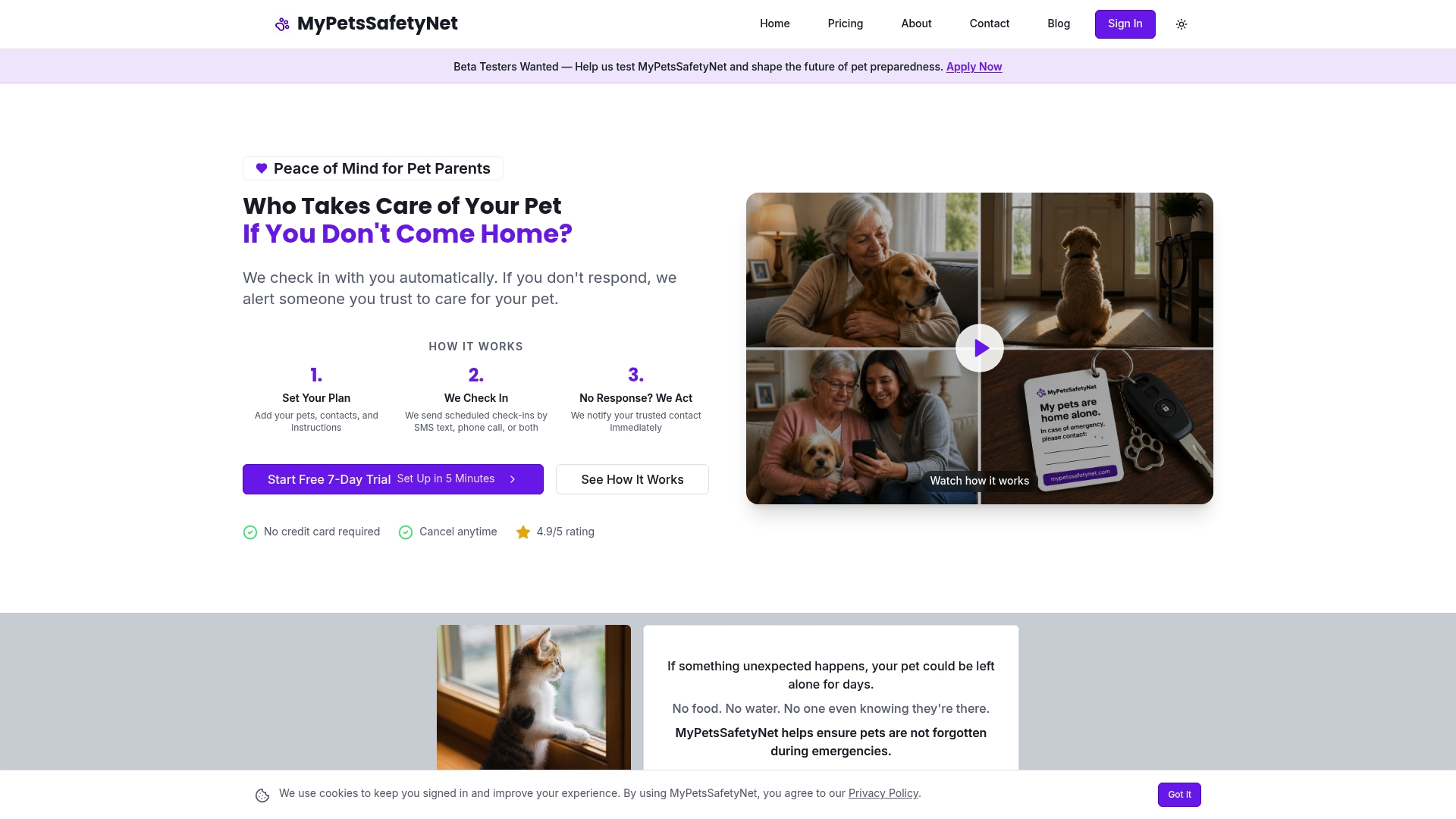
Building this plan on paper is the hard part. Keeping it enforced every single day is where most people give up, which is exactly what automated wellness check-ins are built to handle. An automated wellness check-in service can work with any phone through SMS or calls, so there’s no app required, and setup can take under 10 minutes with a schedule and escalation order you control.
- Set your check-in frequency once and adjust it any time.
- Add multiple pets and emergency contacts with their own care instructions.
- Free trials may be available to test the full sequence first.
If you’re ready to put this plan into practice, you can see pricing and start a trial in a few minutes.
Sources
- Making a Plan for Your Pet | ASPCA
- Ensuring your pet is protected when you’re away | AVMA
- Take care of your pets before disaster strikes | FDA
- Emergency preparedness for pets | CDC
FAQ
Who should I name as my dog walker emergency contact?
Name at least one nearby caregiver who can check on your dog the same day, and a separate long-term contact who can take over extended care. ASPCA guidance recommends confirming both roles periodically rather than assuming availability.
What documents does my emergency contact need from me?
They need a signed veterinary authorization naming the decision-maker and any treatment limits, plus your dog’s medical records, microchip number, and medication schedule. AVMA guidance recommends specifying final decision authority when more than one contact is named.
How does an automated pet check-in service work?
You confirm you’re okay on a set schedule, and if you miss a check-in, the system escalates until it reaches your named emergency contacts with your pet’s care details. MyPetsSafetyNet runs this process by text, call, or email without requiring a smartphone app.
How often should I update my pet’s emergency plan?
Review contacts, medications, and vet information roughly every three months, and immediately after any change to your dog’s health or care team. Keeping records current is part of standard preparedness guidance from the CDC.
Is a pet trust necessary in addition to an emergency contact plan?
A pet trust can provide legally enforceable funding and instructions for long-term care, but ASPCA’s pet trust primer notes that requirements vary by state and legal advice is recommended. It works best alongside, not instead of, an immediately usable emergency contact plan.