Auto Check Ins Enforce 2–4 Emergency Contacts for Solo Pet Owners

If you can’t reach anyone right now to care for your pet, act on three things today: name two to four emergency contacts, post a visible emergency sheet with your pet’s care details, and confirm at least one person has home access and authority to reach your vet. This is the priority over any longer-term planning, and groups like the ASPCA and Ready back this exact approach. Services like MyPetsSafetyNet exist to help you keep this plan current and working.
TL;DR:
- Having two to four emergency contacts with specific roles, such as immediate access and medical decision-making, ensures reliable backup during pet emergencies.
- Include comprehensive but concise information on a well-visible home sheet and wallet card, covering pet details, vet contacts, microchip info, and handling instructions.
- Pre-authorize veterinary treatment and ensure access keys or lockbox codes are up to date to prevent delays in care and access during a crisis.
- Maintain current digital records of vaccination, microchip, and photos, updating contact and permission information every six to twelve months.
- Use automated check-ins and escalate protocols to ensure someone responds even if initial contacts are unreachable during widespread emergencies.
Table of Contents
- Who to pick as your emergency contacts and how many to name
- What belongs on your emergency contact sheet and wallet card
- Access, keys, and vet authorization to avoid delays
- Build redundancy: buddy systems, backups, and ID upkeep
- If you have no personal contacts to name
- How automated check-ins catch what a phone tree misses
- Training pets to stay calm during an emergency
- Legal considerations for pet care authorization
- Communication methods when the usual ones fail
- Prepare emergency supplies and an evacuation plan
- Temporary care plans when contacts don’t answer
- Why a short plan works better than a complicated one
- How MyPetsSafetyNet helps you keep this plan working
- Sources
- FAQ
Who to pick as your emergency contacts and how many to name
A few contacts is best. Fewer than that and you have no backup if one person is traveling or their phone dies. More than that, and coordination gets messy fast. The ASPCA recommends carrying a wallet pet-alert card listing two emergency contacts, but adding extra gives you real redundancy, especially if one lives outside your immediate area.
Split the roles instead of asking one person to do everything:
- Immediate access contact: someone nearby who can physically get to your home within an hour or two.
- Medical decision-maker: someone who knows your pet’s health history and can authorize treatment.
- Long-term guardian: someone willing to keep your pet for days or weeks if needed.
- Out-of-area backup: someone outside your neighborhood who can coordinate if local contacts are unreachable.
Before you write anyone’s name on a list, ask them directly: “Can I list you as an emergency contact for my pet? That means checking on them if I’m unreachable, and possibly picking them up.” Confirm they have a spare key or know where one is and that they’re physically able to handle your pet’s size and temperament. Our companion guide on naming solo pet owner emergency contacts walks through this in more detail.
Pro Tip: Run a practice check-in once a year, calling your contacts to confirm their number still works and they still agree to the role.
The most common mistake isn’t a lack of willing people. It’s naming someone who was never actually asked, or picking a contact who has no way into your home when it matters.
What belongs on your emergency contact sheet and wallet card
A one-page sheet posted at home and a wallet card in your pocket serve different moments: the sheet helps a responder who enters your home, and the card tells a stranger you’re unreachable. The ASPCA provides templates for both and recommends including your veterinarian’s information on the notice.
Include these fields on the home sheet:
- Pet’s name, species, breed, and a recent photo.
- Feeding schedule, medications, and dosing instructions.
- Your regular vet’s name and number, plus the nearest emergency clinic.
- Microchip number and proof of current vaccination.
- Two to four emergency contacts, each labeled by role, with phone numbers.
- Special handling notes (bite history, anxiety triggers, escape tendencies).
- An “EVACUATED” checkbox so responders know at a glance if the pet is already safe.
Post the sheet somewhere obvious: the front door, the fridge, or just inside the entry, and consider using a reliable household well-check system to keep emergency notices updated and accessible. Keep a digital copy in a phone cloud folder and email it to each contact so they have it even if your home isn’t accessible. Review and re-confirm every contact’s willingness and phone number every six to twelve months.
A substantial share of pets go missing at some point during their lifetime, according to AKC Reunite, which is exactly why keeping this sheet current matters as much as writing it in the first place.
Access, keys, and vet authorization to avoid delays
A contact who can’t get into your home is just a name on paper. Compare your options honestly:
- Neighbor with a spare key: fastest access, but only works if that neighbor is home and reliable.
- Lockbox with a code shared among contacts: good backup, but avoid an obvious hiding spot for a key outside.
- Landlord or property manager permission: useful for renters, though it can take time to arrange.
- Written note with pickup location: a last resort, never a primary plan.
Pre-authorize veterinary treatment in writing so your vet can act without waiting on your signature. Include your regular vet’s after-hours arrangement and the nearest emergency clinic on your sheet, along with the ASPCA Poison Control hotline at (888) 426-4435 for suspected poisoning.
Tell your caregiver directly: call the clinic while en route, and if you remain unreachable and the pet is in distress, proceed with care rather than waiting. Charitable programs like AVMF’s vCare offer limited, case-based financial assistance through participating clinics, but they’re not guaranteed. Discuss payment options with your vet ahead of time. Our guide to emergency pet care documents covers authorization paperwork in more depth.
Build redundancy: buddy systems, backups, and ID upkeep
One contact is a single point of failure. Ready.gov recommends a buddy system pairing a local access buddy with an out-of-area backup, so a widespread outage or evacuation in your neighborhood doesn’t take out your entire plan at once. The local buddy handles immediate access; the out-of-area backup coordinates by phone if local lines or roads are down.
Keep these current:
- Microchip registration, with your phone number and address up to date.
- Vaccination records and a recent photo, stored digitally and on paper.
- Pre-registration for pet-friendly evacuation shelters where your area offers it.
- Contact list, re-checked every six months for accuracy.
Pro Tip: Put your microchip number on both the home sheet and the wallet card. It’s the detail that gets an unfamiliar shelter or vet to identify your pet fastest.
If you have no personal contacts to name
Not everyone has friends or family nearby who can take on this role, and that’s a real gap worth solving before an emergency, not during one.
- Call your veterinarian first. Many keep informal lists of trusted boarding options and can vouch for you with local shelters.
- Contact local humane societies, rescue groups, and boarding kennels directly, before you need them, and ask what they need on file (medical history, microchip number, vaccine records, behavior notes).
- Ask animal control about temporary hold policies in your area, since capacity and intake rules vary widely by organization.
- Get any commitment in writing or by email, since availability changes and verbal promises can be forgotten.
If you’re facing a long-term inability to care for your pet rather than a short-term emergency, plan early rather than waiting for a crisis. Surrender-prevention programs and rehoming resources exist specifically to avoid last-minute decisions. Our post on what to do if you can’t take care of your pet walks through both temporary and permanent options.
How automated check-ins catch what a phone tree misses
Even a well-built contact list depends on someone remembering to make a call, and that’s the exact point where plans quietly fail. MyPetsSafetyNet is built around scheduled wellness check-ins: you set an interval, and if you don’t respond, the system escalates automatically to your named emergency contacts with full pet care instructions attached.
- Setup takes less than 10 minutes and works over SMS or phone calls, so no smartphone is required.
- Escalation follows a workflow rather than relying on one missed call being caught by chance.
- Pet profiles and care instructions are stored and delivered directly to caregivers, not just left on a sheet in your home.
- Printable pet care cards give contacts something concrete the moment they’re notified.
This setup fits solo pet owners, people managing mobility or health risks, and frequent travelers, anyone whose plan depends on someone else noticing something is wrong before it’s too late.
Training pets to stay calm during an emergency
A calm pet is easier for any caregiver to handle, familiar or not. Basic obedience cues like “sit,” “stay,” and “come” matter more in a crisis than they do on an ordinary walk, since a stressed pet that won’t hold still or won’t approach a stranger makes rescue and transport harder.
Practice crate training well before you need it. A pet that’s comfortable in a carrier will settle faster during an evacuation, a vet visit, or a stay with an unfamiliar caregiver. Get your pet used to being handled by people outside your household too: ask a friend to practice leashing, feeding, and giving medication, so the first time isn’t during an actual emergency.

Desensitize your pet to loud or unusual sounds when you can, since sirens, alarms, and unfamiliar voices are common in emergencies and a startled pet is a harder pet to manage. Short, low-stress practice sessions work better than one long one.
None of this requires professional training. Ten minutes a few times a week, focused on the basics, builds the kind of composure that makes a real difference when a caregiver who isn’t you shows up at your door.
Legal considerations for pet care authorization
A verbal agreement with a friend to “watch the dog if something happens” carries no legal weight, and that gap can slow down care exactly when speed matters. A written authorization letter naming your emergency contacts and giving them explicit permission to access your home and make care decisions for your pet closes that gap.
For veterinary treatment specifically, put your authorization in writing and share it with your vet’s office directly, not just with your contact. Some clinics keep authorization forms on file that let a named person approve treatment and payment without you present. Ask your vet if they offer this.
If your plan includes a long-term guardian rather than a temporary caregiver, consider whether a pet trust or a provision in your will makes sense, since ownership and financial responsibility are separate questions from day-to-day care. A local estate attorney can advise on what your state recognizes, since these rules vary.
Keep copies of vaccination records, microchip registration, and any authorization letters together, digitally and on paper, so whoever steps in has proof of both the pet’s health status and their own legal standing to act.
Communication methods when the usual ones fail
Phone calls and texts are the first line of contact, but emergencies are exactly when networks get overloaded, power goes out, or a phone gets left behind. Build in backups before you need them.
Email works when cell towers are jammed but Wi-Fi or data still functions, so send your emergency sheet to every contact’s email address, not just their phone. A shared cloud folder, updated whenever your pet’s information changes, means contacts always have the current version instead of a printout from a year ago.
Landlines and workplace numbers matter more than people assume, since a contact’s cell phone might be dead or unreachable while a work line still rings through. List a second number for each contact where possible.
For widespread events, text messages tend to get through networks that voice calls can’t handle, since they use less bandwidth. This is part of why Ready.gov’s buddy system pairs a local contact with an out-of-area backup: a backup outside the affected region can often make calls or send messages that local lines can’t handle, and coordinate from there. Automated systems that alert through multiple channels at once close this gap further, since they don’t depend on one person remembering to try a second method after the first one fails.

Prepare emergency supplies and an evacuation plan
Supplies and a destination matter as much as contacts do, because a caregiver who reaches your pet still needs somewhere to take them and something to bring.
Keep a go-bag ready with:
- A three-day supply of food and any medications, in a clearly labeled container.
- A leash, collar, and carrier sized for your pet.
- Copies of vaccination records and your emergency contact sheet.
- A recent photo, in case you need to describe or identify your pet to someone else.
Ready.gov warns that many public shelters and hotels do not accept pets, so figure out a pet-friendly destination before you need one, not during. Some jurisdictions let you pre-register for pet-friendly emergency shelters, which secures a spot rather than leaving it to chance during an active evacuation. Check with your local emergency management office to see if that option exists where you live.
Give your caregiver this information ahead of time too. A contact who knows where to go, and has the supplies ready to grab, moves faster than one who has to figure it out in the moment.
Temporary care plans when contacts don’t answer
Even a solid list of two to four contacts can fail all at once during a widespread event, so it helps to have a next step already decided rather than improvised.
Boarding kennels and pet daycare facilities near you are often willing to take a pet on short notice for a fee, especially if you’ve called ahead and left your information on file before an emergency. Ask about their intake requirements and whether they hold space for existing clients during local emergencies.
Veterinary clinics sometimes offer short-term boarding too, particularly for pets with medical needs, and your regular vet may know which one. This is worth asking about at a routine visit rather than waiting until you need it.
Local rescue groups and humane societies can sometimes provide temporary fostering, though capacity varies and you should call ahead rather than assume space is available. Get any arrangement confirmed in writing or by email so there’s no confusion later.
An automated check-in service that escalates through a full contact list, rather than depending on the first person you try, reduces how often you land in this situation at all, since it keeps trying until someone actually responds.
Why a short plan works better than a complicated one
Simple plans survive emergencies. Complicated ones fail at the exact moment they’re needed, because nobody has time to remember five steps and three phone numbers while managing a real crisis.
Picture a solo pet owner who’s hospitalized unexpectedly. Her emergency sheet, posted on the fridge, lists two contacts and her vet’s number. Her out-of-area sister gets a text from an automated check-in service after a missed response, calls the local contact, and the cat is fed within hours instead of days. Nothing about that plan was clever. It just existed, and it worked.
Set up your contacts and your emergency sheet today, not next week.
— MyPetsSafetyNet
How MyPetsSafetyNet helps you keep this plan working
Writing a plan is step one. Keeping it accurate and making sure someone actually gets notified when you can’t respond is the harder part, and it’s the part MyPetsSafetyNet is built to handle.
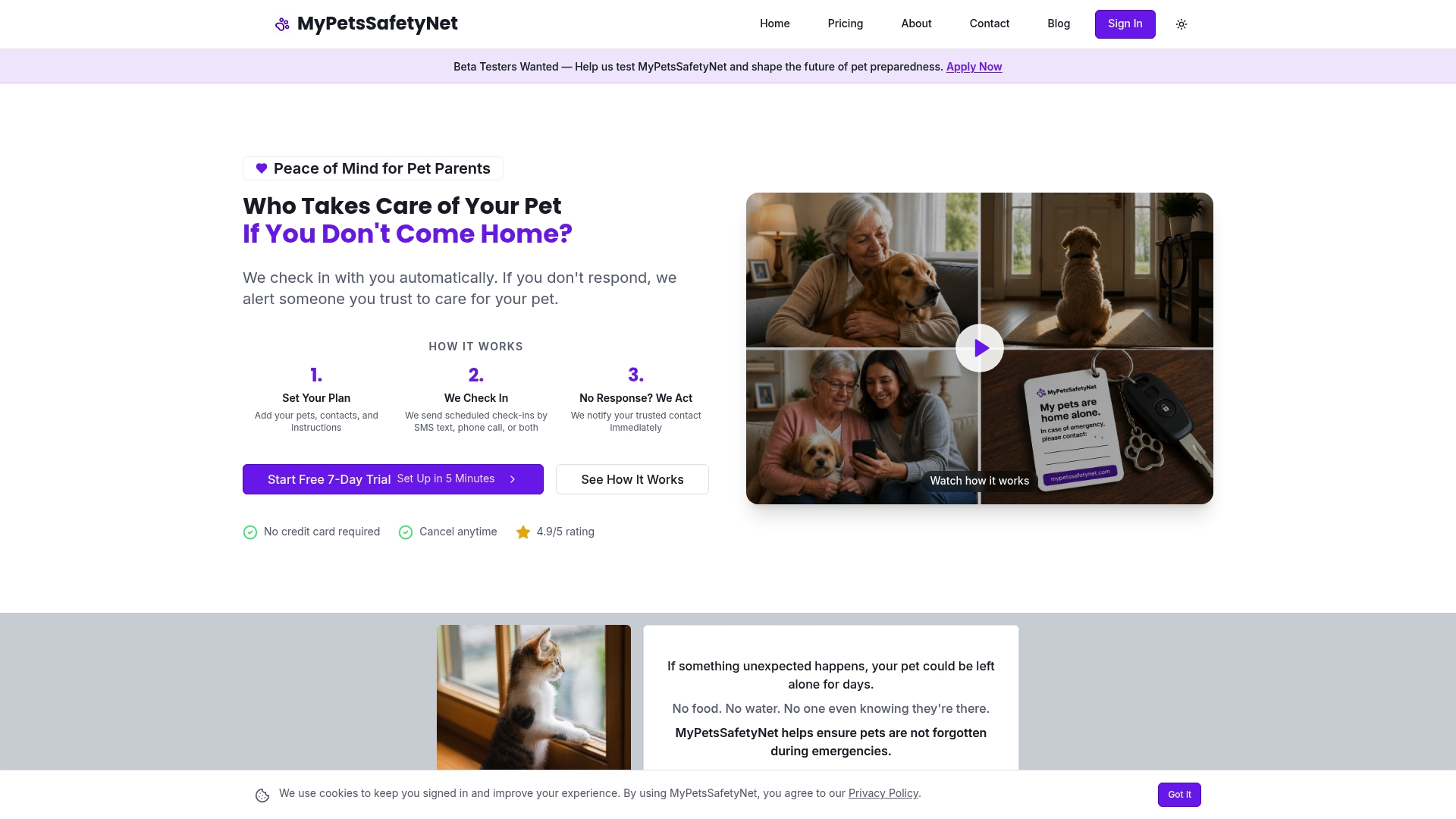
- Scheduled check-ins by SMS, phone call, or email, with no smartphone required.
- Automatic escalation to your named emergency contacts if you don’t respond.
- Pet profiles storing care instructions, medications, and vet information for up to five pets and three contacts.
- A free printable pet care card you can download and post today.
This fits best if you live alone, manage a health condition, or travel often and worry about who checks in while you’re away. Grab the free pet card to get something usable in minutes, or start a 7-day free trial for $6.99 a month after, no credit card required, and let the check-ins run in the background so your contacts are notified the moment they need to be.
Sources
- Ready
- Making a plan for your pet | ASPCA
- AKC Reunite lost & found pet FAQ
- AVMF vCare charitable care information
FAQ
Is there a 911 for pets?
No single emergency dispatch number exists for pets. For immediate danger involving human safety, still call 911; for a pet’s medical emergency, contact your veterinarian or the nearest emergency veterinary hospital, and for a lost pet, reach out to animal control, local shelters, and recovery registries like AKC Reunite.
What do I do if my pet has an emergency and I have no money?
Call your vet immediately and ask about payment plans or emergency financing options before assuming you can’t afford care. Programs like AVMF’s vCare offer limited, case-based charitable assistance through participating clinics, though availability isn’t guaranteed and must be arranged directly with your vet.
What should I do if no one can watch my dog?
Call local boarding kennels, your veterinarian, and nearby humane societies or rescue groups before you need them, since capacity and intake policies vary widely. Get any commitment confirmed in writing, and consider an automated check-in service that escalates to backup contacts if your usual arrangement falls through.
How often should I update my pet’s emergency contact information?
Re-confirm your emergency contacts’ willingness and phone numbers, and check your microchip registration, every six to twelve months. Update your emergency sheet immediately whenever a contact’s information changes or your pet starts a new medication.