Pet Emergency Privacy for Solo & Disabled Owners Without a Smartphone

The most reliable approach pairs privacy-first automated wellness check-ins with 2 to 4 role-assigned emergency contacts and a signed veterinary authorization. This combination gets your pet into trusted hands fast, works without a smartphone, and keeps your personal details protected when your provider discloses its data practices clearly. Confirm or update your contacts and consent documents today, before a crisis forces the decision.
TL;DR:
- Assign 2 to 4 contacts distinct roles, pairing a nearby person with keys or a code and a separate medical decision maker who can approve treatment.
- Sign veterinary consent naming the authorized agent, permitted treatments, financial limits, and final decision maker; confirm clinic requirements and payment arrangements beforehand.
- Keep emergency details on a wallet card and home sheet, but omit your address, full legal name, and financial details from the card.
- Test automated wellness alerts monthly, confirm contacts know how to respond, and update phone numbers and medical notes when circumstances change.
- Before enrolling, check that the provider explains third party sharing, data retention, deletion, encryption, account security, and breach notifications.
Table of Contents
- How to pick 2 to 4 emergency contacts and assign roles
- What to put on an emergency contact sheet and wallet card
- Access, vet authorization, and legal steps so contacts can act
- How automated check-ins and escalation workflows operate
- How to vet a provider for privacy and security before you enroll
- Step-by-step setup checklist and routine maintenance plan
- MyPetsSafetyNet’s privacy-forward design
- Why privacy planning for pets gets overlooked
- Try a no-smartphone wellness check-in today
- FAQ
- Sources
How to pick 2 to 4 emergency contacts and assign roles
Picking the right people matters more than picking many people. We recommend naming 2 to 4 contacts and giving each one a clear job so nobody hesitates when it counts.
- Immediate access contact: someone with a key or lockbox code who lives close enough to reach your pet within an hour.
- Medical decision-maker: the person authorized to approve veterinary treatment and discuss costs with your vet.
- Local backup: a neighbor or friend who can step in if your first contact is unreachable.
- Long-term caregiver: whoever would foster or rehome your pet if your crisis lasts more than a few days.
Local access matters because a decision-maker in another state cannot physically get into your home. Best Friends Animal Society recommends pairing a remote decision-maker with a local contact so authority and physical access never depend on the same person.
When you ask someone to serve as a contact, say it plainly: “If I don’t respond to a wellness check, you’ll get a message with my pet’s care instructions and my vet’s number. Can I count on you?” Confirm they still have a working phone number twice a year.
If you have no personal contacts available, look into local shelters that offer short-term boarding agreements, community pet-sitting networks, or adding a trusted acquaintance as an alternate contact on your microchip registry so rescuers have someone to call even without a formal relationship.
What to put on an emergency contact sheet and wallet card
Your emergency sheet and wallet card should contain exactly what a caregiver needs and nothing more. Keep the following fields on both:
- Pet identification: name, species, breed, age, and a recent photo.
- Microchip number and registry name, so anyone can confirm ownership quickly.
- Medications and allergies, written in plain language with dosages.
- Primary vet and preferred emergency clinic, including phone numbers and addresses.
- Feeding and medication schedule, spelled out by time of day.
- Microchip registry contact information, in case the registry needs to verify an update.
For your own information, list a first name, phone number, and relationship to the pet. Skip your home address, full legal name, or financial details on the wallet card itself. Someone who finds your pet does not need to know where you bank.
Store a waterproof copy at home near your pet’s leash or carrier, a laminated wallet card in your purse or wallet, and a sealed envelope near your front door for first responders. Keep a private digital copy in a password-protected file or app with access limited to your named contacts only.
Add a short note about payment: your pet insurance policy number, a pre-authorized card on file with your regular vet, or a written reimbursement agreement with your chosen caregiver. This single line can prevent hours of delay at a clinic front desk.
Pro Tip: Laminate the wallet card yourself with clear packing tape. It survives a wallet or glovebox far longer than paper alone.

Access, vet authorization, and legal steps so contacts can act
Even a perfect contact list fails if nobody can legally act on your pet’s behalf. The American Veterinary Medical Association recommends appointing an authorized agent and signing a veterinary consent form that names the permitted treatments, any financial limits, and who holds final decision-making authority. Many clinics require this documentation in advance, along with a pre-arranged payment method, so confirm the specifics with your vet before an emergency happens.
Physical access needs the same level of planning as medical authority:
- Give a trusted contact a spare key, or share a lockbox code they can access without your phone.
- Write a brief neighbor agreement, even informally, describing what they’re authorized to do and for how long.
- Add an alternate contact to your pet’s microchip registry entry so a shelter or vet can reach someone besides you.
- Keep a written reimbursement or pre-authorization note with your vet so a decision-maker isn’t paying out of pocket unexpectedly.
Veterinary records are generally kept confidential, and clinics typically need client consent before sharing details with anyone outside your authorized circle. Share only what a caregiver needs for that specific visit, not your pet’s entire history, unless your vet asks for it.
How automated check-ins and escalation workflows operate
An automated wellness check-in follows a simple sequence: a scheduled check goes out, you get a response window, the system retries if you miss it, and your emergency contacts receive a notification with your pet’s care instructions if you still don’t respond. The value is in the retries: a missed message at 9 AM doesn’t trigger a panic call by 9:05, but a pattern of missed responses does.
These systems are built around accessibility, not assumptions about your device:
- SMS text check-ins work on any phone with texting, smartphone or not.
- Automated voice calls reach landlines, which matters for owners who don’t carry a cell phone at all.
- Accessible messaging options support deaf or hard-of-hearing users through text-based formats instead of voice-only alerts.
When you evaluate a provider, look for minimal third-party data sharing, explicit consent before your information moves anywhere, clear rules about how long your data is kept, and a transparent breach notification policy. The FTC’s updated Health Breach Notification Rule requires vendors handling sensitive personal health data, including health-adjacent services, to notify users and the FTC when a breach occurs, with expanded requirements for what that notice must say and how fast it must arrive.
Run a test check-in monthly. Confirm your contacts know what action to take when they get the alert, not just that they’re listed as a contact.
Pro Tip: Schedule your test check-ins for the same day each month, like the first Sunday, so testing becomes routine rather than another task you forget.
How to vet a provider for privacy and security before you enroll
Before you hand over your pet’s details and your own, read the privacy policy with three questions in mind: does it say explicitly that your data won’t be sold, does it disclose any third-party sharing, and does it explain how long your information is retained.
FTC enforcement history shows what happens when companies share sensitive health data with advertisers without clear consent. That’s a useful benchmark: a provider that avoids this kind of arrangement, and says so plainly, is worth more trust than one that stays vague.
The FTC’s Health Breach Notification Rule requires notice to users and the agency when sensitive health data is exposed, which means a provider’s breach notification language is not boilerplate, it’s a real commitment you can check before you need it (FTC).
Check for these basics before enrolling:
- Encryption for data both in transit and at rest.
- Two-factor authentication on your account login.
- Clear contract terms for any third-party vendors the provider uses.
- A stated retention and deletion policy, not just a mention that one exists.
Make a habit of reviewing your account every few months: remove outdated contacts, update phone numbers, and share only the data fields a caregiver actually needs.
Step-by-step setup checklist and routine maintenance plan
Setting this up takes less effort than most people expect once the pieces are in order.
- Choose your 2 to 4 contacts and assign each a role.
- Complete a signed veterinary authorization naming your agent and any financial limits.
- Update your pet’s microchip registry with current contact details and an alternate name.
- Prepare your wallet card and home emergency sheet using the fields above.
- Enroll in an automated check-in service with no-smartphone options.
- Confirm payment arrangements with your vet or insurer in writing.
For testing, run a check-in drill monthly, re-verify contacts whenever a phone number or address changes, and refresh medical notes every 6 to 12 months or after any diagnosis change.
A simple script for confirming a contact: “Just checking, you’re still good to be listed as [role] for [pet’s name] if I don’t respond to a wellness check. Same phone number still work?” Keep it that short. Most people say yes immediately.
MyPetsSafetyNet’s privacy-forward design
We built MyPetsSafetyNet around exactly this plan: automated check-ins that work by SMS or phone call, no smartphone required, with escalation workflows that notify multiple emergency contacts with full care instructions for several pets. Multiple contacts aren’t a nice-to-have in our system, they’re how we avoid a single point of failure when one person doesn’t pick up.
Every check-in, template, and contact record stays under your control, with instructions going only to the people you’ve named, not to emergency services directly. That distinction keeps the information private while still getting your pet real help, fast.
Why privacy planning for pets gets overlooked
Most emergency planning advice focuses on having a contact list and calls it done. That’s where it falls short: a phone number without a signed vet authorization is often useless at a clinic counter, and a wallet card with too much personal information on it creates a privacy risk for you while solving nothing for your pet.
The conventional wisdom treats this as a one-time task, a card you fill out once and forget. In practice, phone numbers change, vets retire, and a contact who agreed two years ago may not remember the arrangement at all. The plans that actually work are the ones treated as living documents, tested monthly and revised whenever life changes.
If you prioritize one thing first, make it the veterinary authorization. Contacts and cards matter, but without signed consent naming an agent, even a willing neighbor can be turned away at the clinic door when your pet needs care the most.
— MyPetsSafetyNet
Try a no-smartphone wellness check-in today
Setting up a privacy-first safety net for your pet doesn’t require a complicated system or hours of your time. Our Monthly plan is available for a monthly subscription fee, includes a 7-day free trial with no credit card required, and takes under 10 minutes to configure with customizable schedules and escalation rules.
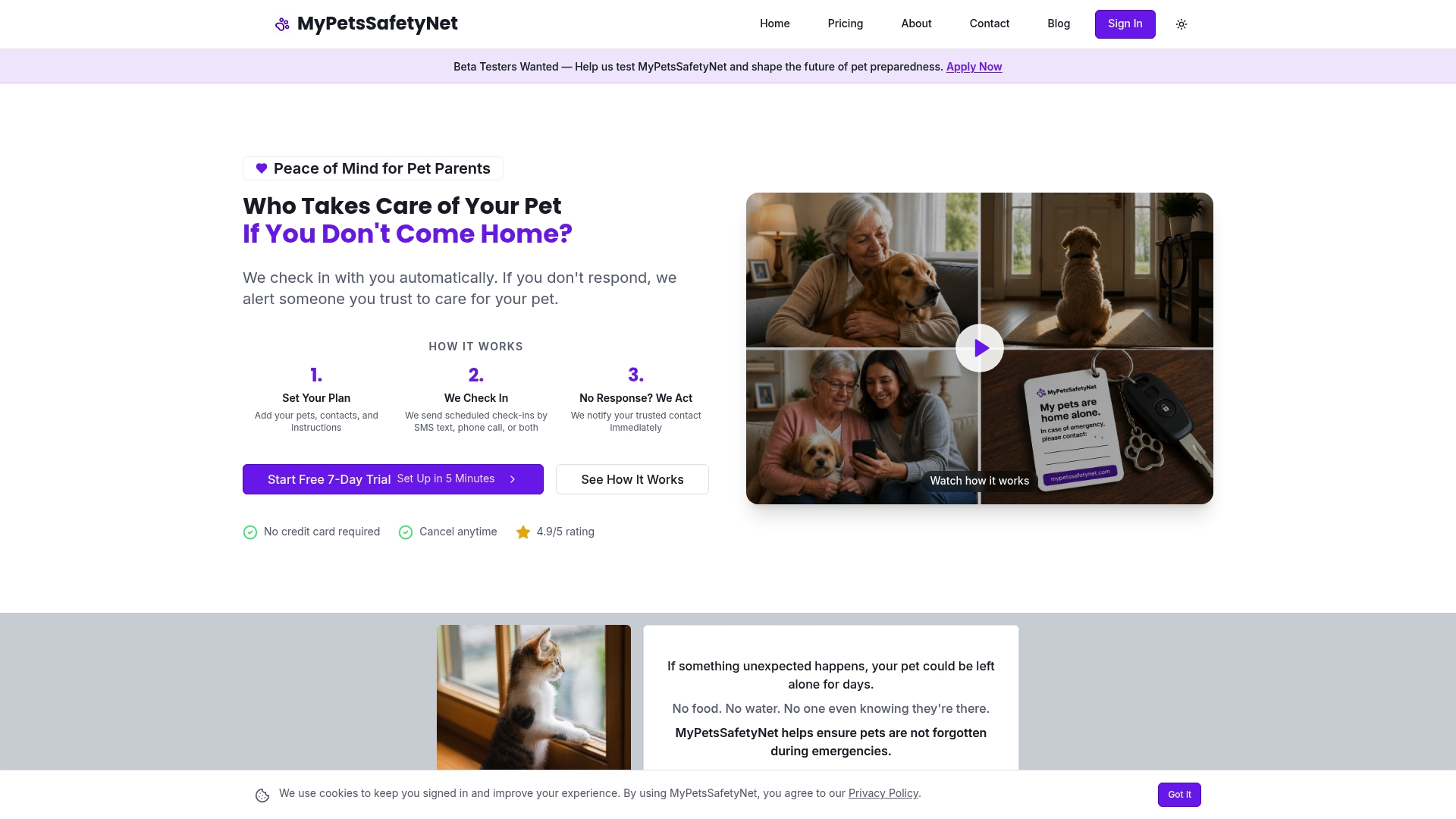
- Works by SMS or phone call, no smartphone needed.
- Covers up to 5 pets and 3 named emergency contacts.
- Pairs well with our free printable pet card for your wallet or home binder.
Review our privacy policy before you enroll, then run a test check-in to see exactly what your contacts would receive.
FAQ
Can I talk to a vet for free online?
Some veterinary organizations and apps offer free basic guidance, but a free online consultation typically can’t replace an in-person exam or prescribe treatment. For emergency authorization purposes, your signed consent form should still name your regular vet or preferred emergency clinic rather than an online-only service.
What should I do if I don’t want my dog anymore?
Contact a local shelter, breed-specific rescue, or animal welfare organization to discuss surrender options rather than leaving a dog unattended or outdoors. Many shelters offer guidance on rehoming directly to a vetted adopter, which can reduce stress for the dog compared to a shelter intake.
What animal is best for anxiety and depression?
There’s no single “best” animal, since the right fit depends on your living situation, energy level, and ability to provide care. Dogs and cats are the most common companions cited for emotional support, but the right choice is the one you can care for consistently, including during a personal health crisis.
Can you sit in an emergency exit row with a pet?
Airlines generally prohibit passengers traveling with pets, including service animals in some cases, from sitting in emergency exit rows, since those seats require passengers to assist in an evacuation. Check your specific airline’s pet policy before booking, as rules vary by carrier.
Sources
- Ensuring your pet is protected when you’re away | American Veterinary Medical Association
- FTC finalizes changes to the Health Breach Notification Rule | Federal Trade Commission
- Pet emergency and disaster preparedness | Best Friends Animal Society