Power of Attorney for Pet Care: What It Covers and How to Set One Up

A power of attorney for pet care is a document that names a person you trust and gives them legal authority to make decisions for your pet, and to spend your money on your pet’s care, if you become incapacitated or can’t be reached. It works while you are alive, which is the gap a will can’t fill. Below, you’ll see what it can authorize, what to write in it, how it differs from a pet trust, and how to make sure your agent actually learns something has happened to you.
TL;DR
- A pet care power of attorney (often called a pet POA) lets your chosen agent make veterinary decisions, arrange care, and spend your funds on your pet while you can’t.
- It should be durable, meaning it stays in effect if you become incapacitated. Rules and formalities differ by state, so have a local estate planning attorney review it.
- A pet POA ends at your death. A pet trust or a will provision covers what happens after, and many owners use both.
- The document only helps if your agent knows to act. An automated check-in with a written care plan gets them there faster.
- Keep the paperwork where responders and your agent will find it.
Table of Contents
- What a pet care power of attorney actually does
- Two ways to use a pet POA
- “Durable” is the word that matters
- What to put in your pet care POA
- Pet POA or pet trust: which do you need?
- The part paperwork can’t solve: getting your agent notified
- Promo: let MyPetsSafetyNet start the chain
- Perspective: why authority and notification belong together
- A simple setup order
- FAQ
- Sources
What a pet care power of attorney actually does
A power of attorney (POA) is a written document in which you, the principal, give another person, the agent, authority to act for you. A pet care POA points that authority at your animals. If you are hospitalized, unconscious, or otherwise unable to act, your agent can step in without waiting for a court to appoint someone.
The Ohio State Bar Association’s pet planning handbook lists 13 specific “pet powers” an agent can be given. They include:
- Providing general care and day-to-day maintenance
- Determining and providing veterinary treatment
- Arranging temporary care during your absence or illness
- Transporting, grooming, and exercising the animal
- Rehoming the pet if you become permanently unable to care for it
- Entering contracts for animal care and maintaining insurance
- Buying equipment and supplies
- Spending your money on the animal’s care
- Creating and funding a trust for the animal, when expressly granted
The Illinois State Bar Association describes the same idea in its Durable Power of Attorney for Pet Care: written authority to make decisions about veterinary care and treatment, including arrangements at an animal hospital or emergency room, and to make sure the pet’s essential needs are met.
You control how wide the authority is. One attorney’s firm notes that a pet care POA can grant broad authority or limit the agent to specific actions, and it can last as long as you are incapacitated or only for a set period.
Two ways to use a pet POA
Owners tend to reach for this document in one of two situations.
Long-term incapacity. A stroke, a dementia diagnosis, or a serious injury can leave you unable to manage your own affairs. A durable POA keeps your agent’s authority alive during that time. If you are thinking about this scenario, our guide to pet care planning for cognitive decline walks through what to put in place early.
Short-term absence. Some owners use a pet POA for a trip, a surgery, or a hospital stay, so a friend can authorize vet care while the owner is out of reach. If a hospital stay is your main worry, read who takes care of your pets if you are hospitalized.
“Durable” is the word that matters
Under common law, a POA becomes ineffective if you become incapacitated. That defeats the purpose here. The Illinois State Bar Association explains that if you specify the POA continues despite incapacity, it is called a durable power of attorney.
Many states have adjusted this default. The Uniform Power of Attorney Act (2006) says a POA created under it is durable unless it expressly provides otherwise. Florida’s statute defines “durable” as not terminated by the principal’s incapacity. Not every state follows the uniform act, though, so the safest approach is to write the word “durable” into the document and confirm how your state treats it.
The same uniform act lists when a POA ends: when you die, when you revoke it, when its purpose is accomplished, or when the agent dies, becomes incapacitated, or resigns with no successor. That last point is why you should name an alternate agent.

What to put in your pet care POA
The Ohio handbook frames good drafting around a few objectives: appoint a pet-friendly agent, grant specific pet authorities, set limits, create duties, and give guidance through standards and instructions. Here is how that turns into a practical checklist.
Choose the agent and an alternate
Pick someone who knows your animals, lives close enough to reach them quickly, and is willing to take on the job. Nominate at least one alternate. The law expects an agent to be honest with and loyal to the person who appointed them, as the Illinois State Bar Association points out, but it can’t make someone available on a Saturday night. Ask first, and ask more than one person.
If several people help with your pets, decide who has the final say. Our post on naming one decision maker for multiple caregivers explains why that prevents arguments during a crisis.
Spell out veterinary authority
This is where pet POAs earn their keep. The Ohio handbook describes authority to consult veterinarians, sign treatment authorizations and consents, and order and administer medications. The DCARE form from the Dog & Cat Advocacy Fund goes further, covering agreeing to, refusing, or withdrawing consent to treatment, surgery, tests, or medications, and notes that the agent is not personally financially responsible for the contracts made on your behalf.

Think through the hard decisions in advance: how much treatment you would want for a very sick pet, and whether you would authorize humane euthanasia when appropriate. Write your wishes down so your agent isn’t guessing. A separate veterinary consent form kept on file with your clinic makes the vet’s side smoother too.
Say how the pet’s care gets paid for
Authority without money stalls quickly. A Montana State University Extension guide explains that provisions can be written into a durable financial power of attorney authorizing the agent to use funds or other property as needed for the pet’s health, care, and welfare, and that you can authorize payment to the caregiver as well. Decide on a budget range or a monthly cap if you want a guardrail.
Give the agent standards and instructions
A legal document won’t tell your agent that your beagle eats at 6 a.m. or that your cat hides under the bed when the doorbell rings. Attach a care sheet covering:
- Feeding amounts, brands, and times
- Medications, doses, and the pharmacy
- Your vet’s name, phone number, and address
- Microchip number and registration details
- Behavior quirks, triggers, and what calms each animal
- Where supplies, carriers, and leashes are kept
- Building access instructions, if you live in an apartment
Our pet caregiver roles article suggests five assignments to include in an emergency packet, and the apartment pet access plan covers how a caregiver gets through the door.
Sign it properly
Formalities vary. The DCARE form calls for two witnesses and signing in front of a notary. Your state may differ, and some states restrict or add rules for “springing” POAs that only take effect upon incapacity. Because a mistake could leave your agent without authority when it counts, have an estate planning attorney in your state review or draft the document. Online forms are a starting point, not a substitute for knowing your state’s rules.
Pet POA or pet trust: which do you need?
The two documents do different jobs, and they often work together.
| Pet care POA | Pet trust | |
|---|---|---|
| Takes effect | When you sign it, or when incapacity triggers it | At creation (living trust) or at death (testamentary trust) |
| Covers incapacity | Yes, if durable | Yes, if it is a living trust |
| Covers death | No, it ends | Yes |
| Who acts | Your agent | A trustee, with a caregiver for the animal |
| Money | Agent spends your funds as authorized | Funds are set aside for the pet only |
The Montana State Extension guide explains that a living (“inter vivos”) trust takes effect right away and can work if you die or are incapacitated, while a testamentary trust in a will only starts after death. A durable financial POA can fund a pet’s care but ends at your death, so the guide suggests considering a pet trust for care afterward.
Pet trusts are widely available. A Financial Planning Association article reports they are available in all 50 states, lasting for the pet’s life or 21 years depending on the state. The same article says naming different people as caregiver and trustee creates checks and balances, and that a trust’s provisions are generally enforceable by a court. It also describes a pet protection agreement, a legally enforceable contract between you and a chosen guardian, as a lower-cost option because an attorney isn’t required to draft it.
One detail connects the two documents. In Ohio, the power to create a trust is a “hot power” that must be expressly granted to an agent. If you already have a pet trust, your POA may also need to authorize the agent to transfer your pets and property to the trustee. Ask your attorney how your state handles this.
If you are also thinking ahead to the end of a pet’s life, grief and remembrance guides can help you plan how to honor them.
The part paperwork can’t solve: getting your agent notified
Picture a solo owner who has a perfect POA in a desk drawer. She collapses at home on a Tuesday. Her agent lives across town and has no idea. The dog is alone, the paperwork is unread, and nobody knows to look.
The DCARE form recommends posting a copy near the pet’s crate so emergency personnel contact your agent rather than animal control or a shelter, and keeping a copy in your glove compartment when you travel with your pet. Both are good habits. Add a few more:
- Keep a wallet card saying you have pets at home and listing your agent’s number.
- Give your agent, your vet, and a neighbor copies of the document.
- Store the care sheet where your agent can reach it without you.
- Set up a system that alerts your agent when you stop responding.
If you live alone, this last step matters most. Our post on why solo pet owners are vulnerable explains how long a gap can last when nobody is expecting to hear from you. A pet caretaker agreement is another helpful companion, because it sets out what your caregiver has agreed to do.
Promo: let MyPetsSafetyNet start the chain
MyPetsSafetyNet is built for the moment your documents depend on someone noticing you’re in trouble. You set a check-in schedule, and we contact you by SMS, phone call, or email. If you don’t respond, an escalation workflow notifies your emergency contacts and sends them your pet care details, so your agent or caregiver can check on you and your animals.
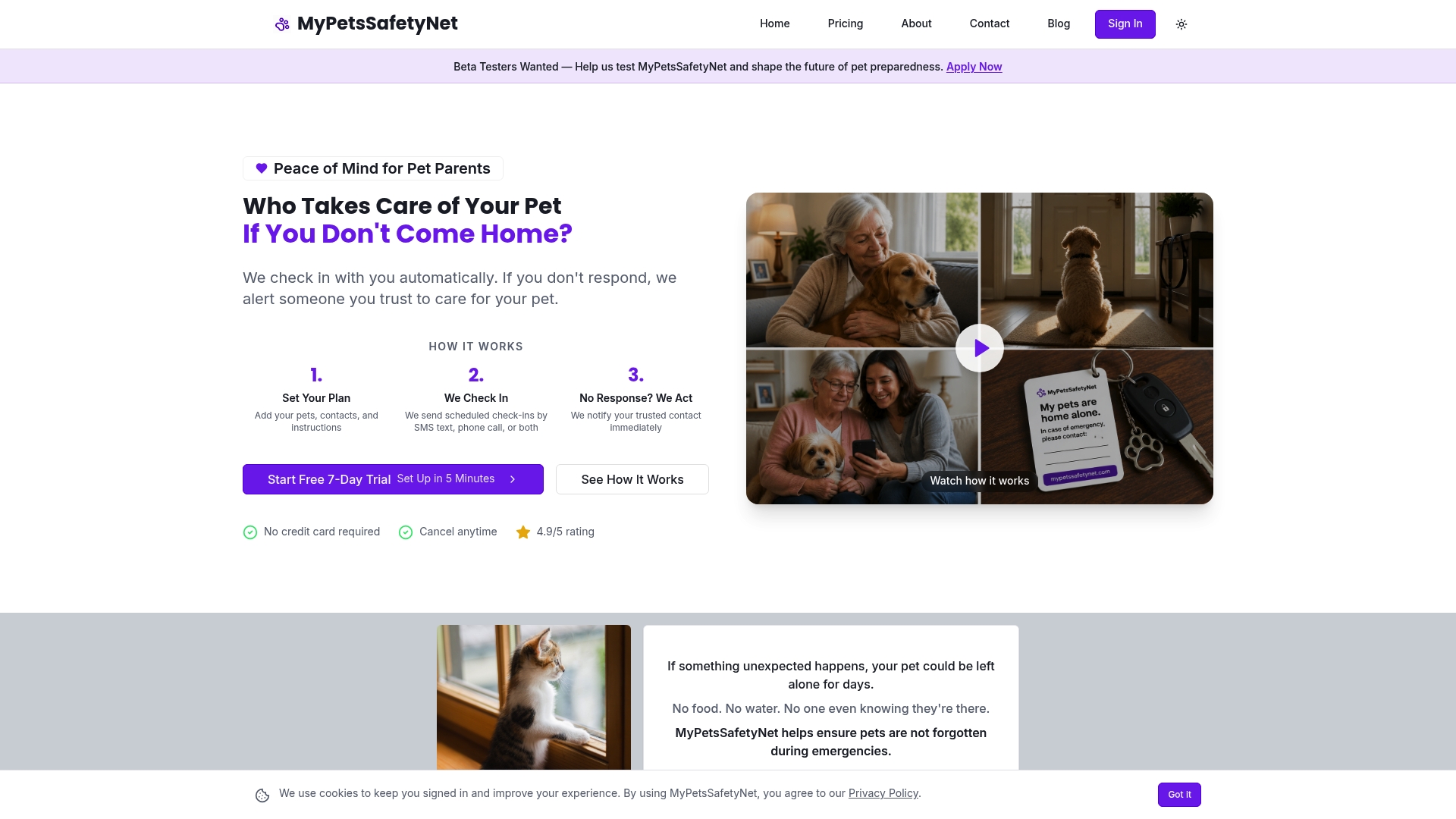
Here is what you get:
- Customizable countdown intervals and escalation steps
- Profiles for up to 5 pets with care instructions
- Up to 3 emergency contacts
- A pet care instruction card generator
- No smartphone required, since check-ins work with any phone through texts or calls
The Monthly plan is $6.99 per month, and you can start with a 7-day free trial that needs no credit card. See the details on our pricing page, or learn more at MyPetsSafetyNet. MyPetsSafetyNet is not a legal document or a substitute for one. It’s the alert and the care instructions that put your legal documents to use.
Perspective: why authority and notification belong together
We started MyPetsSafetyNet because of one question: what happens to a pet when its owner lives alone and something goes wrong? Most of the people we hear from have thought about it and feel uneasy, but few have a complete answer.
A power of attorney answers the question of who is allowed to act. It doesn’t answer who finds out, or how soon. We think of those as two halves of one plan. The legal document gives your agent permission, and a reliable check-in gives your agent a reason to pick up the phone today instead of next week.
That is why we focus on pet care rather than general personal safety. When we notify your contacts, we send them your pet details: feeding, medications, vet, and quirks. Your caregivers get the instructions, not an emergency dispatcher who has never met your dog. We designed setup to take under ten minutes, and it works with any phone, because the owners who most need a backup plan are often the ones least comfortable with new technology.
Have the legal conversation with an attorney, have the personal conversation with your agent, and let us handle the part that has to happen without you.
MyPetsSafetyNet
A simple setup order
- Ask your first-choice agent and an alternate whether they’re willing.
- Write your care sheet and vet details.
- Meet with an estate planning attorney in your state about a durable pet care POA and, if you want care to continue after death, a pet trust or will provision.
- Sign with the witnesses and notary your state requires.
- Give copies to your agent, alternate, vet, and a neighbor, and keep one with your pets’ supplies.
- Set up check-ins so your agent is alerted if you stop responding.
- Review everything yearly, and after any move, new pet, or change in your health.
If you are facing a serious diagnosis, the hospice pet care plan for the first 48 hours shows what to prioritize. And if someone has asked you to be an “elder pet guardian,” see what the role means.
FAQ
Can I make a pet power of attorney without a lawyer?
You can find templates, and some animal welfare groups publish sample forms. But state rules on witnesses, notarization, and incapacity vary, so an attorney review reduces the risk that your agent’s authority is questioned. If cost is the concern, ask whether a limited-scope review is available.
Does a pet POA still work if I die?
No. A power of attorney ends at death, so it can’t decide who keeps your pet permanently. A pet trust or a will provision handles that. Many owners pair a durable POA for incapacity with a trust for afterward.
Who should I name as my agent?
Choose someone who knows your pets, is reachable, and is willing to handle both care decisions and expenses. Name an alternate in case your first choice can’t serve. Tell both people where your documents and care sheet are kept.
Is a pet POA the same as a veterinary consent form?
No. A consent form tells your vet who may approve treatment, while a POA gives an agent broader authority that can include care arrangements, spending, and rehoming. They work well together, and having both on file prevents delays at the clinic.
Sources
- Pet Planning: Pets POA Guide, Handbook & Drafting Manual (Ohio State Bar Association)
- Durable Powers of Attorney for Pet Care (Illinois State Bar Association)
- Incapacity Planning and Pets (The D’Orlando Firm)
- Uniform Power of Attorney Act, Final Version, 2006
- Florida Statutes Section 709.2102
- DCARE Durable Power of Attorney for Pet Care
- Estate Planning Tools for Owners of Pets & Companion or Service Animals (Montana State University Extension)
- Estate Planning for Pets (Financial Planning Association)
- Grief & Remembrance Guides (The Memory Keep Blog)