Elder Pet Guardian: What It Means and What Seniors Should Do
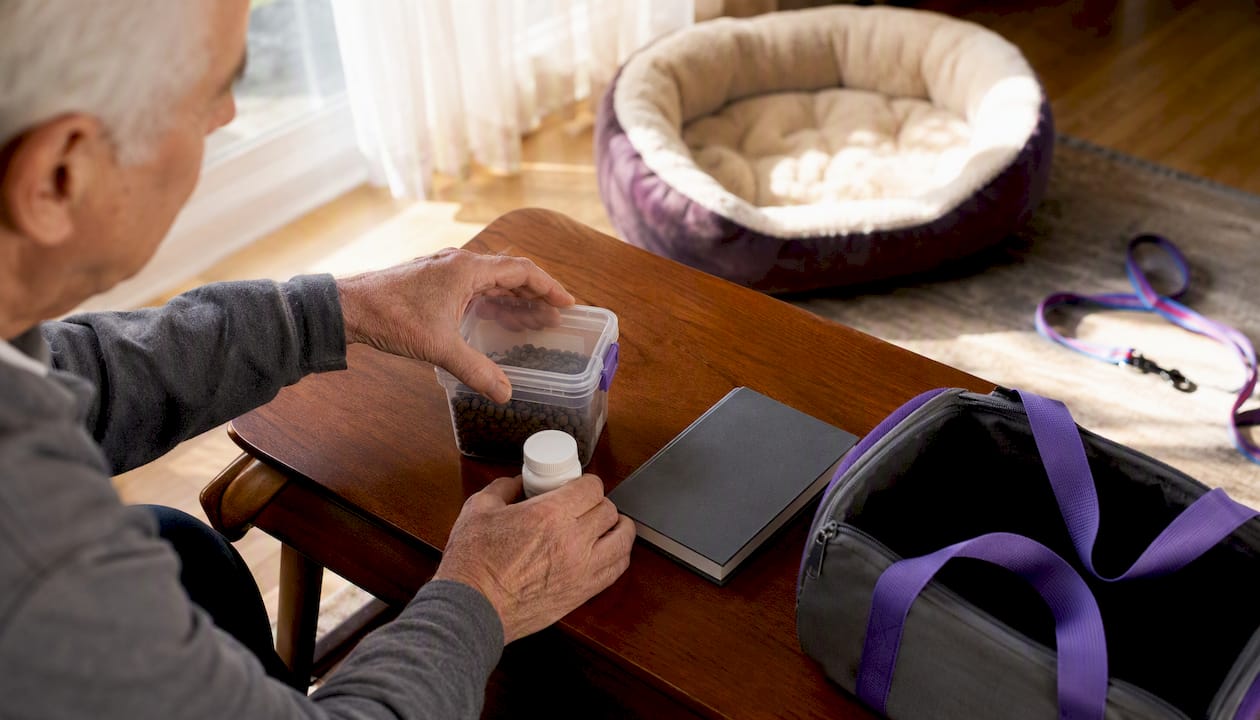
An elder pet guardian is the person you name to take legal ownership and day-to-day care of your pet if you become incapacitated or die. The most important next step you can take right now is to ask your chosen person directly, get their written consent, and document the arrangement in a legal instrument. Without that documentation, even the most willing friend or family member has no legal authority to act on your pet’s behalf.
The three most common ways to create that legal authority are:
- Will clause (pet provision): Names a guardian and transfers ownership of your pet through your estate; takes effect only after death.
- Pet trust: Creates a funded, enforceable structure where a trustee manages money for your pet’s care; recognized in all 50 U.S. states and Washington D.C.
- Informal plan (letter of intent + emergency contacts): A written document covering short-term or emergency care; not legally binding but operationally critical for immediate situations.
Pro Tip: Don’t wait until estate planning feels urgent. Naming a guardian and getting written consent takes less than an afternoon, and it’s the single most protective thing you can do for your pet today.
Key Takeaways
Naming a pet guardian is only half the plan; pairing legal documents with an operational notification service is what actually protects your pet when you can’t.
| Point | Details |
|---|---|
| Define the role clearly | A pet guardian takes legal ownership and daily care responsibility; get written consent before naming anyone. |
| Choose the right legal tool | Pet trusts offer the strongest enforceability across all 50 U.S. states; will clauses are simpler but have no oversight mechanism. |
| Name alternates and document everything | A guardian can decline; always name a backup and keep an emergency packet with vet records and microchip info accessible. |
| Close the notification gap | Legal authority means nothing if your guardian isn’t alerted; pair your plan with an automated wellness-check service. |
| Mypetssafetynet as your operational layer | Mypetssafetynet sends check-in alerts and notifies emergency contacts with full pet care details if you don’t respond. |
Table of Contents
- What does “elder pet guardian” actually mean in U.S. law?
- How do you appoint a pet guardian in the United States?
- What is a pet guardian expected to do in practice?
- How does funding work, and what happens if the guardian doesn’t follow through?
- What happens if the named guardian declines or you have no plan?
- Do shelter and nonprofit pet guardian programs offer a reliable alternative?
- How emergency notification services close the gap in elder pet care planning
- How do you choose the right person to be your pet guardian?
- Why legal planning and emergency notifications belong together
- Mypetssafetynet pairs with your guardianship plan to protect your pet right now
- Sources
What does “elder pet guardian” actually mean in U.S. law?
The phrase “elder pet guardian” is a descriptive, informal term, not a recognized legal title. The standard legal concept is simply “pet guardian,” and it refers to the person designated to take custody and ongoing care of an animal when the original owner can no longer do so. AVMA coverage has tracked how this language has evolved in veterinary and legal practice over the past two decades, noting that the shift from “owner” to “guardian” reflects a cultural change in how people relate to their animals, even though the law hasn’t fully caught up.
Here’s the legal reality you need to understand: under U.S. probate law, pets are classified as personal property. That means your cat or dog holds the same legal status as your furniture. A will can transfer ownership of your pet to a named person, but it cannot leave money directly to the animal. As Willful explains, owners typically pair a named guardian with a pet trust or a human trustee who receives funds specifically for the animal’s care.
There’s also an important distinction between two types of guardians:
- Emergency guardian: A person designated for short-term situations, such as a hospitalization or temporary incapacity. This role is usually documented in a letter of intent or informal plan and takes effect immediately when needed.
- Permanent guardian: Named in a will or pet trust to take full ownership and care responsibility after the owner’s death or permanent incapacity.
Research on guardian versus owner behavior shows that people who identify as “guardians” rather than “owners” tend to take more proactive steps, including higher rates of microchipping and estate planning. The terminology you use shapes the actions you take.
How do you appoint a pet guardian in the United States?
You have three main paths, and the right one depends on your situation, your pet’s needs, and how much legal protection you want to build in.
Option 1: Will provision (pet clause)
A will clause names your chosen guardian and transfers ownership of your pet to them upon your death. Here’s what to include:
- Full legal name and contact information of your primary guardian
- Full legal name and contact information of at least one alternate guardian
- A description of each pet (name, species, breed, microchip number)
- A statement of your care preferences (diet, vet, medications)
- A separate bequest of funds to the guardian (not to the pet directly) to cover care costs
Store the signed will with your attorney and give your guardian a copy of the relevant section. Update it any time your pet situation changes.
Option 2: Pet trust
A pet trust is a separate legal document that names both a trustee (who manages the money) and a caretaker/guardian (who provides daily care). All 50 U.S. states recognize pet trusts as enforceable. Steps to set one up:
- Work with an estate-planning attorney to draft the trust document.
- Name a trustee who is different from the caretaker, so there’s financial oversight.
- Specify how funds are to be released (monthly allowance, reimbursement for receipts, etc.).
- Fund the trust with a lump sum, life insurance proceeds, or regular contributions.
- Name successor trustees and caretakers in case your first choices are unavailable.
Option 3: Informal plan (letter of intent)
A letter of intent is not legally binding, but it’s operationally critical for emergency situations. It should include vet records, medication schedules, microchip numbers, feeding instructions, behavioral notes, and the names and phone numbers of your primary and backup guardians.
Keep this document somewhere accessible, such as with your medical alert card or posted inside a kitchen cabinet. Give copies to your emergency contacts.
Pro Tip: Always ask your nominee before naming them. A guardian who is surprised by the responsibility after your death may decline, leaving your pet without a plan. Get written consent and revisit the conversation every few years.
What is a pet guardian expected to do in practice?
Accepting the role of pet guardian is a meaningful commitment, not a formality. Before you ask someone to take on this responsibility, make sure they understand what it actually involves.
Routine care duties
- Daily feeding, fresh water, and exercise appropriate to the pet’s age and health
- Grooming, dental care, and parasite prevention
- Scheduled veterinary visits, including annual wellness exams and vaccinations
- Administering medications on the correct schedule
- Behavioral management and, when needed, professional training
Administrative duties
Once a guardian takes custody, several legal and logistical steps follow:
- Transferring ownership on microchip registries (such as HomeAgain or PetLink) to the guardian’s name and contact information
- Updating veterinary records to reflect the new authorized decision-maker
- Completing any ownership transfer paperwork required by local animal control
- Maintaining records of veterinary visits, expenses, and any trust disbursements
Pro Tip: Before naming someone, estimate your pet’s remaining life expectancy and annual care costs. A 3-year-old parrot may need care for 40 more years. A guardian who is 70 years old today may not be the right long-term choice for that bird. Think generationally, and name a younger alternate.
The AVMA’s coverage of pet guardianship notes that guardianship-minded owners are more likely to document care preferences and maintain consistent veterinary relationships, both of which make the transition easier for whoever steps in.
How does funding work, and what happens if the guardian doesn’t follow through?
The two main funding tools are a pet trust and a direct bequest in a will. They work very differently, and the difference matters when it comes to enforcement.
A pet trust names a trustee who holds and manages funds specifically for your animal’s care. Because the trust is a separate legal entity, a court can enforce it if the caretaker misuses funds or neglects the animal. As Companion Pet Magazine explains, trusts generally offer stronger enforceability than simple bequests, and they provide a layer of oversight that a will clause alone cannot.
A bequest in a will leaves a sum of money to the human guardian (not the pet) with the expectation that it will be used for the animal’s care. There’s no legal mechanism to enforce that expectation. If the guardian spends the money on something else, your pet has no recourse. Bequests are simpler and cheaper to set up, but they rely entirely on the guardian’s goodwill.
| Feature | Pet trust | Will bequest |
|---|---|---|
| Legal enforceability | High (court can intervene) | Low (no oversight mechanism) |
| Who manages funds | Trustee (separate from caretaker) | Guardian receives funds directly |
| Oversight | Yes (trustee accountable to trust terms) | None after transfer |
| Typical cost to create | Varies depending on attorney and complexity | Minimal (added to existing will) |
| Takes effect | At death or incapacity (if funded) | Only at death, through probate |
Annual pet care costs vary widely depending on species, age, and health status. Cost drivers include routine veterinary care, prescription medications, boarding or pet-sitting, grooming, food, and dental procedures. For budgeting guidance specific to seniors on fixed incomes, it’s worth calculating a realistic annual figure before deciding how much to fund a trust.
One practical note: courts can reduce trust funds they find unreasonably large relative to the animal’s actual needs. Fund the trust based on documented, realistic costs, not a round number.
What happens if the named guardian declines or you have no plan?
FreeWill’s guidance on pet guardianship is clear on this point: being named as a pet guardian is entirely voluntary. A nominee can decline, and if no alternate is named, a probate court steps in to decide what happens to your pet. That decision may result in the animal going to a family member who didn’t want the responsibility, or being surrendered to a shelter.
The steps that reduce this risk most effectively are:
- Name a primary guardian and at least one alternate in every legal document
- Get written consent from both nominees before finalizing any document
- Keep a current letter of intent with vet records, microchip numbers, medication lists, and feeding instructions
- Register your emergency contacts with a microchip registry so they can be reached immediately
- Store a copy of your guardianship documents with your attorney, your guardian, and in your home
Pro Tip: Put together a simple emergency packet right now: a one-page care sheet, your pet’s vet contact, a list of current medications, your pet’s microchip number, and a signed note confirming your guardian’s consent. Keep it in a labeled envelope near your important papers. This packet can prevent your pet from spending even one night in a shelter if something happens to you unexpectedly.
For solo seniors aging alone with pets, the risk of an unplanned gap is especially real. A hospitalization without a documented plan can leave a pet without food or care for days.
Do shelter and nonprofit pet guardian programs offer a reliable alternative?
Yes, and for pet owners who don’t have a trusted person to name as guardian, these programs can be a genuine safety net. A shelter or nonprofit pet guardian program is an organized arrangement where a humane organization agrees to take custody of your pet and find it a new home after your death or incapacity.
Lollypop Farm in Rochester, New York, is one well-known example of this model. Programs like theirs typically require enrollment during the owner’s lifetime, a registration fee, and documentation of the pet’s health history and behavioral profile. The organization then commits to placing the animal in a suitable home rather than euthanizing it for space.
What these programs generally offer:
- A guaranteed intake commitment (the shelter won’t turn the pet away)
- Screening of potential adopters to match the pet’s needs
- Veterinary assessment upon intake
- Some programs accept a financial contribution to support the pet’s care during placement
Limitations to understand before enrolling:
- Eligibility rules vary; some programs serve only seniors or people with documented health conditions
- Enrollment fees can range from modest to several hundred dollars
- The program places the pet, but you cannot guarantee a specific home or lifestyle
- Funds you contribute go to the organization, not to a specific trustee managing your pet’s care
Pro Tip: If you enroll in a shelter guardian program, still complete a letter of intent with your pet’s care details. The more the intake staff knows about your animal’s personality, preferences, and medical history, the better the placement match.
As Companion Pet Magazine notes, shelter-run programs exist specifically for owners without reliable family or friends, and they represent a legitimate, organized alternative to personal guardianship. They work best when paired with a funded contribution and thorough documentation.
How emergency notification services close the gap in elder pet care planning
Legal documents give someone the authority to care for your pet. They don’t guarantee that person will be notified in time to act. That gap, between legal authority and real-world response, is where many elder pet care plans break down.
Research on aging and pet guardianship from Purdue University recommends integrating pet planning with broader elder-care planning, specifically because older adults face a higher likelihood of sudden incapacity. A hospitalization, a fall, or a medical event can leave a pet without care for hours or days before anyone realizes something is wrong.
Automated wellness-check services address this directly. Here’s how they work alongside a guardianship plan:
- You set a regular check-in schedule (daily, every two days, or weekly) via SMS, phone call, or email.
- If you don’t respond within your chosen window, the service escalates to your emergency contacts automatically.
- Your emergency contacts receive your pet’s care instructions, vet contact, and medication details, so they can act immediately.
- Your pet profile stays on file, meaning whoever responds has the information they need without searching through paperwork.
Pairing a pet trust with an operational wellness-check service closes the gap between legal authority and real-world response time. When a senior is incapacitated, the legal documents tell the guardian what they’re authorized to do. The notification service tells them it’s time to act.
For cognitive decline planning, this kind of automated check-in is especially valuable, because the owner may not be able to make a phone call or send a message when the situation becomes critical.
Pro Tip: When you finalize your will or pet trust, add a note listing your wellness-check service, your check-in schedule, and your emergency contact list. Your attorney can include this as an exhibit to your letter of intent, so your guardian knows exactly what system is in place and how it works.
How do you choose the right person to be your pet guardian?
Choosing a guardian is more than picking the person who loves your pet most. The right person needs to be realistically able to take on the responsibility, not just emotionally willing.
Checklist of candidate attributes
- Lives within a reasonable distance (or is willing to relocate the pet)
- Has housing that permits your type of pet (lease terms, HOA rules, yard space)
- Has the physical mobility and health to manage daily care
- Has financial stability to cover unexpected vet costs, even with trust funds in place
- Has prior experience with your pet’s species or breed
- Is younger than you, or has a named successor of their own
Questions to ask a nominee
- Are you willing to take [pet’s name] permanently if something happens to me?
- Does your home allow [species/breed]?
- Do you have other pets, and how might they interact?
- Are you comfortable administering medications or managing a health condition?
- Would you be willing to sign a written consent form confirming this agreement?
Written consent should include the nominee’s full name, the date, a description of the pet, and a statement that they agree to serve as guardian. It doesn’t need to be notarized, but having it signed in front of a witness adds credibility.
Red flags that should rule out a nominee
- Hesitation or reluctance when asked directly
- Unstable housing (renting month-to-month, frequent moves)
- Significant financial difficulty
- Allergies or health conditions that would make daily care unsafe
- A household that already has animals with known aggression issues
The Purdue research on aging and pet guardianship emphasizes that integrating pet planning into elder-care conversations early, before a crisis, produces far better outcomes than trying to arrange care under pressure. Have the conversation now, while you have time to find the right person.
Why legal planning and emergency notifications belong together
At Mypetssafetynet, we’ve seen what happens when one piece of the plan is missing. A pet owner has a beautifully drafted pet trust, a named guardian, and a funded account. But when a medical emergency happens at 2 AM, no one knows to check on the animals until the next afternoon. The legal authority was there. The operational alert wasn’t.
That’s the gap we exist to close. Legal documents give your guardian the right to act. Mypetssafetynet gives them the signal to act, with your pet’s full care profile already in their hands. For seniors living alone, that combination isn’t a luxury. It’s the difference between a pet being cared for within hours and a pet going without food or medication for a day or more.
We believe that responsible pet ownership for older adults means addressing both the legal and the operational side of the plan. A senior pet owner wellness check is the operational layer that makes your legal documents work in real time.
Mypetssafetynet pairs with your guardianship plan to protect your pet right now
Most guardianship plans have a legal layer and nothing else. Mypetssafetynet adds the operational layer your pet actually needs when something goes wrong.
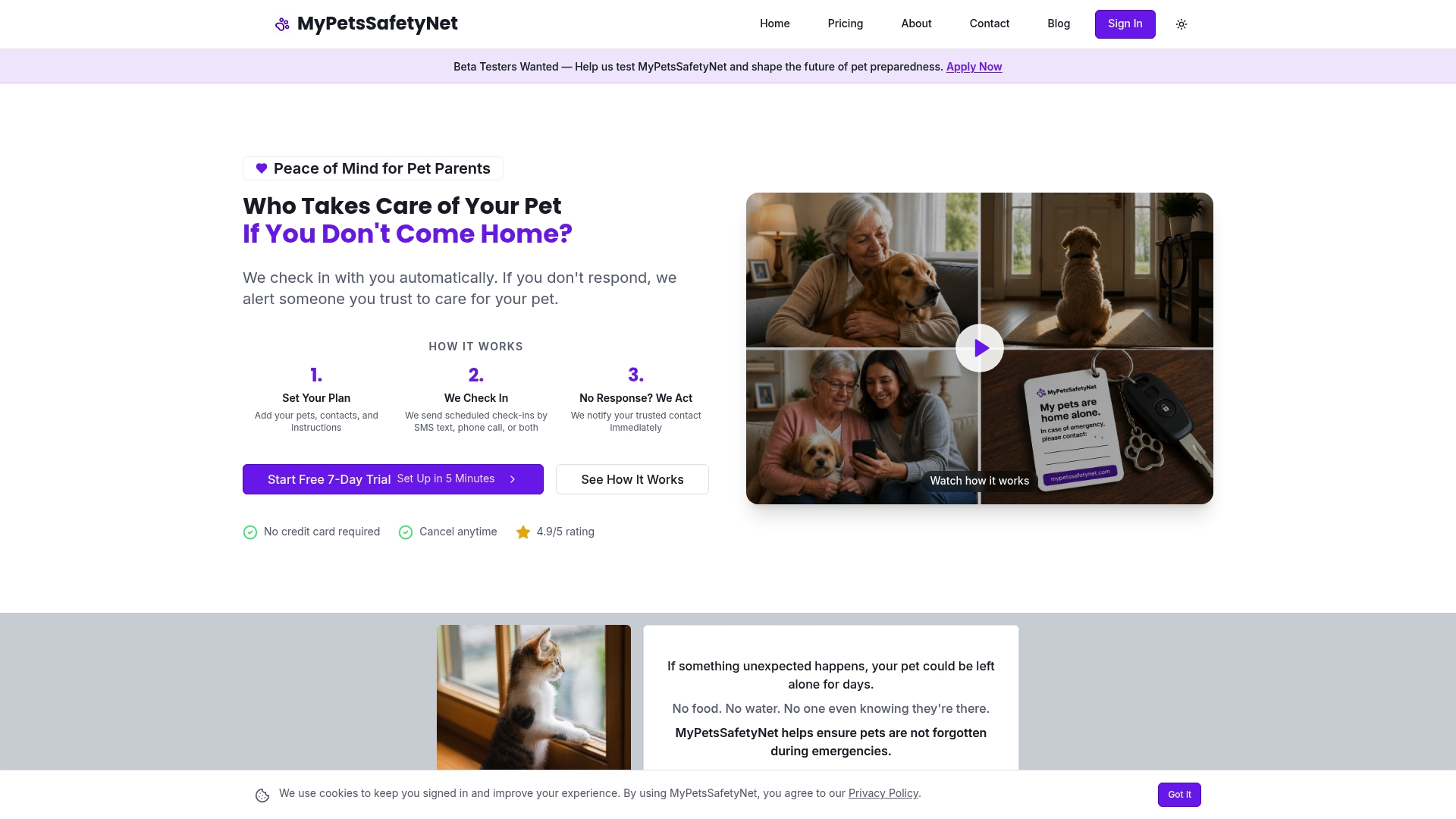
The service sends you a scheduled check-in by SMS, phone call, or email. If you don’t respond within your chosen window, it automatically notifies your emergency contacts with your pet’s full care profile: feeding schedule, medications, vet contact, and microchip number. You can store details for up to 5 pets and 3 emergency contacts, and the escalation workflow runs without you having to do anything once it’s set up.
When you finalize your will or pet trust, list Mypetssafetynet as part of your operational plan. Your attorney can note it in your letter of intent so your guardian knows the system is in place and what to expect when they receive an alert.
Start a free trial at Mypetssafetynet and give your guardian the notification they need to act fast.
Sources
These sources are reliable starting points for U.S.-based pet owners building a guardianship plan. Laws and programs referenced apply to the United States.
- You were named as pet guardian — now what? | FreeWill
- What Is A Pet Guardian? | Willful
- What is a pet guardian (and why do you want one)? | Companion Pet Magazine
- The Intersection of Aging and Pet Guardianship - Purdue e-Pubs
- After more than a decade, has pet guardianship changed anything? | AVMA
This article is general information, not a substitute for advice from a qualified lawyer. Consult a qualified legal professional about your own circumstances before acting on anything here.