Disabled Pet Owners Safety: A Backup Plan That Works

If you’re disabled and live alone, your pets’ safety depends on one question: if you couldn’t respond tomorrow, who would know, and what would they do next? A good plan has three parts. You name caregivers who have agreed to help, you give them everything they need to care for each animal, and you set up a way for them to find out something is wrong. We built MyPetsSafetyNet around that third part, because a card in a drawer helps no one until somebody is alerted.
This guide walks you through the whole plan, step by step, in a calm and practical way. You don’t need a smartphone or any special equipment to follow it.
TL;DR
- Name at least two local emergency caregivers, confirm they agree, and re-check with them at least once a year.
- Put everything a caregiver needs in one place: feeding routines, medications, vet details, and how to get into your home.
- Carry a wallet card and post a visible sheet inside your home so responders know animals are there.
- Plan around your own access needs: reachable contacts, multiple ways to communicate, and supplies you can actually move.
- Add an automated check-in so your contacts are told when you don’t respond, with your pets’ care details attached.
Table of Contents
- Why pets change the safety picture for people living alone
- Step 1: Choose your emergency caregivers
- Step 2: Write down everything a caregiver needs to know
- Step 3: Pack supplies your caregiver can grab
- Step 4: Build the plan around your own access needs
- Step 5: Make sure responders know your pets are home
- Step 6: Close the gap between a plan and an alert
- Putting it together in one afternoon
- Our perspective
- Start your pet safety net
- FAQ
- Sources
Why pets change the safety picture for people living alone
For many people, pets are family, and they are also a daily responsibility. If you live alone, nobody else is in the house to notice a fall, a medical event, or a sudden hospital stay. Your pets can’t call for help, and they may go without food, water, medication, or a bathroom break until someone happens to visit.
Pets also influence the choices people make about their own health. A federal CMS webinar on aging with pets notes that worry about a pet is one reason people refuse or delay needed medical care. It recommends having an emergency contact willing to help with pet care, along with a written list of the pet’s needs and routine, medications, and vet contact information.
That is the core of the matter. A plan lets you say yes to the ambulance, the surgery, or the hospital stay without wondering who is feeding the cat. A University of Pittsburgh guide on aging in place with pets makes a similar point: even a simple letter of instruction and a packed go bag can ease an older owner’s anxiety about what will happen to the pet, because the plan can be put into action quickly.
The Los Angeles County Department of Public Health’s pet emergency guide names people who live alone among those with access and functional needs who may need extra help planning for their pets. Planning ahead is the sensible response to that, not a sign that something is wrong.

Step 1: Choose your emergency caregivers
Your caregivers are the center of the plan. Pick them with care.
Choose people who are close by. Best Friends Animal Society advises choosing local emergency contacts, ideally neighbors, who can reach your home quickly and care for the pet. If your decision-maker lives far away, connect them with someone local who can handle immediate tasks, such as picking up a key or dropping off food.
Name more than one. ElderPet’s care planning document suggests two emergency contacts who live near the pet’s home. Georgia’s Get Ready toolkit goes further for people living alone: at least two in-case-of-emergency contacts with at least one out of town, and two emergency pet caregivers.
Ask first. Both of those sources say a caregiver’s agreement has to be confirmed before you name them. Put the question plainly: “Would you be willing to take my dog for a week if I’m in the hospital?” Also ask about things that affect the real job:
- Can they physically manage your pet’s size, strength, or medical needs?
- Do they have transportation?
- Do they have allergies, or other animals that might not get along with yours?
- Can they come at any hour?
A Los Angeles senior-services guide recommends confirming a buddy’s willingness, physical ability, transportation limits, and allergies and naming both a primary and a backup.
Remember the stand-in doesn’t have to be the forever home. The ASPCA points out that the emergency caregiver need not be the permanent guardian. A neighbor or friend can step in while you’re hospitalized. The ASPCA also tells owners to check in periodically with their chosen caregivers rather than assume they remain willing and able. Georgia’s toolkit sets the same rhythm: re-check at least once a year.
If you want to think through who does what, our guide to pet caregiver roles breaks the job into five assignments you can hand out.
Step 2: Write down everything a caregiver needs to know
A willing caregiver who doesn’t know your pet’s routine is still starting from zero. Write it down so they can act without calling you, which may not be possible.
Best Friends recommends keeping copies of vaccination records, medication schedules, veterinarian contact information, and detailed care instructions somewhere your contacts can reach them. The Pittsburgh guide adds names, ages, breeds, photos, routines, and dietary preferences.
A useful care sheet covers:
- Each pet’s name, age, breed, and a recent photo
- Feeding amounts and times, and foods to avoid
- Medications: name, dose, schedule, and where they’re stored
- Your regular vet, a 24-hour animal hospital, and an out-of-area vet (the LA County guide asks for all three)
- Habits that matter: walking routine, where the cat hides, how the dog reacts to strangers
- Where leashes, carriers, litter, and supplies are kept
- Who may enter your home, and how
The DARE Pet Promise Kit goes as far as specifying which contact can enter the home and how, and listing up to three emergency pet sitters in order of preference. It suggests reviewing the kit once a year, or sooner when the vet, a medication, or a phone number changes.
One caution on access details. The Los Angeles guide advises recording exactly how authorized entry works while keeping alarm codes, spare-key locations, and passwords off any card that is visible to the public. Share those privately with the people who need them.
If you have more than one animal, say which ones must stay together. The ASPCA suggests owners of more than two pets plan ahead, especially if the pets should remain together. Our multi-pet care plan guide covers that situation in detail.
Step 3: Pack supplies your caregiver can grab
Supplies are the second half of the information. Best Friends recommends a two-week supply of food, medications, and care supplies, packed and ready, with its location known to your contacts. FEMA’s pet preparedness guide lists:
- Several days of food and water in airtight, waterproof containers
- An extra supply of regular medicine in a waterproof container
- A pet-appropriate first aid kit
- A backup collar with ID tag, plus a harness or leash
- A bag, crate, or sturdy carrier for each pet
For a hospital stay in particular, see our list of what goes in a pet hospital go bag and how to prepare your home for pet caregivers.
Step 4: Build the plan around your own access needs
Generic checklists often assume you can lift a carrier, walk a dog out of a building, or answer a phone on the first ring. A plan for disabled owners should start from what you can and can’t do.
Illinois’s functional-needs preparedness tip sheet recommends assessing what you and your animals can do and what help you need, building a support network of at least three people at each place you regularly spend time, and choosing an out-of-town contact who can be reached in more than one way. It also says to list several contact methods, such as cell, text, video phone, TTY, and email, so that people with communication disabilities stay reachable. The reason for the out-of-town contact: after a disaster, local lines may be down while calls to outside the area connect more easily.
Some practical adjustments:
- Keep supplies where you can reach them. Alaska’s Get Ready toolkit suggests people with mobility disabilities keep an emergency kit in a backpack attached to a walker, wheelchair, or scooter, and keep extra batteries for mobility devices.
- Plan for a power outage. Pennsylvania’s emergency preparedness guide tells people with disabilities to register with their power company’s power-dependent customer list and keep a spare wheelchair battery or a lightweight manual backup.
- Keep a medication list. The same guide advises older adults to keep at least a week of medicines in original containers with a written list of names, doses, schedules, and prescribers.
- Do a dry run. The Los Angeles guide suggests having your primary buddy practice finding the pet, carrier, supplies, card, and exit route before you set an update date. Walking through it once shows what you missed.
- Carry a pet in a carrier. Alaska’s toolkit notes that a pet in a carrier raises the chance shelter staff will let it in.
Keep in mind a shelter rule many owners don’t know about. Illinois’s tip sheet notes that pets, unlike service animals, generally aren’t allowed in emergency shelters because of health regulations, so you should identify animal shelters ahead of time, keep ID tags current, and consider a microchip. Pennsylvania’s guide says service animals are allowed in emergency shelters while other pets are housed in nearby separate pet shelters. Rules differ by state and community, so ask your local emergency management office what applies where you live.
Step 5: Make sure responders know your pets are home
If paramedics or police come to your door, they may not know that a dog or cat is inside. The ASPCA recommends two simple tools:
- A Pet Alert Card you carry in your wallet. It tells authorities a pet is at home and lists two emergency contacts.
- A clearly visible Emergency Contact Sheet inside your home, so friends, family, or emergency services who enter can account for the animals and contact someone right away.
Alaska’s toolkit adds door and window stickers showing the kinds of animals in the home and where they may be, ID tags carrying your phone number and an out-of-town contact’s, and dated photos of each pet beside something that shows size, with the microchip number, vet contact, shots, medications, food, and allergies on the back.
Hospital stays are the most common planned version of this. Our articles on what happens to your pets if you’re hospitalized and how to prepare pets for a hospital stay go through the details.
Step 6: Close the gap between a plan and an alert
Here is the weak point in most plans. Cards, sheets, and care instructions all assume that someone finds out you need help. When you live alone, that depends on luck: a neighbor noticing the mail, a friend wondering why you haven’t called.
An automated check-in fills this gap. It contacts you on a schedule you choose. If you respond, nothing else happens. If you don’t, the people you named are notified. That’s how MyPetsSafetyNet works, and it was designed for exactly this situation:
- It works with any phone. No smartphone is required; check-ins arrive by SMS, phone call, or email.
- You set the schedule. Countdown intervals are customizable, and an escalation workflow moves through your steps if you don’t respond.
- Your contacts get the pet details. When a contact is notified, the message carries your full pet care information, so they know who needs care and how.
- It fits a real household. You can add up to 5 pets and 3 emergency contacts.
A check-in doesn’t replace the steps above. It’s what activates them. Your caregivers still need to have agreed, and your instructions still need to be written down. The check-in makes sure they hear about it in time.
Putting it together in one afternoon
You can finish a first version of this plan in a single sitting. Here’s an order that works:
- Call or text two local people and ask whether they’d be your emergency pet caregivers.
- Ask one more person who lives out of town to act as your coordinating contact.
- Fill in a care sheet for each pet, including medications and vet details.
- Pack a go bag and tell your caregivers where it is.
- Put a Pet Alert Card in your wallet and a contact sheet where it can be seen inside the home.
- Set up your check-in schedule and add your contacts.
- Put a reminder on your calendar to confirm with your caregivers once a year.
Our emergency pet care plan guide offers a fuller walk-through, and the article on who takes care of your pets if you’re hospitalized helps if you’re still deciding whom to ask.
Our perspective
Most of the people who come to us aren’t worried about themselves. They’re worried about the animal who is waiting at home. That worry is reasonable, and it can be solved with a few ordinary steps.
We built MyPetsSafetyNet because a plan on paper can’t tell anyone that you need help. You can choose the best caregivers and write the clearest instructions, and the plan still depends on someone noticing. So we started with the check-in. If you don’t respond, the people you chose hear about it, and they receive your pet care details in the same message.
We also built it for people who don’t want to depend on a particular device. It works with any phone, by text, call, or email, and setup takes less than 10 minutes. We focus on pets, not just personal safety, and the details go to the caregivers you named, not to emergency services.
You decide how often you hear from us, how long the countdown runs, and who is contacted. Your routine stays yours.
MyPetsSafetyNet
Start your pet safety net
MyPetsSafetyNet is a subscription at $6.99 per month, with a 7-day free trial and no credit card required to start. You build pet profiles and care instructions, generate a pet care instruction card, add your emergency contacts, and choose your check-in schedule and countdown. If you don’t respond, your contacts are notified with your pets’ care details.
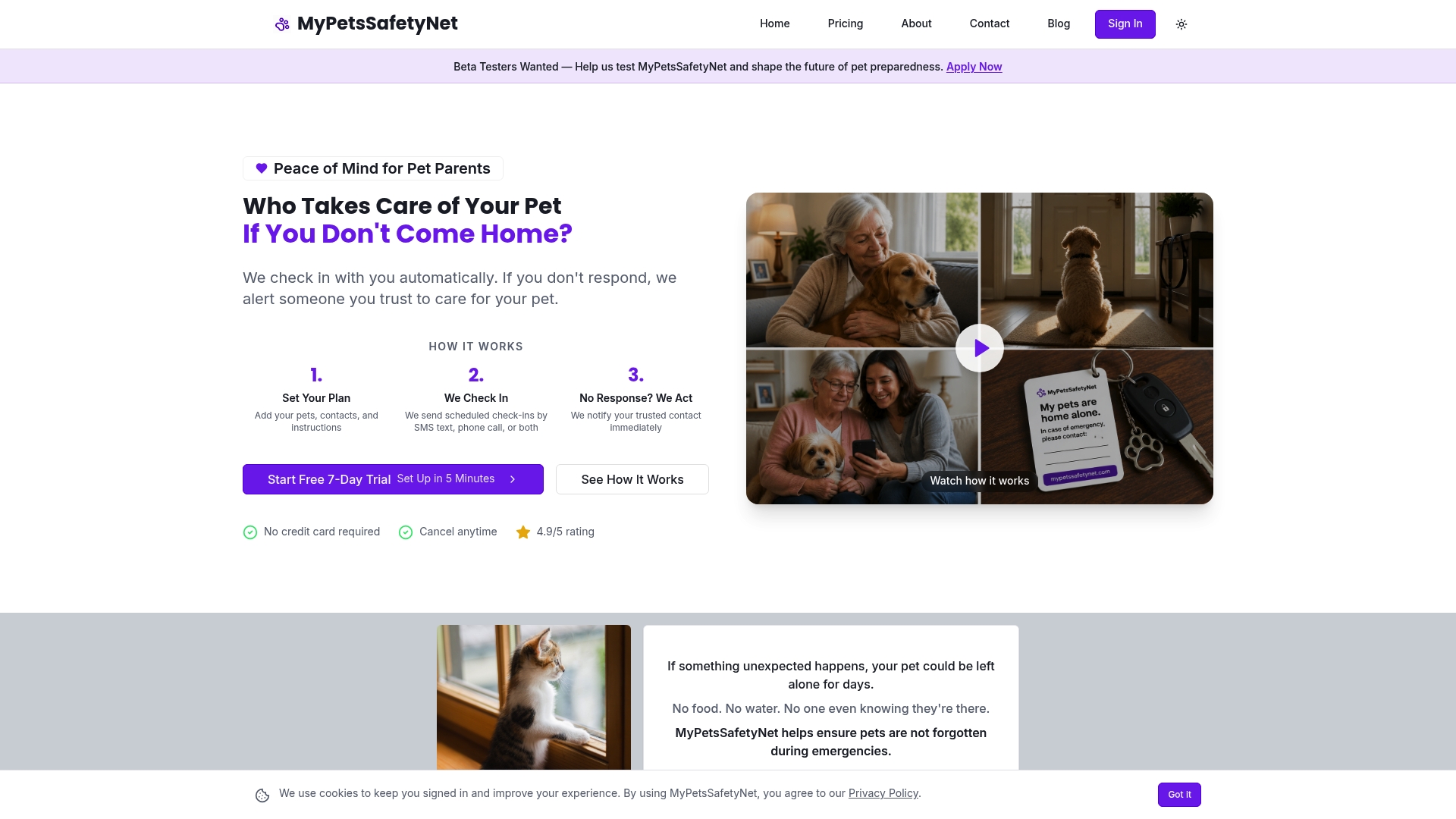
You can start on our home page and have your first check-in running the same day.
FAQ
Who should I name as emergency contacts for my pets?
Choose people who live close enough to reach your home quickly, ideally neighbors, and add one contact who lives out of town. Ask each person in advance and get their agreement before you list them. Re-confirm at least once a year, as the ASPCA and Georgia’s toolkit both advise.
Does my emergency caregiver have to adopt my pet?
No. The ASPCA notes that an emergency caregiver doesn’t have to be the permanent guardian. A friend or neighbor can care for your pets while you’re in the hospital, and you can arrange longer-term care separately.
What should I do if I can’t find anyone to be a caregiver?
The ASPCA suggests getting to know your local humane societies and rescue groups, which may be able to help place an animal if they have enough notice that you live alone or have no one to care for the pet. Start building relationships with neighbors who have pets as well, since Illinois and Alaska both recommend it.
Do I need a smartphone to use an automated check-in?
Not with MyPetsSafetyNet. Check-ins can arrive as SMS messages, phone calls, or email, so any phone will work.
What belongs on a pet alert card?
The ASPCA says a wallet-sized Pet Alert Card should tell authorities that a pet is at home and list two emergency contacts. Keep alarm codes and spare-key locations off it, and share those privately with the people who need them.
Sources
- Making a Plan for Your Pet, ASPCA
- Prepare Your Pets for Disasters, FEMA
- Emergency Preparedness & Pets: A Guide for Pet Owners, LA County Public Health
- Aging with Pets: Benefits, Challenges, and Opportunities, CMS
- Resource guide for aging in place with pets, University of Pittsburgh
- Pet Emergency and Disaster Preparedness, Best Friends Animal Society
- Get Ready Toolkit, Georgia ADA
- Care Planning, ElderPet
- DARE Pet Promise Kit
- Emergency Preparedness Tips for Those with Access and Functional Needs, Illinois
- Pennsylvania Emergency Preparedness Guide
- Get Ready: Alaska’s emergency preparedness toolkit
- Pet Care Backup Plan for Older Adults, Los Angeles