Multi-Pet Care Plan: Protect Every Pet in an Emergency

A multi-pet care plan is a written arrangement that tells someone you trust exactly who your animals are, what each one needs, and how to reach them if you can’t be there. It names backup caregivers, puts each pet’s routine and medical details on paper, and decides whether your pets stay together. If you live alone, it also needs a way for someone to find out something is wrong. This guide walks you through each piece, one step at a time.
More pets means more of everything: more medications, more feeding schedules, more carriers, and more to explain to a stranger at your door. A plan that works for one cat can fall apart with three dogs and a rabbit. The good news is that you can build a solid plan in an afternoon.
TL;DR
- Name at least two emergency caregivers, and decide up front whether your pets stay together or split up.
- Write one care profile per pet: food, habits, medications, vet details, and records.
- Sign a veterinary treatment authorization and arrange a way to pay for emergency care.
- Make sure responders know pets are at home, and that your caregivers can get inside.
- Add an automatic check-in so someone is alerted if you stop responding, then review the plan every few months.
Table of Contents
- What a multi-pet care plan covers (and what it doesn’t)
- Step 1: Decide whether your pets stay together
- Step 2: Choose a primary and backup caregiver for each pet
- Step 3: Write a care profile for each pet
- Step 4: Handle vet authorization and payment
- Step 5: Make sure responders and caregivers can find your pets
- Step 6: Plan transport and a place to go
- Step 7: Share, store, and review the plan
- Care plan, insurance, and long-term guardianship: how they fit together
- Our perspective: the plan only works if someone knows to start it
- Add an automatic check-in to your plan
- A one-afternoon checklist
- FAQ
- Sources
What a multi-pet care plan covers (and what it doesn’t)
When people search for “multi pet care plan,” many land on pet insurance pages. Insurance helps pay vet bills. It does not feed your dog tonight, walk your beagle, or tell a neighbor where the cat hides when she’s scared. A care plan solves a different problem: who steps in, what they need to know, and how they get the information fast.
The ASPCA says a plan for your pets should cover emergency contacts, a Pet Portfolio with care information and medical records, immediate temporary care, and long-term guardianship. Think of it as four layers:
- Who to call. Emergency contacts who will actually pick up.
- What to know. A care profile for every animal.
- Who steps in now. Temporary caregivers who can reach your home quickly.
- Who takes over later. A long-term plan, which may involve a will or trust.
Most of this article focuses on layers one through three, because those are the ones that matter in the first hours and days of an emergency.
Step 1: Decide whether your pets stay together
This is the question multi-pet owners skip, and it shapes everything else. Best Friends Animal Society advises that if you have multiple pets, you should decide whether they should stay together or be placed with different caregivers.

The ASPCA adds a practical warning: if you have more than two pets, it may not be realistic for one person to care for them all, so plan ahead, especially if you want them kept together.
Here’s how to think it through:
- Bonded pairs. Two cats who sleep curled together, or dogs who get anxious apart, may do better in one home.
- Conflicts. A dog who chases the cat, or two animals who need to be separated at feeding time, may need different homes or a careful setup.
- Special needs. A senior dog on insulin needs a caregiver who is comfortable giving injections. A bird or reptile may need a caregiver with specific equipment.
- Space and capacity. Be honest about what each caregiver’s home, schedule, and landlord rules allow.
Write down your decision, including your reasoning. If two caregivers each take part of the group, say so in the plan so nobody assumes they’re taking everyone.
Step 2: Choose a primary and backup caregiver for each pet
Best Friends recommends asking trusted friends or family members to act as emergency caregivers, arranging more than one in case someone is unavailable, and staying in touch if their circumstances change. Ready.gov suggests a buddy system with neighbors, friends, or relatives so someone is available to care for or evacuate your pets if you can’t.
The person who steps in during an emergency does not have to be the person who would take your animals for good. The ASPCA points out that the emergency helper and the permanent guardian can be different people. That takes pressure off the conversation. You’re asking a neighbor to cover a few days, not to adopt three animals.
Give each caregiver a clear role
Vague plans create confusion. If three people get the same alert, each may assume another is handling it. Spell out who does what:
- One person who makes decisions and coordinates.
- One person who can reach your home first.
- One person who can take animals in if they can’t stay home.
- One person who holds your vet authorization or payment details.
We cover this in more detail in our guides on five caregiver roles for your emergency packet and on how to name one decision maker when you have multiple caregivers.
Ask before you list anyone
Never add a name without a conversation. Ask directly: Can you reach my home within a few hours? Are you comfortable with all my animals? Would you hold a key? Then tell them what to expect, and let them say no. A “no” now is far better than a surprise later.
Step 3: Write a care profile for each pet
The ASPCA calls this a Pet Portfolio. It can include habits, food preferences, medical conditions and medications, and veterinary information and records. With several animals, the risk is mixing them up, so keep one page per pet and put the pet’s name and a description at the top.
Include for each animal:
- Name, species, breed, age, weight, color, and markings
- Photo, ideally one clear photo of the pet on its own
- Food type, amount, and feeding times
- Medications, doses, times, and how your pet takes them (in a pill pocket, crushed in food, and so on)
- Medical conditions, allergies, and known fears
- Behavior notes: bites, escapes, dislikes of strangers, hiding spots
- Litter box, walking, or cage-cleaning routine
- Microchip number and registry
- Vet name, clinic phone number, and after-hours emergency clinic
The AVMA says caregivers should have vaccination and medical records, medication instructions, emergency contact information including your veterinarian, and a signed veterinary medical treatment authorization.
A worked example
Say you live alone with two dogs, a cat, and a bird. Your care profiles might look like this at a glance:
| Pet | Key needs | Who can handle it | Notes for the caregiver |
|---|---|---|---|
| Biscuit, 9-year-old lab | Joint medication twice daily, three walks | Neighbor (primary), sister (backup) | Pulls on the leash near squirrels |
| Pepper, 3-year-old terrier | Daily exercise, crate at night | Neighbor (primary), sister (backup) | Nervous around visitors; give him space first |
| Mochi, 12-year-old cat | Thyroid pill in the morning, wet food | Friend across town | Hides under the bed; don’t chase her |
| Kiwi, parakeet | Fresh water and seed daily, cage cover at night | Neighbor | Keep away from the kitchen if cooking |
Notice that the table tells the caregiver at a glance who is covering whom. Someone who only has twenty minutes can scan it and act. Seasonal details also matter: what a caregiver needs to do in January can differ from July, and resources on winter pet care can help you think through which items to note for the colder months.
If you want a ready-made format, the guide to pet care emergency document essentials lists what to include.
Step 4: Handle vet authorization and payment
A caregiver who can feed your pets but can’t authorize treatment is stuck if an animal gets sick. Clinics generally want to know who has permission to make decisions. That’s why the AVMA lists a signed veterinary medical treatment authorization among the items to leave with caregivers. Call your vet’s office and ask what form they prefer, then sign it and give copies to your primary caregivers.
Payment is the other half. The AVMA suggests giving an emergency decision-maker a payment method, such as a credit card or prepaid debit card, and contacting the issuer ahead of time to authorize its use for veterinary emergencies. With several animals, a prepaid card with a clear limit can be easier to manage than handing over a full credit card.
If your pets are microchipped, the AVMA also says to consider adding your agent as an alternate contact in the microchip registry. Ready.gov recommends microchips with up-to-date contact information, including an emergency contact outside the immediate area. Check each chip, because one outdated record among four pets is easy to miss.
Step 5: Make sure responders and caregivers can find your pets
If you’re hospitalized or found at home, responders may not know animals are inside. Two simple tools help.
- A wallet card. The ASPCA recommends carrying a Pet Alert Card in your wallet that alerts authorities to a pet at home and lists two emergency contacts.
- A removable notice. The Humane Society of the United States suggests removable notices on doors or windows that say how many and what types of pets you have, because permanent stickers may be outdated or misleading to responders.
With multiple animals, include the exact count and species on both. “Three pets” is less useful than “two dogs, one cat, one bird.”
Then deal with access. Decide how your caregivers will get in: a spare key with a trusted neighbor, a lockbox with a code you share only with named caregivers, or a building manager who has been told. Write the plan down so you aren’t relying on memory under stress.
If you might be stuck away from home rather than incapacitated, see our solo owner’s plan for when you can’t get home. If you’re facing a hospital stay, our article on what happens to your pets if you’re hospitalized covers the practical details.
Step 6: Plan transport and a place to go
If pets must leave the home, someone needs to move them. The AVMA advises you to pre-arrange an evacuation site outside the impacted area and know how to transport pets and their supplies. For several animals, that means counting carriers.
A short transport checklist:
- One secure carrier or crate per animal that needs one
- Leashes, harnesses, and a spare collar with ID
- At least a few days of food and any medications, stored where the caregiver can find them
- Litter, bags, bowls, and a towel or blanket
- A copy of each pet’s profile in the same bag
Store this kit in one place and tell your caregivers where it is. If your caregiver has a small car and you have two large dogs, that’s a problem to solve today, not on the day it happens.
Step 7: Share, store, and review the plan
The ASPCA recommends keeping the Pet Portfolio somewhere safe but accessible with important papers and giving copies to everyone in your pet’s circle of care. It also suggests checking in with caregivers periodically, especially if circumstances change. Best Friends adds that emergency contact information should be kept in your wallet and at home.
A simple review rhythm works well:
- Every few months: confirm each caregiver is still willing and reachable.
- After any change: a new pet, a new medication, a move, a caregiver’s new job or baby.
- After every vet visit: update weights, doses, and vaccination dates.
How many contacts is enough? Our guides on naming emergency contacts as a solo pet owner and how many emergency contacts you need help you decide.
Care plan, insurance, and long-term guardianship: how they fit together
These three tools do different jobs, and you may want more than one.
| Tool | What it does | What it doesn’t do |
|---|---|---|
| Emergency care plan | Gets someone to your pets quickly, with instructions | Doesn’t transfer ownership or fund care by itself |
| Pet insurance | Helps reimburse eligible vet costs | Doesn’t arrange who feeds or shelters your pets |
| Will or pet trust | Provides for long-term care and ownership | Can be slow to act in the first days |
The ASPCA explains that an emergency arrangement provides immediate help, while a will or pet trust is a formal option for long-term care. A will may be delayed and may not ensure ongoing care after estate administration. A pet trust can be different: it can take effect during a person’s lifetime and provide care instructions if the owner becomes incapacitated, and it is legally enforceable. The ASPCA notes that all 50 states and the District of Columbia have a pet trust law.
For long-term arrangements, the Humane Society recommends working with an attorney to draw up a will, trust, or other document. Rules differ by state, so ask an estate planning attorney in your state about the right option for your animals. The care plan in this article is the bridge until that is in place, and the first line of defense after.
Our perspective: the plan only works if someone knows to start it
We built MyPetsSafetyNet around one worry: what happens to our pets if we have an emergency and live alone? Over and over, the weak point in a good plan isn’t the paperwork. It’s the moment before anyone realizes something is wrong.
You can name three caregivers and print four care profiles, but if you collapse on a Tuesday and nobody expects to hear from you until Friday, the plan sits in a drawer. That’s why we think a plan for several pets needs two parts: the information, and a trigger. The trigger is a regular check-in that asks, “Are you OK?” and, if you don’t answer, contacts the people you chose.

We also think the alert should carry the pet details. A message that says “please check on Sam” sends your contact looking for answers. A message that includes how many pets you have, what each one needs, and who else has been notified lets them act. And it should not depend on a smartphone, because many of the people who most need a backup plan don’t want to rely on an app.
Finally, we keep it focused on animals. Personal safety alerts exist. Our emphasis is the pet side: instructions that go directly to named caregivers, not to emergency services.
— MyPetsSafetyNet
Add an automatic check-in to your plan
MyPetsSafetyNet sends you scheduled check-ins by SMS, phone call, or email, and works with any phone, no smartphone required. If you don’t respond within the countdown you set, the service escalates and notifies your emergency contacts with your full pet care details. You can store profiles for up to 5 pets and add up to 3 emergency contacts, set your own schedule and intervals, and generate a pet care instruction card. Setup takes less than 10 minutes.
The Monthly plan is $6.99 per month, and you can start with a 7-day free trial with no credit card required.
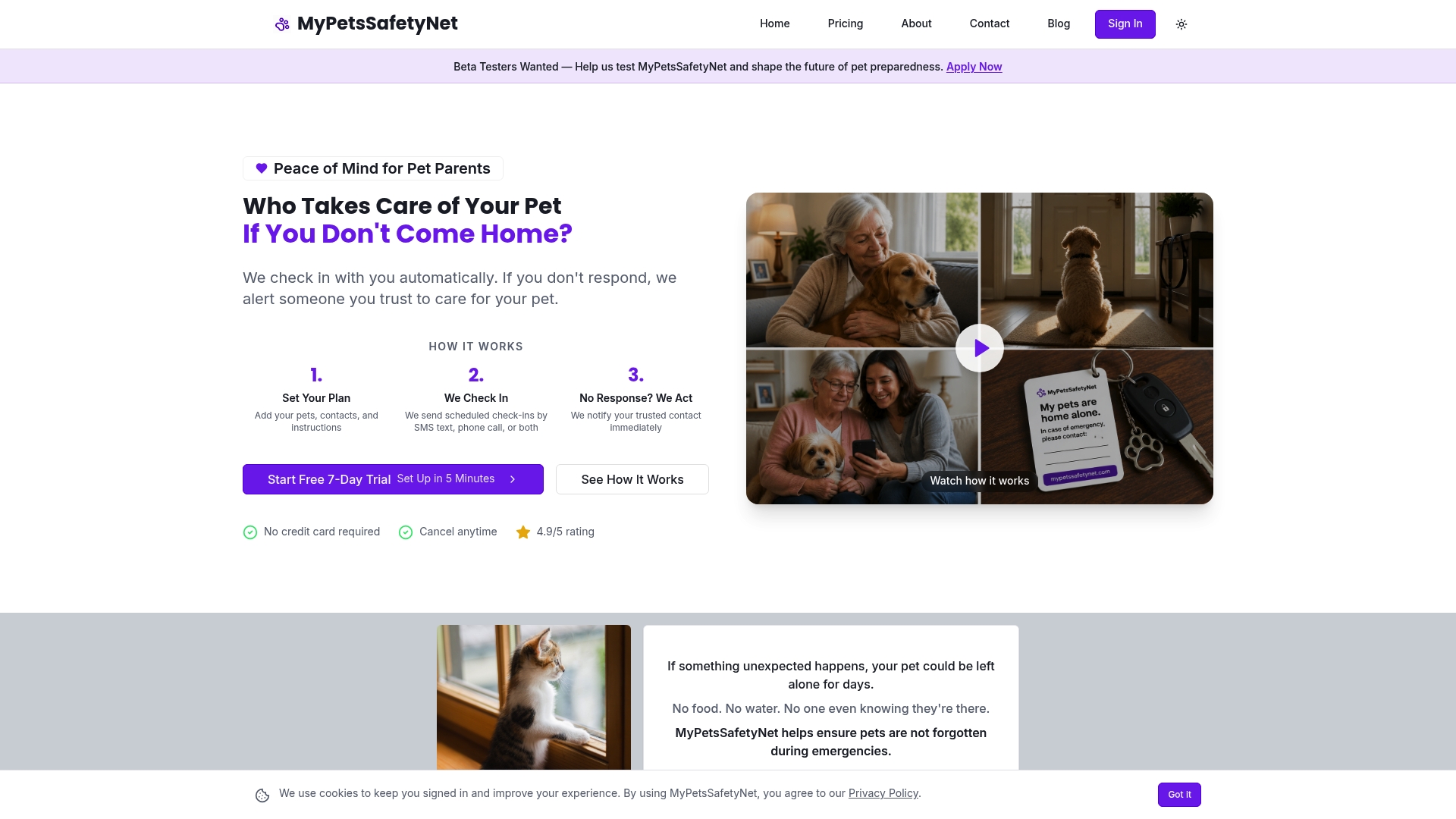
If you want to start with the paper side, you can also try our free pet care card. To see how the check-in handles unreachable contacts, read about auto check-ins and emergency contacts, or start from our emergency pet care plan overview. If you rely on a service animal, the service animal emergency plan adds steps specific to handlers.
A one-afternoon checklist
If you want to finish this today, work through the list in order:
- Decide: together or apart.
- Ask two caregivers per group of pets, and get a yes.
- Write one profile per pet with a photo.
- Sign the vet authorization and arrange payment.
- Check each microchip record.
- Fill out a wallet card and place a removable notice near your door.
- Pack the transport kit and tell caregivers where it is.
- Set up an automatic check-in.
- Put a review date on your calendar.
FAQ
How many caregivers do I need for multiple pets?
At least two, so there’s a backup if one is unavailable. If you have more than two pets, one person may not be able to care for all of them, so you may need separate caregivers for different animals. Write down who covers which pet.
Should my pets stay together if something happens to me?
Often that’s best for bonded animals, but not always. Think about bonds, conflicts, and special needs, then pick what suits each animal. The important thing is to make the decision now and put it in writing, not leave your caregivers guessing.
Is pet insurance part of a multi-pet care plan?
It can be a helpful piece for vet costs, but it doesn’t arrange who looks after your animals. A care plan covers caregivers, instructions, and access to your home. Many owners use both.
Does the person who helps in an emergency have to adopt my pets?
No. The emergency helper and the long-term guardian can be different people. You can ask a neighbor to cover the first few days and arrange permanent care separately, such as through a will or pet trust drawn up with an attorney.
What if I live alone and nobody would notice if I couldn’t respond?
That’s the gap an automated check-in fills. You choose a schedule, and if you don’t answer, your named contacts are notified with your pet care instructions. It also helps to keep a wallet card and a removable door notice so responders know pets are inside.
Sources
- Making a Plan for Your Pet, ASPCA
- Prepare Your Pets for Disasters, Ready.gov
- Estate Planning for Pets, Best Friends Animal Society
- Pets and disasters, American Veterinary Medical Association
- Who’s in charge of your animal’s care while you’re away, AVMA
- Providing for your pet’s future without you, Humane Society of the United States
- Pet Emergency and Disaster Preparedness, Best Friends Animal Society
- Pet Trust Primer, ASPCA
- Pet Trust Laws, ASPCA
- Winter Pet Care