Pet Hospital Go Bag: What to Pack for Your Caregiver

A pet hospital go bag is a ready-packed bag that holds everything a stand-in caregiver needs to look after your pets while you’re in the hospital: about two weeks of food and medication, feeding and medical instructions, records, contacts, and basic gear. Pack it once, tell someone where it is, give them a way into your home, and check it every few months. This guide walks through each step, and what to do if you live alone and nobody would know to use the bag.
TL;DR
- Pack about two weeks of food, water and medication per pet, plus written instructions, bowls, leash or carrier, waste bags and comfort items.
- Add a waterproof folder with vet records, vaccination certificates, proof of ownership and a contact list.
- Give your caregiver a way into your home and tell them exactly where the bag is.
- Rotate food and medication on a schedule so nothing in the bag is expired.
- If you live alone, set up a way for someone to be alerted when you can’t speak for yourself, or the bag may never get used.
Table of Contents
- How a hospital go bag differs from an evacuation kit
- What goes in the bag
- How much food, water and medication to pack
- The paperwork your caregiver needs
- Getting your caregiver into your home
- Pack your bag in one afternoon
- If you live alone, the bag isn’t the whole plan
- Our perspective: a bag only works if someone is told to use it
- Put the “when” in place with MyPetsSafetyNet
- FAQ
- Sources
How a hospital go bag differs from an evacuation kit
Most pet preparedness advice is written for disasters: hurricanes, wildfires, floods. Those kits are built so you can leave quickly with your pet. A hospital go bag has a different job. You won’t be there. Someone else will walk into your home, possibly on short notice and possibly never having met your pets, and they need to find everything in one place.
That changes what you put in it:
- The reader is someone else. Every instruction has to make sense to a person who doesn’t know that your cat only eats from the blue bowl or that your dog pulls on walks.
- The pets usually stay home. A caregiver may feed and walk your dog at your house for days, so the bag has to support care in place as well as travel.
- Timing is unpredictable. A planned surgery gives you days to prepare. An ambulance ride gives you none. The bag has to be finished before either happens.
If you want the bigger picture of what happens to pets when an owner is admitted, our article What Happens to My Pets If I’m Hospitalized? covers it, and How to Prepare Your Pets for a Hospital Stay goes deeper on a planned admission.
What goes in the bag
Choose a sturdy, easy-to-carry container. A duffel or a lidded plastic tote works. Keep it near the front door or in a hall closet, somewhere a person who has never been in your home could reasonably find it. VCA Animal Hospitals’ emergency pet care guide lists these essentials for a caregiver bag:
- Two weeks of food and medications, with instructions
- Food and water bowls and a manual can opener if you feed canned food
- Leashes, harnesses or a carrier
- Waste bags (or litter and a small scoop for cats)
- Comfort items such as a favorite toy or blanket
- A waterproof copy of medical records
- A completed pet information brochure with identification and emergency details
The CDC’s pet disaster preparedness kit guidance adds that dishes, a can opener, and written feeding and medication instructions belong in the kit too.
Extras worth adding for your situation
The lists above are the baseline. Then think about your own pets:
- Dogs: a spare leash, a collar with a current ID tag, a note on walking routine and whether the dog reacts to other dogs or strangers.
- Cats: extra litter, a carrier that’s easy to reach (not buried in the attic), and a note on where the cat hides when it’s scared.
- Small animals and birds: cage covers, spare bedding, and a written note on the temperature and light they need.
- Senior or special-needs pets: mobility aids, ramps, or special bedding, and a short note on what a bad day looks like for this animal.
Keep the bag to what a stranger can use. Everything else can live in your normal supply cabinet, as long as the written instructions say where it is.
How much food, water and medication to pack
The CDC recommends two weeks of food and water per animal, with food kept in waterproof containers, along with two weeks of medication. VCA’s guide likewise calls for a two-week medication supply with up-to-date instructions. Two weeks covers most hospital stays and gives your caregiver time to plan if you’re away longer.
A few practical notes:
- Portion it out. Seal each pet’s food in a labeled, airtight container with the daily amount written on the lid. A caregiver shouldn’t have to guess.
- Keep medications in original labeled containers. Add a written dose and time for each one, plus what to do if a dose is missed. Ask your vet whether they can dispense an extra supply for the bag if your pet takes a daily prescription.
- Rotate on a schedule. Food and medication expire. Put a recurring reminder in your calendar, every three months for instance, to swap the food for fresh and check every expiration date.
- Water. Pack bottled water for the bag, or write on the instructions where a caregiver can get fresh water. Keep bowls clean and dry.
If you have a lot of pets, remember the limits of any single bag. Consider one container per animal, each clearly labeled with the pet’s name.
The paperwork your caregiver needs
Supplies are only half of it. A caregiver who can’t tell a vet what the dog is allergic to is limited in what they can do. Put a waterproof folder in the bag with:
- Medical records. The CDC lists photocopied veterinary records, vaccination certificates (including rabies), and proof of ownership, all kept in a waterproof container.
- Identification details. Photos of each pet, microchip number and registry, and a description of any markings. The AVMA advises owners to keep identification and microchip information up to date.
- Contacts. VCA recommends the contact list include your primary veterinary clinic, local emergency veterinary hospitals, the Pet Poison Helpline, and local animal control.
- Written care instructions. Feeding amounts and times, medications, walking routine, behavior quirks, and where everything is.
- Your own contact details and your caregivers’ numbers. Include a note on who is the first call and who is the backup.
Write the feeding and medication notes so a stranger can follow them
Good instructions are specific. “Feeds twice a day” is vague. “Half a cup of dry food at 7 a.m. and 6 p.m., with the pill hidden in a spoonful of canned food” is something anyone can follow. Our guide to pet feeding schedule documentation has paste-ready blocks you can fill in, and the pet care handoff checklist is a one-page printout that fits right on top of the folder.

Consider a signed permission letter
The AVMA suggests giving caregivers a signed letter releasing them from liability if a pet is injured during an evacuation. The same idea is worth thinking about for hospital care: a short note that authorizes your caregiver to take your pet to the vet and approve reasonable treatment gives them confidence to act. Ask your vet clinic what authorization form they prefer to have on file.
Getting your caregiver into your home
The best-packed bag is useless if no one can reach it. VCA’s guidance is to give a temporary caregiver spare keys and tell them where the go bag is, and to assign someone to take charge of your pet’s care if you can’t.
The ASPCA notes that a neighbor or friend could step in to check on pets if you’re hospitalized, and recommends giving copies of a Pet Portfolio to everyone in the pet’s circle of care.
Before you rely on someone, have a short conversation with them:
- Will they say yes if you call at 2 a.m.?
- Do they have a key, a door code, or a lockbox combination?
- Do they know where the bag is, and have they met your pets?
- Are they comfortable with the medications, such as injections?
- Who is their backup if they’re traveling?
It helps to name more than one person, and to give each a distinct job. Our article on pet caregiver roles explains five assignments you can split up, and Who Takes Care of My Pets If I Am Hospitalized? helps you think through who to ask. If you live in an apartment or building with controlled access, see our apartment pet access plan.
Pack your bag in one afternoon
This takes less time than most people expect.
- Pick the container and the spot. Make it easy to see and carry, and tell your caregivers where it is.
- Gather supplies. Use the checklist above. Buy duplicates of bowls, leashes and waste bags rather than borrowing from daily use.
- Portion and label food and medications. Note the dates.
- Print your instructions. Fill in feeding, medication, walking and behavior notes. Add vet contacts and the poison helpline number.
- Make the records folder. Copy records and vaccination certificates, add photos, and seal it in a waterproof sleeve.
- Brief your caregivers. Show them the bag, hand over keys or access details, and walk through the instructions.
- Set a recurring reminder. Review the bag every quarter and after every vet visit that changes a medication.
The AVMA also advises practicing with your pets and supplies. For a hospital bag, that can mean a dry run: have your caregiver open the bag, read the notes, and feed the pets once while you watch. You’ll find what’s unclear in ten minutes.
If you live alone, the bag isn’t the whole plan
Here’s the gap many solo owners miss. A go bag assumes someone knows you’ve been hospitalized. If you live alone and collapse at home, or an accident happens when you’re out, your caregiver may not hear about it for a day or more. Your pets can’t call anyone.
The FDA advises that if you must leave pets at home, put a rescue alert sticker on your door so people know animals are inside. FEMA’s caregiver guidance also tells people to plan who will care for a pet if they can’t bring it when leaving home. Both ideas are worth doing today.
Then close the loop on the “who will know?” problem. Some practical options:
- Agree on a daily text or call with a friend or relative, with a clear rule about what happens if you miss it.
- Keep a card in your wallet that says you have pets at home and lists a contact.
- Tell your building manager or a neighbor that your pets are home alone when you’re away.
- Use an automated check-in that contacts your caregivers for you (more below).
If you have a disability or a health condition that could make it hard to communicate in an emergency, our guide to a disability pet care plan that alerts contacts can be done in an afternoon. The emergency pet care plan article and What to Do If You Can’t Take Care of Your Pet cover the wider picture.
Our perspective: a bag only works if someone is told to use it
We built MyPetsSafetyNet around one worry: what happens to the pets of someone who lives alone if they can’t call for help.
A go bag answers the question of what a caregiver needs. It doesn’t answer when they find out. We’ve seen the gap in plans that look complete on paper: the supplies are packed, the instructions are written, and no one is told for a day or two because nobody knew to worry.
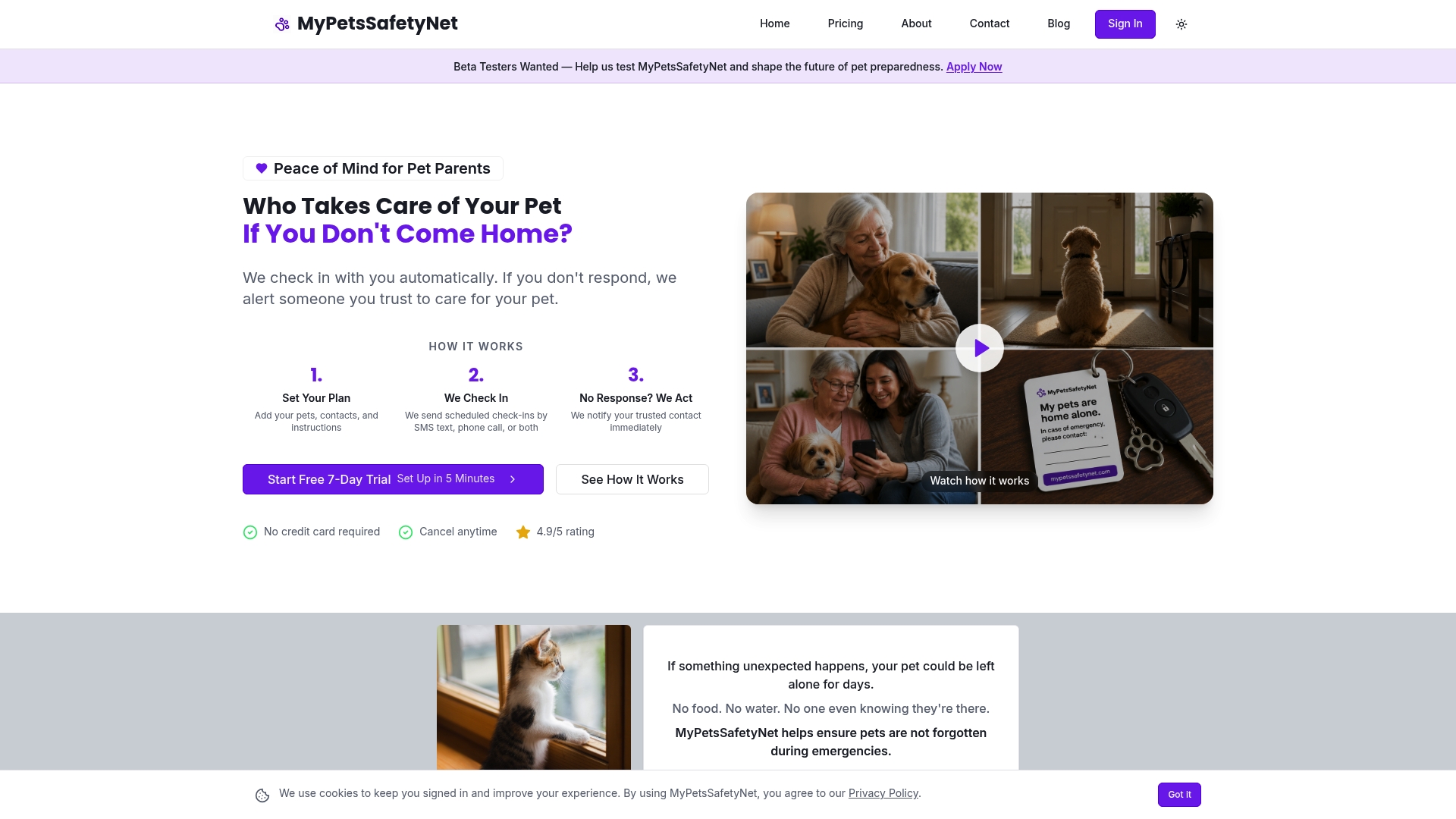
That’s why our service is designed to check in with you on a schedule you choose, by text message, phone call or email. It doesn’t need a smartphone; it works with any phone. If you don’t respond, it’s designed to escalate and notify your emergency contacts, with your pets’ care details included, so they can check on you and on your animals.
We think the best plan has two parts: a bag that tells a caregiver what to do, and a system that tells them when. Together, they let you go into a hospital stay knowing your pets are looked after by a person you chose.
MyPetsSafetyNet
Put the “when” in place with MyPetsSafetyNet
Once your bag is packed, MyPetsSafetyNet can handle the alert side. You can set up scheduled check-ins, customize the countdown before your contacts are notified, store care instructions for up to 5 pets, and list up to 3 emergency contacts. The service costs $6.99 per month, and you can try it with a 7-day free trial that needs no credit card. Setup is designed to take less than 10 minutes. See the pricing page to get started.
If you’d like to start with a printable summary of your pet’s care details, you can also try our pet care card.
FAQ
How many days of supplies should a pet hospital go bag hold?
The CDC recommends two weeks of food and water per animal, plus two weeks of medication. VCA gives the same two-week figure for food and medication in a caregiver bag. If your pet needs a prescription refill that’s hard to get, ask your vet about keeping an extra supply.
Where should I keep the bag?
Somewhere a person who’s never been in your home could find it, such as near the front door or in a hall closet. Make sure your caregivers know the spot. VCA advises telling a temporary caregiver where the bag is and giving them spare keys.
Who should I ask to be my pet’s caregiver?
Choose someone nearby, reliable and comfortable with your pets. The ASPCA suggests a neighbor or friend as one option. Ask a backup too, and meet with both so they know the routine and where things are.
How often should I update the bag?
Check it every few months, and again whenever your pet’s medication, diet or vet changes. Swap food for a fresh supply and check every expiration date. Review the written instructions so they match today’s routine.
What if no one would know I’d been hospitalized?
That’s the most important question for people who live alone. Put a rescue alert sticker on your door, carry a wallet card that mentions your pets, and set up a regular check-in with a person or an automated service that alerts your emergency contacts if you don’t respond.
Sources
- Build a Pet Disaster Preparedness Kit, CDC
- Emergency pet care guide, VCA Animal Hospitals
- Making a Plan for Your Pet, ASPCA
- Pets and disasters, American Veterinary Medical Association
- Take Care of Your Pets Before Disaster Strikes, FDA
- Disaster Preparedness Guide for Caregivers, FEMA