How to Prepare Your Pets for a Hospital Stay

To prepare your pets for hospitalization, do five things: name a trusted emergency caregiver and a backup, write down each pet’s care routine, stock supplies for more days than you expect to need, give your vet written authorization for treatment and payment, and make sure someone can get into your home and knows to check on your pets. Do this now, while you’re well. A sudden hospital admission leaves no time to explain any of it.
If you live alone, this matters even more. Nobody is at home to notice that you didn’t come back, and your pets can’t call for help. The steps below are practical and take an afternoon or two. You don’t need to cover everything at once.
TL;DR
- Choose an emergency caregiver and at least one alternate, then confirm each one has agreed and knows how to reach the others.
- Write a care sheet for every pet: food, medications, routines, behavior, vet contacts and where supplies are kept.
- Keep at least two weeks of food, medication and supplies on hand, and tell your caregivers where they are.
- Give your vet written authorization and a clear payment plan so your caregiver can get your pet treated.
- Plan for the day you can’t speak for yourself: a wallet card, door notices, a way into your home, and an automatic check-in that alerts your contacts if you go silent.
Table of Contents
- Start with people: your emergency caregiver and a backup
- Write a care sheet for every pet
- Stock supplies for longer than you expect
- Get your vet involved: medications, treatment and payment
- Make sure your caregiver can get into your home
- Plan for the day you can’t tell anyone
- A simple timeline: planned versus sudden hospitalization
- Our perspective: a plan is only as good as its trigger
- How MyPetsSafetyNet fits into your plan
- Review your plan every year
- FAQ
- Sources
Start with people: your emergency caregiver and a backup
Everything else depends on this choice. The American Veterinary Medical Association (AVMA) suggests choosing an authorized agent who can act for your pet if there’s an emergency and you can’t be reached. That person should have your contact information, your veterinarian and preferred emergency clinic, and your written care instructions.
A few points that make the choice easier:
- Your short-term caregiver doesn’t have to be your long-term one. The ASPCA notes that the person who steps in during an emergency can be different from the person you’d want as a permanent guardian. That takes pressure off. You’re asking for a few days or weeks of help, not a lifetime commitment.
- Neighbors are valuable. Best Friends Animal Society recommends local emergency contacts, ideally neighbors, because they can be reached quickly and can get to the home and the pet.
- Pick someone who already knows your pet. When thinking about longer-term care, the Humane Society of the United States suggests family or friends who have met your pet and have good experience with animals.
- Think about multiple pets. The ASPCA points out that if you want your animals to stay together, one person may not be able to take them all, so plan that out ahead of time.
Name an alternate, and have them talk to each other
Your first choice may be traveling, sick or at work when you need them. RedRover recommends naming at least one alternate caregiver, giving the alternate the same information as the primary, and making sure the two know how to contact each other. Ask each person directly and get a clear yes. “I’d probably be able to help” isn’t a plan.
If you honestly can’t find anyone, the ASPCA suggests contacting local humane societies or rescue groups ahead of time to ask about placement options. Don’t wait until a crisis to have that conversation.
We’ve also written about how to divide the work among helpers in pet caregiver roles for your emergency packet, and about who takes care of your pets if you are hospitalized.
Write a care sheet for every pet
Your caregiver shouldn’t have to guess. A written care sheet turns a stressful handover into a simple one. Triage Health suggests a pet directive for each animal with identification and a photo, medical and veterinary information, diet, habits, behavior, training rules, daily feeding and exercise instructions, grooming or litter needs, and where supplies are kept.
Here’s a checklist you can copy into a document or notebook, one page per pet:
- Name, species, breed, age, and a recent photo
- Microchip number and the registry it’s with
- Food type, amount and feeding times
- Every medication, dose, time and how your pet takes it (in food, by mouth, by injection)
- Chronic conditions, allergies and known triggers
- Walk or exercise routine and any leash or equipment quirks
- Behavior notes: fears, how your pet reacts to strangers, other animals or children, hiding spots
- Litter, cage, tank or grooming needs
- Veterinarian name, phone and address, plus your preferred emergency clinic
- Where food, medications, carriers, leashes and records are kept
Best Friends also advises copying vaccination records and medication schedules and writing out diet, walking and behavior instructions. Keep a paper copy where a caregiver will find it and a digital copy they can open on a phone.
If you’d like a ready-made format, our free pet care card walks you through the details. For a deeper look at what to include, see our guide to pet care emergency document essentials.
Stock supplies for longer than you expect
Hospital stays run longer than planned, and a caregiver who has to buy prescription food or chase a refill is already struggling. The AVMA recommends stocking enough food, medication and supplements for the time you expect to be away plus extra days. Best Friends suggests a two-week supply of food, medications and care supplies, and says your emergency contacts should know where it’s stored.
A simple routine helps: when you open the last bag of food or the last month of medication, reorder. Put everything in one labeled spot, such as a bin by the door or a shelf in a hall closet. Include:
- Food and treats, with a measuring cup
- Medications and supplements, with the dosing schedule taped to the container
- Litter, waste bags, puppy pads or bedding
- Leash, harness, carrier and any mobility aids
- A favorite toy or blanket, which can help a stressed pet settle
If your pet might need to leave home, the CDC advises writing the pet’s name, your name and your contact information on each carrier. Make sure your caregivers know where the carriers are.
Get your vet involved: medications, treatment and payment
A caregiver can feed a dog or scoop a litter box without much help. The hard part is when your pet gets sick while you’re in the hospital. The vet won’t necessarily treat someone else’s animal without permission and a way to pay.
The AVMA recommends giving your agent your vet’s contact details, your preferred emergency clinic, any chronic conditions and specific limits on treatment or procedures. It also says to clarify payment, for example by providing a credit card authorized for emergency use or checking whether your vet has a payment method on file.

RedRover makes a related point: a willing caregiver may still be unable to continue if food, medication or veterinary costs aren’t arranged. Decide in advance who pays for routine care and who pays for emergencies, and write it down.
Tell your caregiver your wishes
These are uncomfortable questions, but your agent may face them. The AVMA lists several things worth sharing: treatment limits, euthanasia wishes, insurance, financial limits and aftercare preferences. A short, honest conversation now spares your caregiver from making those calls alone. Talk with your veterinarian if you’re unsure what limits make sense for a pet’s age and condition.
Complete the authorization form
Many clinics have their own paperwork. The AVMA advises completing your veterinarian’s or pet-care provider’s emergency authorization form, which states your agent’s identity and authority along with treatment and payment instructions, and sharing it with everyone involved. Call your clinic and ask what they need on file.
If your pet is microchipped, the AVMA also suggests adding your emergency agent as an alternate contact in the microchip registry. That way, if your pet gets lost during the confusion, someone besides you can be reached.
For longer-term arrangements, such as what happens if you can’t return to your pet at all, the Humane Society of the United States advises working with an attorney on a trust or will that covers your pet’s ownership, care and funding. That’s a legal question, so an estate-planning attorney in your state is the right person to ask.
Make sure your caregiver can get into your home
A plan fails at the front door if nobody can open it. RedRover says to make sure your caregiver can enter your home. Triage Health suggests arranging access through a spare key or, in an apartment, permission from building management.
Practical options:
- Give a spare key to a trusted neighbor or to each caregiver.
- If you use a lockbox or smart lock, share the code only with the people on your list, and update it when it changes.
- In an apartment building, tell the manager who your emergency contacts are and that they may need entry.
- Note any door quirks, alarm codes or gate latches in your care sheet.
Renters and people with disabilities often face extra hurdles here. Our guide to an apartment pet access plan covers them in detail.
Plan for the day you can’t tell anyone
The hardest case is a sudden emergency: a fall, a stroke, a car accident. Paramedics and hospital staff may not know you have pets at home. The Humane Society of the United States recommends carrying a wallet alert card and placing removable emergency notices inside your front and back doors. It advises removable notices, not permanent ones, so you can take them down when they’re not needed. Triage Health likewise suggests a pet-alert card with your home address and your caretaker’s contact information and an emergency note posted where it’s easy to see.
A card in your wallet helps only if someone finds you and reads it. If you live alone and are unconscious or unable to speak, the card may not matter for hours or days. That’s the gap an automatic check-in can fill: if you don’t respond, someone is told to go check.
Our article on what happens to your pets if you’re hospitalized and the one on who checks on pets when an owner is hospitalized explain what often goes wrong when nothing like this is in place.
A simple timeline: planned versus sudden hospitalization
The preparation is the same either way, but the order differs.
| When | Planned surgery or admission | Sudden emergency |
|---|---|---|
| Weeks before | Confirm caregiver and alternate, update care sheets, call vet about authorization | Not applicable, which is why you prepare in advance |
| Days before | Restock food and medication, deliver keys, walk caregivers through routines | Already in place if you’ve prepared |
| Day of | Text caregivers your admission time and expected return | Wallet card and door notices alert responders; check-in alerts your contacts if you go silent |
| During the stay | Caregiver sends updates; you share any changes by phone or message | Contacts check on you and your pets and follow your written instructions |
| After | Thank your helpers, restock, adjust the plan | Review what worked and what didn’t |
If you know a stay is coming, do a dry run. Have your caregiver visit once while you’re home, meet the pet, find the supplies and read the care sheet. Five minutes of questions then will save hours of worry later.
Our perspective: a plan is only as good as its trigger
We built MyPetsSafetyNet around one worry: what happens to a pet if the person who lives with them can’t get help? Most pet emergency guides tell you to write a plan. Few address the moment the plan has to start. If you live alone, nobody is there to say, “Something’s wrong, call the caregiver.”

That’s why we think of preparation in two halves. First, the information: who cares for your pets, what they need and how to reach your vet. Second, the trigger: something that tells those people to act when you can’t. Paper plans can sit in a drawer for days. A check-in that escalates when you don’t answer puts the plan into motion.
We also believe the people who help should receive pet care details directly, not just a generic alert. A neighbor who gets a message that you’ve missed a check-in is far more useful if the same message tells them which pets are in the house, what they eat and where the spare key is. And because many of the people we serve are older or have disabilities, we’ve made sure it works on any phone through text or calls, with no smartphone required.
— MyPetsSafetyNet
How MyPetsSafetyNet fits into your plan
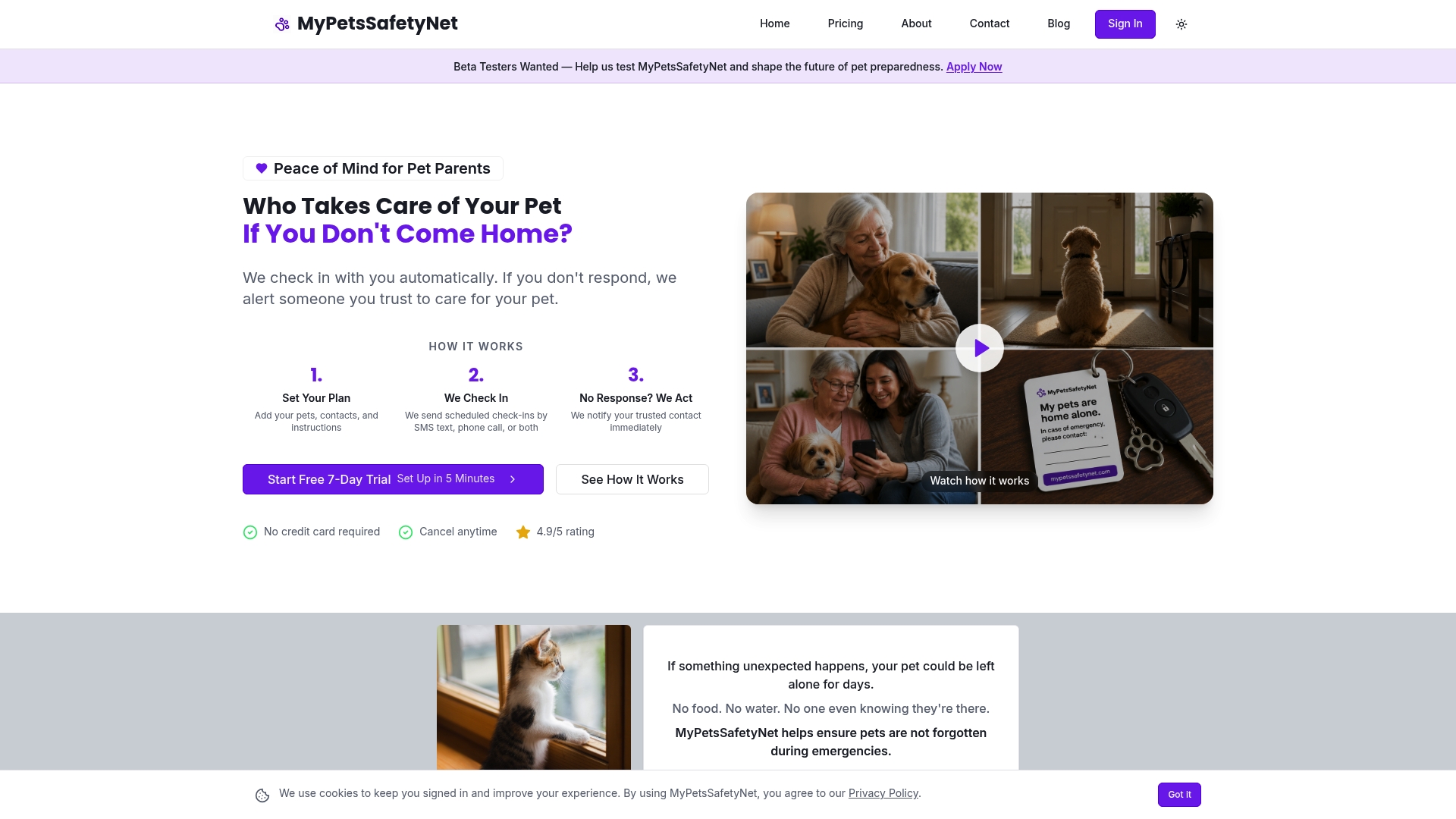
Once your caregivers and care sheets are ready, MyPetsSafetyNet connects them. You set a check-in schedule by text, phone call or email. If you don’t respond within the countdown you choose, we escalate and notify your emergency contacts, giving them your pets’ care details so they can check on you and your animals. You can add up to 5 pets and 3 emergency contacts, and setup takes less than 10 minutes.
The plan is $6.99 per month, and there’s a 7-day free trial with no credit card required. You can see the details on the pricing page.
Not ready to subscribe? Start with our free pet care card, then come back to MyPetsSafetyNet when you want the plan to run on its own.
Review your plan every year
People move, pets age and phone numbers change. RedRover advises reviewing and updating arrangements regularly, and says once a year is not too often, because your animal’s needs may change or your caregiver may move. A good time is when you renew your pet’s vaccinations or schedule an annual checkup.
At each review:
- Ask each caregiver whether they’re still willing and able.
- Update medications, doses, weight and diagnoses.
- Refresh vaccination records and vet contact details.
- Check keys, codes and building-management notes.
- Replace your wallet card and door notices if anything changed.
- Make sure your check-in contacts and phone numbers are current.
If your situation involves a disability or ongoing health condition, our disability pet care plan guide shows how to build the whole thing in about two hours. For the broader picture, see our emergency pet care plan overview, and our guide for solo owners who can’t get home.
FAQ
How far ahead should I prepare my pets for a hospital stay?
Start as soon as you know about a planned admission, ideally several weeks ahead so you can confirm caregivers, talk to your vet and restock supplies. For sudden emergencies, there’s no warning, so it’s best to have the basics in place now. Annual reviews keep the plan current.
What should I tell my vet before I go into the hospital?
Tell your vet who your emergency agent is, and complete the clinic’s authorization form for treatment and payment. The AVMA also suggests sharing any limits on treatment and your preferred emergency clinic. Ask whether the clinic keeps a payment method on file for emergencies.
Can my caregiver be someone different from my pet’s long-term guardian?
Yes. The ASPCA says the emergency caregiver doesn’t need to be the same person you’d choose for permanent guardianship. Many people choose a nearby neighbor for short-term help and a family member or friend for the long term.
What if I live alone and nobody knows I’ve been hospitalized?
Carry a wallet card and post removable notices inside your doors so responders know you have pets. Then add an automatic check-in so your contacts are alerted if you stop responding. That combination covers both being found and being missed.
How much food and medication should I keep on hand?
Best Friends recommends at least a two-week supply of food, medications and care supplies, and the AVMA advises planning for your expected time away plus extra days. Tell your caregivers where everything is stored.
Sources
- AVMA: Ensuring your pet is protected when you’re away
- Best Friends Animal Society: Pet Emergency and Disaster Preparedness
- ASPCA: Making a Plan for Your Pet
- Humane Society of the United States: Providing for your pet’s future without you
- CDC: Be Prepared: Pet Safety in Emergencies
- RedRover: Providing for Your Companion Animal
- Triage Health: Quick Guide to Planning Ahead for Your Pets