How to Verify Your Pet’s Emergency Contacts

A name in your phone is not a plan. To verify an emergency contact for your pet, you confirm three things: they have said yes, you can reach them, and they know how to care for your animal. Then you recheck on a schedule, because phone numbers, jobs and friendships change. If you live alone, that last part matters most, since no one else in the house will notice when a contact has gone quiet. We built MyPetsSafetyNet so that your contacts are alerted, with your pet’s care details, if you stop responding to a scheduled check-in. Verifying them is still the foundation, and this guide walks you through it.
TL;DR
- Ask each person directly, and get a clear yes. The ASPCA says not to assume a friend is willing, and to check in periodically.
- Name at least two contacts, ideally one close enough to reach your home quickly, and confirm each one’s phone number and availability.
- Give every contact written care instructions, vet details and home access before anything happens.
- Recheck on a calendar, at least once or twice a year, and any time your pet’s health, your address or your relationships change.
- Update microchip, vet and tag information whenever a contact changes.
Table of Contents
- What “verifying” an emergency contact really means
- Step 1: Ask each person directly
- Step 2: Choose people who can actually get there
- Step 3: Confirm you can reach them
- Step 4: Give them what they need to act
- Step 5: Tell the places that will be asked
- How often to update your emergency contacts
- When a contact does not answer
- How MyPetsSafetyNet helps you keep contacts current
- Our perspective
- FAQ
- Sources
What “verifying” an emergency contact really means
Most people set up an emergency contact once, on a phone or a vet form, and never look at it again. Verification is different. It is a short conversation and a few checks that turn a name on a list into someone who will actually show up.
For a pet owner, a contact has to pass four tests:
- Willing. They agreed, knowing what it involves.
- Reachable. The number and email you have still work, and they answer or call back.
- Able. They live close enough, can handle your animal and can follow your instructions.
- Equipped. They have the information and access they need before the emergency, not during it.
The emergency caregiver also does not have to become your pet’s permanent guardian. The ASPCA notes that a neighbor or friend can simply look after your pets while you are in the hospital. Saying that out loud makes it easier for people to agree.
Step 1: Ask each person directly
A text that says “you’re my emergency contact, ok?” is not a real conversation. Call or meet in person, and be specific about what you are asking.
Cover these points:
- What it involves. Feeding, walking, medications, litter, a few days of care while you are in the hospital.
- How long. A weekend is different from a month. Say which you are asking for, and whether they would ever be asked to take the animal permanently.
- How they would get in. A key, a code or a lockbox.
- Their own limits. Allergies, travel, a landlord’s pet rules, other animals in their home.
The AKC’s guide to setting up an emergency caregiver suggests questions that apply well beyond dogs: does your pet like this person, have they cared for animals before, will your pet get along with the people in their home, and can they meet your pet’s medical needs. It also stresses that fit works both ways. The caregiver should be able to give your pet something close to the life it is used to, whether that means a yard, daily exercise or a quiet home.
If the answer is hesitant, treat it as a no. A contact who agrees out of politeness is the one who is unavailable on the day.
Step 2: Choose people who can actually get there
Willingness is not enough if the person lives three hours away. Best Friends Animal Society recommends local contacts, neighbors if possible, who can be activated quickly for home access. If your preferred decision-maker lives far away, pair them with a local person who can pick up a key or drop off pet food.
Two is the minimum. The Connecticut Humane Society advises identifying at least two trusted relatives or friends who agree to serve as temporary caregivers, and Alexandria Animals says to list several alternates in case the first one cannot help.
A good mix for someone living alone:
- A neighbor who can reach your door in minutes.
- A friend or relative with a flexible schedule who can take over for days.
- A third person, ideally outside your immediate area, in case a local emergency affects the first two.
We go deeper on how many people to name in how many emergency contacts a solo pet owner needs and on the different jobs each person can take in pet caregiver roles.
One practical point: if your pet might need same-day veterinary care, your local contact should know where to go. Having the address of a nearby urgent care for pets written into the instructions saves a caregiver from searching in a stressful moment. Use the clinic closest to you, and keep your regular vet’s number beside it.
Step 3: Confirm you can reach them
This is the quick, mechanical part, and it is where plans quietly fail.
- Call each number you have saved. If it goes to a voicemail you do not recognize, you have a wrong number.
- Send a text and ask for a reply, so you know the number accepts messages.
- Confirm a second way to reach them, such as an email or a work number.
- Ask when they are hardest to reach. A night-shift nurse or a frequent traveler may need a backup paired with them.
- Save each person in your phone under a clear label so a paramedic or a hospital staffer can find the right name.
A contact who never picks up an unknown number is a real risk. Tell them in advance that the call or message will come from you or from your check-in service, so they recognize it.
Step 4: Give them what they need to act
Being willing and reachable is half of it. The other half is information. Best Friends recommends giving contacts copies of vaccination records, the medication schedule, your veterinarian’s contact information and detailed care instructions, and keeping the originals somewhere your contacts know to look. Their stated goal is to make it as easy as possible for someone else to care for your pet.

Build a single packet per pet. NASC’s records guide suggests starting with emergency contacts (how to reach you, trusted friends or family, your primary vet, the nearest 24-hour emergency clinic and the Pet Poison Helpline), then identification, medical records and diet.
A useful packet includes:
- Feeding amounts and times, including treats and foods to avoid
- Medications, doses and where they are stored
- Vet name, phone number and any known conditions
- Behavior notes: fears, triggers, how your pet reacts to strangers
- Walk or litter routine
- Where the leash, carrier, food and supplies are
- How to get into the home
Templates help here. Our pet feeding schedule documentation blocks are one example, and the pet care handoff checklist gives you a one-page version you can print. For access, see how to prepare your home for caregivers. If you have not formalized the arrangement, a power of attorney for pet care and pet caretaker agreements explain how to put it in writing.
Once a contact has the packet, ask them to read it and tell you what is unclear. Our caregiver onboarding checklist covers that handover.
Step 5: Tell the places that will be asked
Your contact’s name should exist in more than your head and their phone.
- Your vet. Tell the clinic who your emergency contact is, so they can speak with that person about your pet’s care.
- Your wallet and your home. Best Friends recommends keeping contact information in both places.
- Your microchip registry. Best Friends advises scanning the chip, which most vet clinics and shelters can do, and looking up the number through the American Animal Hospital Association’s pet microchip lookup to see where it is registered. Make sure the registry holds a phone number that works and an alternate contact.
- Your pet’s tags. Keep them current.
If you live in a state or county with its own emergency contact registry, check whether you can add a note about pets. The Animal Welfare Society also suggests keeping the numbers for local first responders, nearby shelters and animal control on hand.
How often to update your emergency contacts
The short answer: on a schedule, and any time something changes.
The Connecticut Humane Society says to revisit your plan periodically because relationships and circumstances change. The ASPCA says to check in with caregivers periodically to confirm they are still willing and able. Other guides give concrete rhythms. One example is the Presbyterian Disaster Assistance preparedness workbook, revised in 2024, which suggests reviewing the plan every six months when the clocks change and updating phone numbers on your communication plan.
A simple routine:
| When | What to do |
|---|---|
| Twice a year (clock changes) | Call or text each contact, confirm numbers, confirm they are still willing |
| After any move, new job or new phone number | Update contacts, microchip registry, vet and tags the same week |
| When a pet’s health, medications or diet change | Reprint or resend the care packet |
| When you add or lose a pet | Update every contact’s copy |
| When a contact moves, changes jobs or has a life change | Ask whether they can still serve, and replace them if not |
Put the dates in your calendar with a reminder. Then update the copy each contact holds, not only your own.
When a contact does not answer
The hardest case is the one verification cannot fully solve: the day you need help and the first person is out of reach. That is why a plan needs more than one name, and why the order matters. Decide who is called first, who is second and who is the last resort, and tell everyone that order.
We cover why a single unreachable contact can break a plan in how auto check-ins keep 2 to 4 emergency contacts in play and the case for naming several people in our guide to pet emergency contacts.
How MyPetsSafetyNet helps you keep contacts current
MyPetsSafetyNet is an automated wellness check-in service for pet owners. It sends scheduled SMS, phone or email check-ins, and if you do not respond, it follows an escalation workflow and notifies your emergency contacts with your full pet care details. You can store up to 5 pets and up to 3 emergency contacts, set your own countdown intervals and generate a pet care instruction card.
It works with any phone, by text or call, so you do not need a smartphone. Setup takes less than 10 minutes. The Monthly plan is $6.99 per month, and there is a 7-day free trial with no credit card required. You can start at our pricing page.
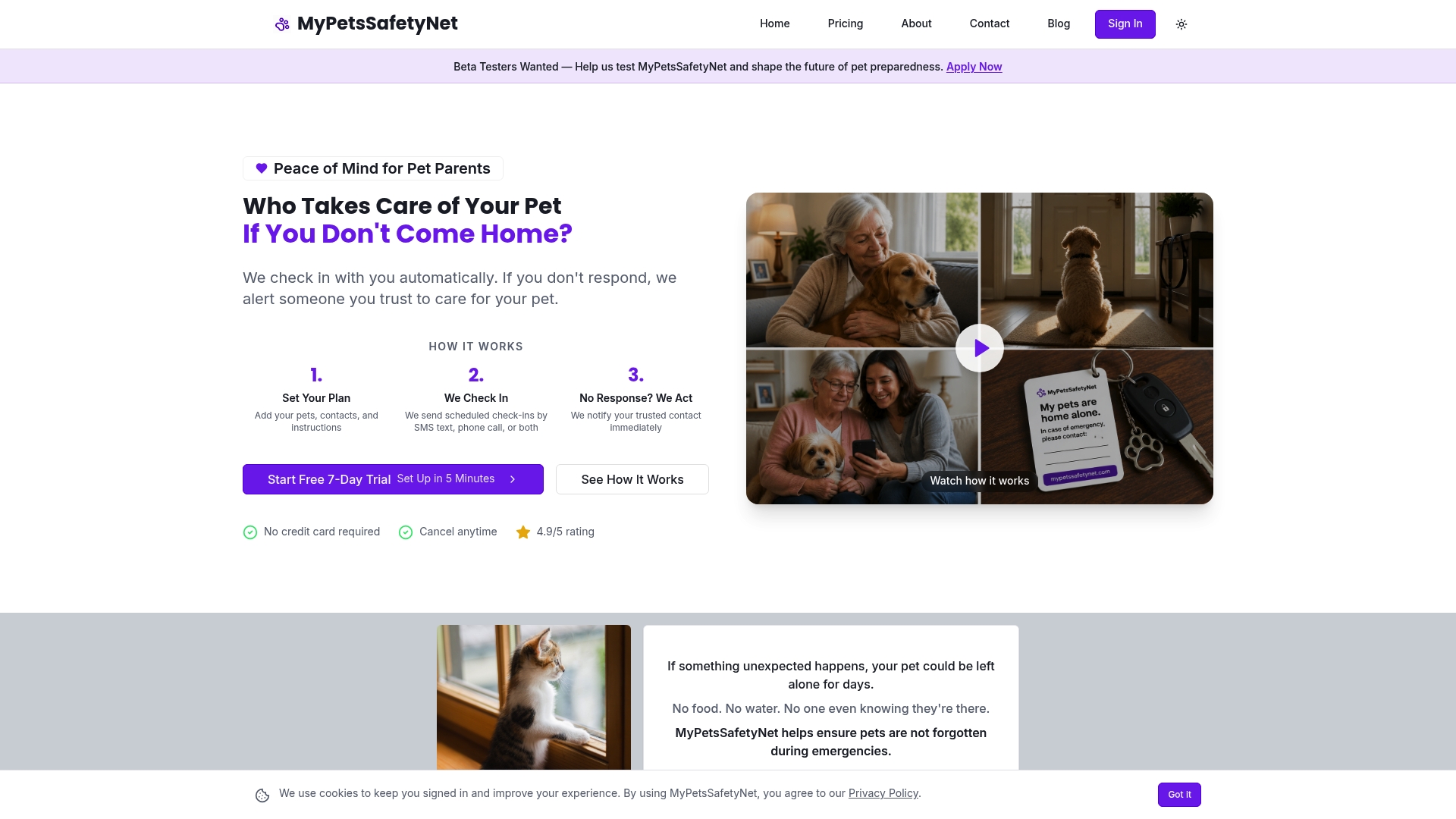
If you are already working through the steps above, the service gives your verified contacts one place to receive your pet’s care details, so the instructions reach the named caregiver and not only emergency services.
Our perspective
We started MyPetsSafetyNet because of one question: what happens to a pet when the person who cares for it lives alone and cannot respond?
Most emergency contact advice stops at writing down a name. In our view, the name is the beginning. The people who reach a home in time are the ones who said yes, knew the routine and had the instructions already in hand.
That is why our service is built around your caregivers and not only around you. When a check-in goes unanswered, the people you chose are notified, and they receive the pet care details they need to step in. It is a pet-focused safety net, designed to get information to named caregivers.
Pair that with the habit of verifying your contacts twice a year, and you have a plan that holds up when life changes.
MyPetsSafetyNet
FAQ
What qualifies as an emergency contact for a pet?
An emergency contact is someone you trust who has agreed to check on your pet and, if needed, care for it. Choose people who are reliable, comfortable with your animal and close enough to get to your home. Name at least two, as the Connecticut Humane Society advises.
How do I update my emergency contacts?
Change the number or name everywhere it appears: your phone, your vet’s records, your microchip registry, your pet’s tags and the care packet each caregiver holds. Then message the person to confirm they received it. Do this the same week anything changes.
How often should I check that my contacts are still willing?
At least twice a year is a practical rhythm, and any time your life or your pet’s needs change. The ASPCA recommends periodic check-ins with caregivers to confirm they are still willing and able.
Should my contact have a key to my home?
They need a way in. Give them a key, a code or access through a lockbox, and do it before an emergency. Make sure they know the alarm and door details and have walked through the home once.
Can my emergency contact be someone who lives far away?
Yes, as a decision-maker, but pair them with someone local who can reach your home quickly. Best Friends recommends this pairing.
Sources
- Making a Plan for Your Pet, ASPCA
- Pet Emergency and Disaster Preparedness, Best Friends Animal Society
- Preparing for the Unexpected, Connecticut Humane Society
- Disaster Preparedness, Animal Welfare Society
- How to Set Up an Emergency Caregiver for Your Dog, AKC
- Planning for Your Pets, Alexandria Animals
- How to Keep Your Pet’s Records Organized, NASC LIVE
- Family Preparedness Plan Workbook, Presbyterian Church (U.S.A.)