Solo Pet Owners: 2–4 Emergency Contacts, Docs, and Check Ins

Name two to four trusted people, plus your primary vet’s number and a 24/7 emergency clinic or poison control line. That split matters more than the count: you need at least one person who can physically reach your home fast, and at least one who can make veterinary decisions on your behalf. If your pets depend on you alone, an automated daily check-in closes the gap between “something’s wrong” and “someone knows.”
TL;DR:
- Having between two and four trusted contacts ensures effective response coverage without causing confusion or delays during emergencies.
- Local responders should be no more than ten minutes away, with reliable access like spare keys or codes, and at least one decision-maker authorized for vet treatment.
- Emergency packets must include vaccination records, medications, vet info, proof of ownership, and explicit authorization language, not just contact names.
- Automated daily check-ins help alert someone quickly if your pet needs urgent care, reducing response times from over 30 minutes to under five.
- Clear, up-to-date instructions are crucial for each specific emergency, especially for speed in medical crises versus evacuation or natural disaster scenarios.
Table of Contents
- How many emergency contacts should you actually list?
- Choosing contacts who can actually show up
- What your emergency contacts need in hand
- Why automated check-ins close the gap contacts alone can’t
- Matching your contact plan to the emergency
- Who sees your emergency contact information, and how safely
- Telling the people who need to know
- MyPetsSafetyNet perspective: lessons from supporting solo pet owners
- How Mypetssafetynet turns your contact list into a real safety net
- Sources
How many emergency contacts should you actually list?
Two people is generally the minimum recommended. Having more than a few can make the list too complicated to follow in a crisis. Inside that range, every contact should have a clear job, not just a name on a card.
The logic behind 2 to 4 human contacts comes down to coverage without confusion. One person alone creates a single point of failure. Five or six people creates a different problem: nobody knows who’s actually supposed to act, and consent gets murky when multiple people think they’re in charge. AVMA guidance on delegating pet care specifically recommends naming one agent with final decision-making authority if you appoint more than one, precisely because split authority slows everything down.
Here’s how the roles typically break down:
- Primary local responder — lives nearby, has a key or access, can be at your door within the hour.
- Backup local responder — a second nearby option in case the first is unreachable or traveling.
- Remote decision-maker — may live farther away but knows your wishes and can authorize treatment by phone.
- Primary veterinarian — your pet’s regular clinic, with existing records on file.
- Emergency clinic or poison control — for after-hours situations your regular vet can’t handle.
You may need more than four human contacts if you have multiple pets with different care needs, travel frequently, or manage a pet with complex medical requirements that only one or two people fully understand.
Pro Tip: Don’t confuse “trusted” with “useful in a crisis.” A sibling three states away who loves your dog can still be the wrong first call if they can’t get through your front door.
Choosing contacts who can actually show up
The right emergency contacts aren’t necessarily your closest relationships. They’re the people who can act, fast, with your explicit permission already on record.
- Rank by proximity first. A neighbor ten minutes away beats a best friend two hours away for the local-responder role, every time.
- Confirm they can get in. Access means a spare key, a garage code, or a documented plan for entry, not a vague assumption they’ll “figure it out.”
- Name a veterinary decision-maker. At least one contact needs the authority to approve treatment and agree to a rough spending limit before an emergency happens, not during one.
- Pair remote contacts with local ones. If your most trusted person lives far away, give them the decision-making role and pair them with a nearby backup who can handle logistics on the ground.
- Write down who has final say. If two people could plausibly make a call, put one name in writing as the tiebreaker.
Best Friends’ guidance on building a pet care plan echoes this: choose local contacts when you possibly can, and make their job easy by handing them records before they need them, not after.
What your emergency contacts need in hand
A name and phone number isn’t a plan. Your contacts need documents and explicit permission the moment they’re activated, or they’ll spend precious time chasing down information that should already be theirs.
Build a packet that includes:
- Vaccination records and your pet’s microchip ID number
- Current medications, exact dosing, and the date of the last dose given
- Your veterinarian’s name, clinic, and phone number
- Pet insurance provider and policy number, if applicable
- Proof of ownership, in case a shelter or clinic asks
Authorization language matters just as much as the paperwork itself. Spell out who can consent to treatment, whether there’s a spending cap, and whether euthanasia can be authorized in a worst-case scenario, and by whom. PetNPrep’s emergency planning guidance stresses this exact point: caregivers need explicit authorization language before an emergency, not vague trust.
Logistics round out the packet: where the spare key lives, where the carrier and food are stored, and which clinic to head to first. One source recommends listing a backup emergency clinic alongside your primary vet, since after-hours availability varies.
A well-built list changes outcomes. One estimate suggests a prepared pet emergency contact list can cut response time from over 30 minutes to under 5, largely because the caregiver isn’t hunting for information mid-crisis. It is recommended to keep copies of your emergency contact information in multiple places to ensure access even if a phone is unavailable. Mypetssafetynet’s guide to emergency document essentials walks through building that packet in full.
Why automated check-ins close the gap contacts alone can’t
A contact list only works once someone knows to check it. That’s the piece most solo pet owners miss: nobody will call your emergency contacts if nobody knows something’s wrong yet.
A daily automated check-in solves the timing problem directly. You get a scheduled prompt, whether by text, call, or email, and a set response window. Miss it, and the system escalates on its own. One analysis of pet care planning for solo owners describes exactly this mechanic: automated check-ins turn a silent, unnoticed gap into an early-warning trigger, often narrowing the window from days to hours.
A sound escalation order looks like this:
- First contact: your primary local responder, immediately after a missed check-in.
- Second contact: your backup local responder, if the first doesn’t respond within a set window.
- Third contact: your remote decision-maker, notified alongside or shortly after, with vet and clinic details attached automatically.
Embedding authorization and records directly into that alert is what actually saves time. A responder who opens a notification and already sees medications, vet contact information, and consent language doesn’t need to call you first to figure out what to do.
This is precisely what Mypetssafetynet was built to automate. The service manages pet profiles and care instructions, supports up to 3 emergency contacts and 5 pets, generates a printable authorization card, and runs the entire escalation workflow on a countdown you set. You configure it once; it handles the notification math every day after.
Pro Tip: Set your countdown interval to match your actual routine. If you check in with your phone every morning, a 24-hour window catches problems fast without generating false alarms on a slow Sunday.
Matching your contact plan to the emergency
Not every emergency plays out the same way, and your contact plan should flex accordingly.
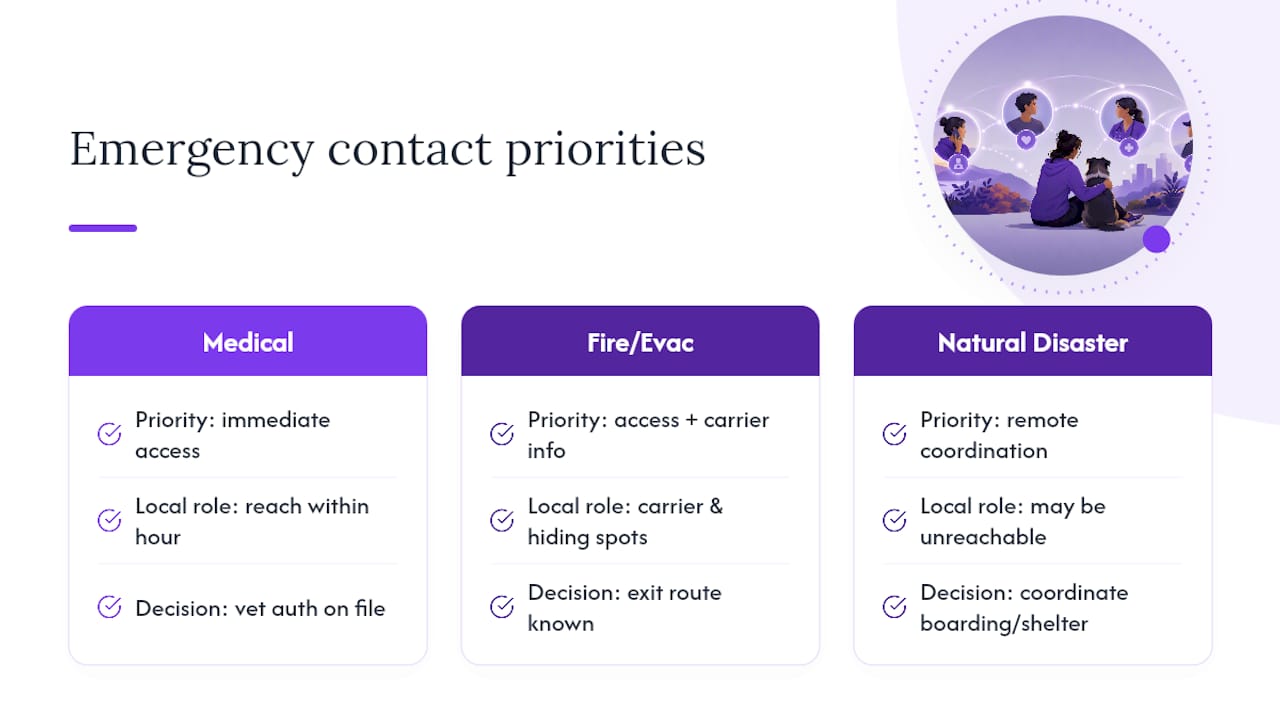
A medical emergency, a fall, a hospitalization, a sudden illness, usually calls for speed above all. Your local responder needs to reach your pet within the hour, and your decision-maker needs veterinary authorization already on file so treatment isn’t delayed by a phone call nobody can answer.
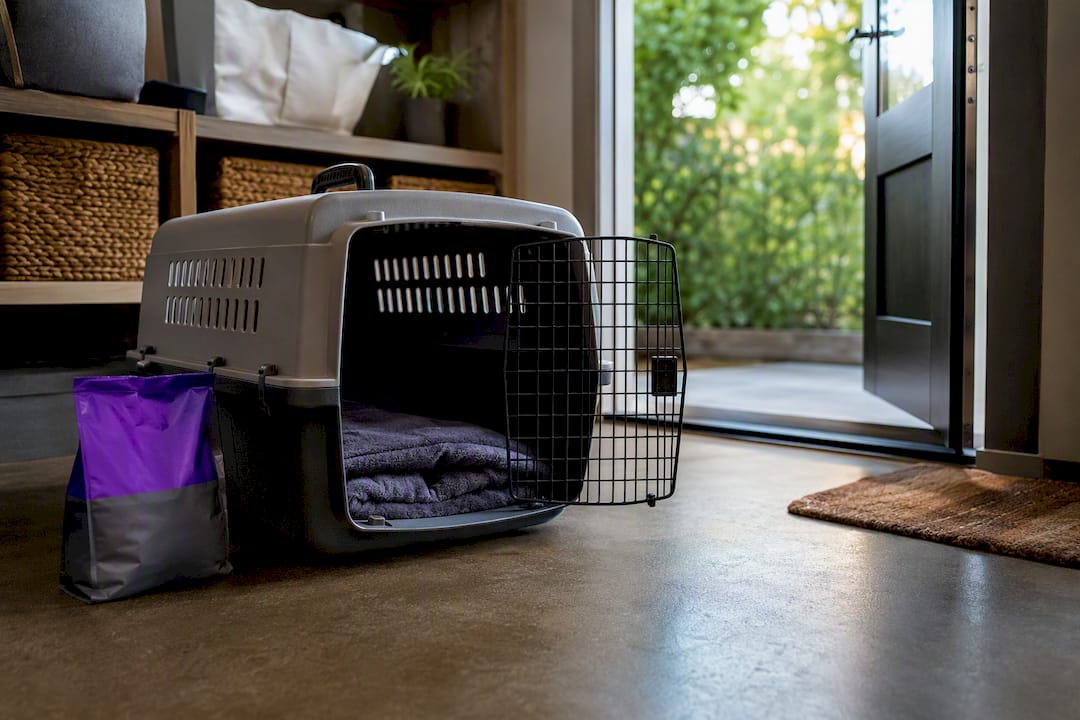
A fire or evacuation changes the priority entirely. Contacts need to know where carriers are stored, whether your pet is hidden-prone under a bed or in a closet, and which exit route works if you’re not there to guide them. Speed still matters, but so does know your pet’s specific hiding habits under stress.
A natural disaster, flooding, a hurricane, a wildfire evacuation zone, often means your local responder can’t get to you either. This is where your remote decision-maker becomes essential: they may need to coordinate boarding, transport, or a shelter placement from a distance while local roads are blocked.
Across every scenario, the constant is the same: contacts need current information, not a stale list from two years ago. If your pet’s medication changed last month, that update has to reach every contact, not just live in your head.
Who sees your emergency contact information, and how safely
Sharing your contacts’ names, phone numbers, and your home access details means trusting that information stays where you intended it.
A physical card in your wallet or on your fridge is low-risk by nature; the only people who see it are people already in your home. Digital storage, apps, cloud documents, shared spreadsheets, carries more exposure. Before you use any digital tool for this, check whether it encrypts stored data, who else at that company could see your contacts’ phone numbers, and whether the app shares information with third parties.
Ask your contacts, too, before you list them. Confirm they’re comfortable having their name and number stored digitally and possibly shared with a vet clinic they’ve never met. That’s a basic courtesy, and it also protects you: a contact who’s surprised to get a call is a contact who might not respond well.
Keep home-access details, key locations, door codes, deliberately separate from anything shared broadly. That information should live only with the specific people who need it, not embedded in a document that could end up forwarded, printed, or exposed in a data breach.
Telling the people who need to know
An emergency contact list that lives only in your head, or only in one app, doesn’t help anyone if the people around you don’t know it exists.
If you work outside the home, your employer or a trusted coworker should know you have pets and a plan in place, especially if a workplace emergency, like a sudden hospitalization, could leave your pets uncared for. If you have kids in school who help with pet care, make sure the school or after-care program has a copy of who to call if you’re unreachable at pickup time.
Regular caregivers, dog walkers, pet sitters, a neighbor who feeds your cat when you travel, need the same information your emergency contacts have. Give them the same card, not a simplified version. Mypetssafetynet’s free printable pet card works well here: one document, shared identically with everyone who might need it.
Review and update that list every few months, and any time a contact moves, changes their number, or is no longer able to help. A card with an outdated phone number is worse than no card at all, since it creates false confidence.
MyPetsSafetyNet perspective: lessons from supporting solo pet owners
The most common mistake we see isn’t too few contacts. It’s too many remote ones and no clear decision-maker. A list of five out-of-state relatives looks thorough, but none of them can unlock your front door, and none of them agree on who has the final call.
The second mistake is skipping authorization paperwork entirely. A willing neighbor without written veterinary consent can still get stuck at the clinic door. Mypetssafetynet’s guide to phone-tree setup for solo owners and veterinary consent form guidance both exist because of how often we hear this exact problem.
Start today: pick three contacts, assemble the emergency card, and turn on a daily check-in.
— MyPetsSafetyNet
How Mypetssafetynet turns your contact list into a real safety net
A list of names in a notes app doesn’t do anything on its own. Mypetssafetynet is built specifically to activate that list the moment you can’t respond, instead of leaving it to sit unused until someone happens to notice something’s wrong.
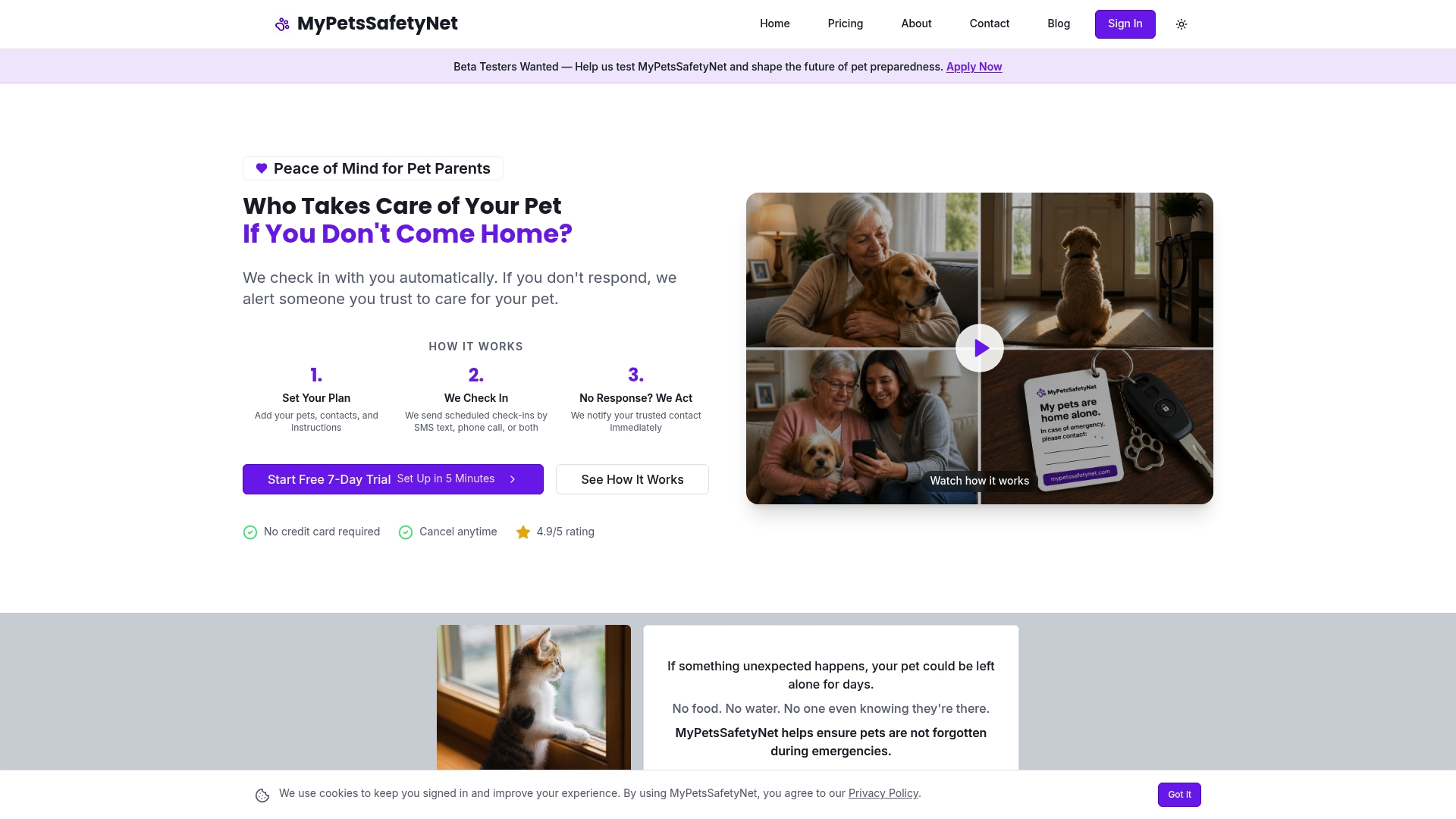
Setup takes minutes. Add your 2 to 4 emergency contacts, upload your vet’s information and your pet’s medications, and generate your authorization card directly inside the platform. Set your countdown interval to match your routine, and the escalation workflow handles the rest: local responder first, backup second, decision-maker third, with your pet’s full care details attached to every alert automatically. No one has to guess what to do or call you first to find out.
Get your free pet emergency card started now, or set up your full automated check-in and escalation plan today so your pets are never left waiting on a plan that only exists in your head.
Sources
For deeper guidance, the AVMA’s advice on delegating pet care covers authorization language in detail. Keep the ASPCA Animal Poison Control Center (888-426-4435) on hand for after-hours poisoning cases. Mypetssafetynet’s emergency document essentials guide and free printable pet card round out a ready-to-use packet.
- AVMA — Who’s in charge of your animal’s care while you’re away?
- Best Friends — How to build a pet care plan for emergencies
- How to Create a Pet Emergency Contact List: Essential Info to Save (2025)
- PetNPrep — Emergency pet care plan for hospitalization, disability, or travel