Aging in Place With Pets Checklist: Home, Care and Backup Plan

Staying in your own home with your pets is a good goal, and it takes four things: a home that is safe to walk through, daily routines that fit your body, a written plan your caregivers can follow, and a way for someone to find out quickly if you can’t respond. This checklist covers all four, so you can work through it one section at a time.
TL;DR
- Make the home safer first: clear walkways, add non-slip surfaces, and raise or lower pet gear to a comfortable height.
- Adapt daily care with tools such as automatic feeders, long-handled bowls and a visible daily checklist.
- Write a pet portfolio, name at least two emergency contacts, and give copies to everyone in your pet’s circle of care.
- Plan for the day you can’t respond: someone has to know, and they need your pet’s care details in hand.
- Review the whole plan once a year, and any time a vet, medication or phone number changes.
Table of Contents
- Part 1: Make your home safer for you and your pets
- Part 2: Make daily pet care easier on your body
- Part 3: Build your pet portfolio
- Part 4: Choose your caregivers
- Part 5: Prepare for the day you can’t respond
- Our perspective
- Put your plan on autopilot
- Part 6: Keep the plan current
- The full checklist at a glance
- FAQ
- Sources
Part 1: Make your home safer for you and your pets
Falls often happen where people and pets share space. Start with a slow walk through each room, looking at the floor.
Floors and walkways
- Remove floor clutter and keep pet toys in one designated spot.
- Keep pet beds out of walkways, especially the route to the bathroom at night.
- Put rugs or runners on slippery surfaces, and secure them so they don’t slide. AAHA’s pet-proofing guidance recommends them to reduce falls.
- Place a non-slip mat under food and water bowls.
- Add nightlights along the path between the bedroom, the kitchen and the door.
Stairs and doors
- Use gates or barriers where stairs are unsafe for you or an older pet.
- Choose non-slip stair surfaces and ramps with good traction. VCA’s guidance covers these for dogs with mobility problems, along with uncluttered routes and padded sharp edges.
Things pets can get into
AAHA’s list says to secure electrical cords, toxic plants, food, medications, chemicals, trash and cabinets, and to close toilet lids. If you keep houseplants, check each one before it comes home. This list of ASPCA-verified pet-safe houseplants is a good place to start.
If your pet is getting older too
AAHA’s senior care kit guidance suggests elevated bowls, ramps, mobility harnesses, accessible bedding, lower-sided litter boxes, nightlights and temperature control. Small changes like these help an aging pet get around without help from you.

Part 2: Make daily pet care easier on your body
You don’t have to give up routines you love. You can change how they work.
- Feeding and water: The Arthritis Foundation recommends adaptive tools for joint pain, including long-handled bowls, automatic feeders and water stations.
- Grooming: Grooming gloves are easier on sore hands than a small brush.
- Walks: Hands-free leashes and no-pull harnesses give you more control with less strain.
- Reminders: Adaptive Pet Strategies suggests a visible daily checklist, alarms or phone reminders, and keeping frequently used supplies at a convenient height.
- Lifting: The advice for caring for your pet as you age is to keep your back safe: set the pet at your feet, keep it close, and lift with your legs. If lifting is hard, ramps and steps are better than carrying.
- Deliveries: Have food, litter and medications delivered when that saves you a heavy trip.
For more local help, see our guide to pet care help resources for seniors.
Part 3: Build your pet portfolio
The ASPCA recommends a pet portfolio: one place that holds everything a stranger would need to care for your animal. Keep it with your important papers in a spot that is safe but easy to reach.
Include:
- Name, age, breed or type, and a current photo of each pet
- Vaccination records and veterinary records
- Medical conditions and medications, with doses and times
- Food, feeding times, treats and exercise routines
- Behavior notes: fears, triggers, how your pet handles strangers
- Bonded animals that should stay together
- Identification and microchip details
The University of Pittsburgh’s aging-with-pets guide adds that a care letter should name the caregiver and the care location.
The ASPCA says to give copies to everyone in your pet’s circle of care. Our pet care emergency document essentials guide goes through each paper in detail, and the one-page handoff checklist gives you something to print.
Part 4: Choose your caregivers
A plan only works if real people have said yes.
- Pick a temporary caregiver. The ASPCA notes the person who steps in during an emergency need not be the person who takes your animals permanently. A neighbor or friend could check on pets during a hospital stay.
- Pick a permanent guardian. This can be a different person.
- Add a neighbor buddy. Best Friends Animal Society recommends local contacts, preferably neighbors, who can get into your home quickly.
- Add backups. The Humane Rescue Alliance suggests several care plans with neighbors, family, friends, pet sitters or boarding facilities, so pets can stay in trusted care rather than go to a shelter.
- Check in with them. The ASPCA says to contact your chosen caregivers periodically to confirm they are still willing and able.
Not sure who should do what? Our guide to pet caregiver roles breaks it into five assignments.
Part 5: Prepare for the day you can’t respond
This is the part most checklists skip, and it matters most if you live alone.
If you fall, are hospitalized or become confused, your pets may be alone for hours or days before anyone knows. The plan below closes that gap.
Make yourself findable
- Put a pet-alert card in your wallet. The ASPCA suggests listing two emergency contacts on it.
- Post a notice near the exterior door that says pets are inside and who to call. Oklahoma State University Extension recommends this, along with current tags, microchips and a recent photo.
- Keep a visible emergency contact sheet inside the home.
Authorize your caregiver
The AVMA says to name an authorized decision-maker and spell out what they need to know: contact routes, veterinary and medical information, treatment and euthanasia preferences, insurance and financial limits, payment arrangements and written authorization. AAHA adds that an authorization letter should include your contact information and time zone and who may make veterinary decisions.
Keep a go-bag ready
The University of Pittsburgh guide recommends a ready-to-grab bag with species-specific supplies: food, bowls, medicines, leashes, litter, waste bags, towels and a crate or carrier. Best Friends suggests a two-week supply of food, medications and care supplies. The ASPCA says to rotate food and medicines before they spoil or lose effect. For a hospital stay, see our pet hospital go bag list.
Know where pets can go
The CDC cautions that many local shelters and Red Cross evacuation centers don’t accept pets other than service animals. Line up pet-accepting hotels, friends or boarding facilities now. The ASPCA also advises keeping carriers, leashes and supplies near an exit.
Plan for memory changes
If you worry about cognitive decline, start earlier. We cover it in pet care planning for cognitive decline.
Our perspective
A paper plan is a good start, but it has one weakness: it only works if someone knows to use it. When you live alone, that is the hard part. Nobody notices a missed morning.
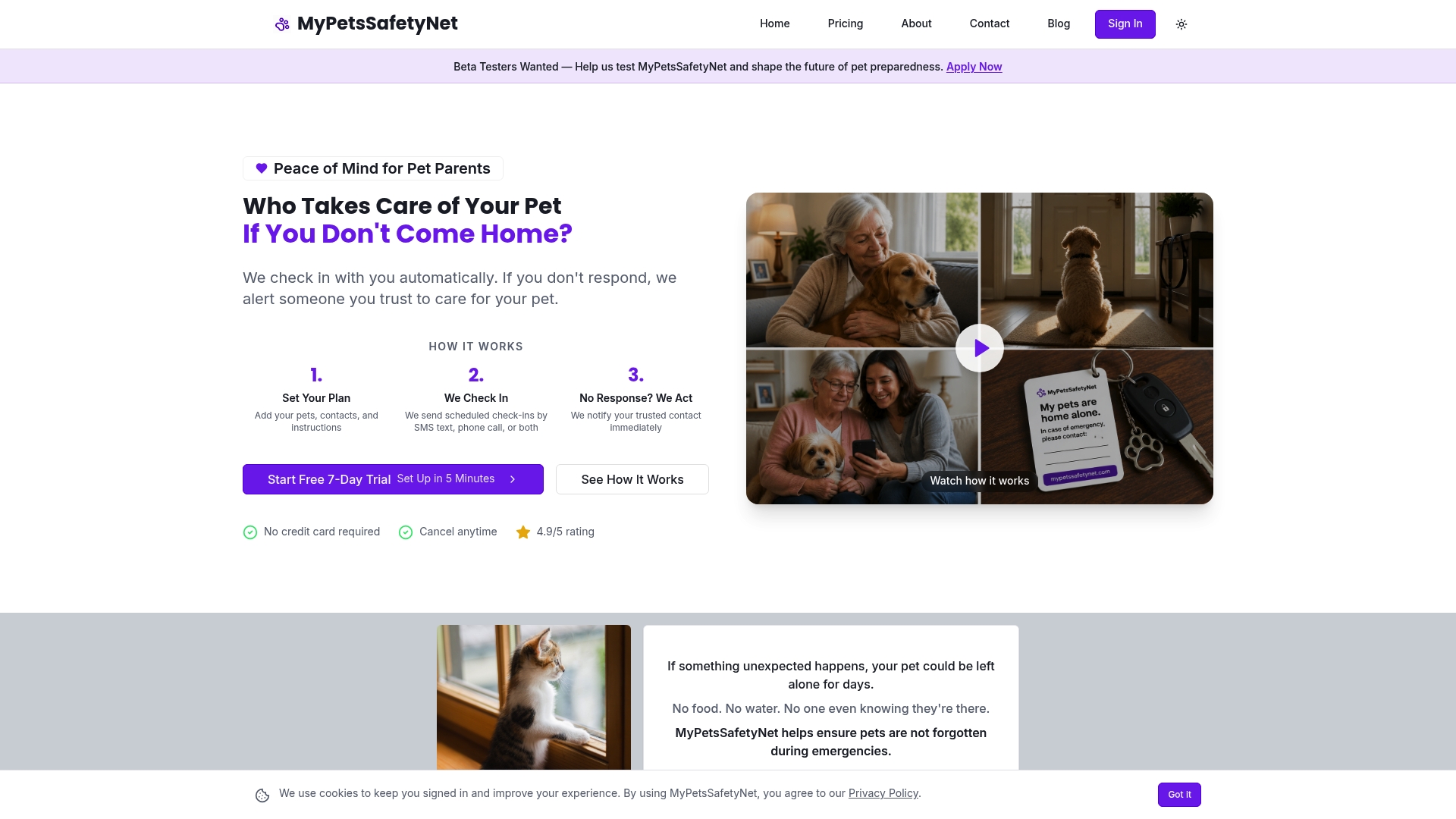
That is why we built MyPetsSafetyNet around a simple check-in. You choose a schedule and we reach out by text, phone call or email. If you don’t respond, our escalation workflow notifies your emergency contacts and sends them your pet’s care details, so they can check on you and your pets.
We designed it for people who don’t want to depend on a smartphone. It works with any phone through SMS or calls. We focus on pets, not just personal safety, and our alerts go to the caregivers you named, not to emergency services.
The checklist in this article and a check-in service work best together: the checklist tells your people what to do, and the check-in tells them when.
MyPetsSafetyNet
Put your plan on autopilot
MyPetsSafetyNet sends scheduled check-ins by SMS, phone or email. If you don’t respond within the countdown you set, your emergency contacts get notified with your pets’ full care instructions. You can store up to 5 pets and 3 emergency contacts, and generate a pet care instruction card. Setup is designed to take less than 10 minutes, and there is a 7-day free trial with no credit card required. The Monthly plan is $6.99 per month.
You can also read how living alone changes your pet care plan, or see the full emergency pet care plan.
Part 6: Keep the plan current
A plan from three years ago may point to a vet who has retired or a phone number nobody answers. The DARE Pet Promise Kit says to review the pet-care file once a year and whenever a vet, medication or phone number changes.
Your yearly review:
- Call each caregiver and confirm they are still willing
- Update medications, doses and vaccination records
- Replace the photo if your pet has changed
- Check tags and microchip registry details. The AVMA recommends keeping identification and microchip information current, and a caregiver can be an alternate registry contact
- Rotate food and medicine in the go-bag
- Reprint the contact sheet and pet-alert card
If you may someday move into senior living, read about pet-friendly care facilities early, since options vary.
The full checklist at a glance
| Area | Do this | Done |
|---|---|---|
| Home | Clear walkways, secure rugs, add nightlights, gate stairs | ☐ |
| Daily care | Automatic feeder, adaptive tools, daily checklist | ☐ |
| Papers | Pet portfolio, vaccination and vet records | ☐ |
| People | Temporary caregiver, guardian, neighbor buddy | ☐ |
| Visibility | Wallet alert card, door notice, contact sheet | ☐ |
| Supplies | Go-bag, carrier, rotated food and medicine | ☐ |
| Alerting | A check-in that tells caregivers when to step in | ☐ |
| Review | Once a year and after any change | ☐ |
FAQ
What should be on an aging in place with pets checklist?
It should cover a safer home, easier daily care, a pet portfolio, named caregivers and a way to alert them. Add a yearly review so the details stay accurate.
Who should I name as my pet’s emergency caregiver?
Choose someone who lives close, can get into your home and has agreed to help. The ASPCA says temporary and permanent caregivers can be different people. Name backups too.
How many emergency contacts do I need?
The ASPCA suggests two on your pet-alert card. MyPetsSafetyNet lets you add up to 3 emergency contacts, so you can cover more than one person.
Do I need a smartphone for a check-in service?
Not with MyPetsSafetyNet. It works with any phone by SMS or call, and you can set the schedule and countdown to suit your routine.
Sources
- Essential Tips for Pet-Proofing Your Home, AAHA
- Senior Care Kits, AAHA
- Creating a Comfortable Home for Your Mobility Compromised Dog, VCA
- 3 ASPCA Verified Pet Safe Houseplants for Cats and Dogs, The Plant Seed
- Make Caring for Pets Easier on Your Joints, Arthritis Foundation
- Pet Care Strategies, Adaptive Pet Strategies
- Making a Plan for Your Pet, ASPCA
- Aging in place with pets resource guide, University of Pittsburgh
- Pet Emergency and Disaster Preparedness, Best Friends Animal Society
- Plan for Pets, Humane Rescue Alliance
- Pet Emergency Preparedness, Oklahoma State University Extension
- Ensuring your pet is protected when you’re away, AVMA
- Disaster Preparedness, ASPCA
- Be Prepared: Pet Safety in Emergencies, CDC
- Pets and disasters, AVMA
- DARE Pet Promise Kit