PetProsVT Alternatives for Solo Pet Owners

If you’re a solo pet owner searching for petprosvt.com alternatives, the clearest answer is Mypetssafetynet. It’s the only option purpose-built for what you actually need: automated wellness check-ins that escalate to your emergency contacts, with full pet care instructions, when you don’t respond.
Here’s why it stands apart from every other approach:
- 24/7 automated escalation via SMS, phone, or email, with no human scheduler required
- Configurable emergency contacts (up to 3) who receive your pet’s care details automatically
- Pet profiles for up to 5 pets, including feeding, medication, and care instructions
- Free trial available, so you can test the full escalation path before committing
You can start a free trial today and have your first check-in configured in under an hour.
Table of Contents
- What are the real petprosvt.com alternatives for solo owners?
- How do you decide which alternative fits your situation?
- What does setup actually look like, and what will it cost?
- Why Mypetssafetynet is the recommended alternative
- Key Takeaways
- Why we recommend this approach for solo owners
- Ready to protect your pets with a free trial?
- Sources and further reading
What are the real petprosvt.com alternatives for solo owners?
PetProsVT (Green Mountain Pet Professionals) is a local, in-person pet care service based in Underhill, VT. It offers drop-in visits, dog walking, and home care during scheduled windows. That’s genuinely useful, but it’s not designed to monitor whether you are okay or to alert anyone if you’re incapacitated. For solo owners, that gap matters.

The table below maps the five main approaches that people consider when looking for similar sites or services.
| Approach | Best for | 24/7 emergency escalation | Requires physical presence | Geographic coverage | Typical cost | Setup time | Reliability signals |
|---|---|---|---|---|---|---|---|
| Automated wellness check-in service (e.g., Mypetssafetynet) | Solo owners needing owner-incapacity alerts | Yes, automated | No | US and Canada | Monthly subscription; free trial | Minutes to configure | Published escalation workflow, subscription model, support contact |
| Smart-monitoring devices (cameras, feeders) | Observing pets remotely | No escalation to humans | No (device only) | Anywhere with Wi-Fi | Device cost + app fee | Hours (hardware setup) | Brand reputation, app reviews |
| Local in-person care (drop-in sitters/walkers) | Scheduled physical pet care | No automated escalation | Yes | Local/regional only | Per-visit or hourly; travel fees may apply | Days (vetting, scheduling) | Reviews, verification, references |
| Community fallback (neighbors, volunteers) | Low-cost backup care | No formal escalation | Yes | Hyper-local | Free or informal | Variable | Informal; no documented workflow |
| DIY emergency plan (printed cards, manual contacts) | Baseline documentation | No automation | No | Anywhere | Free | Hours to days | Depends entirely on owner follow-through |
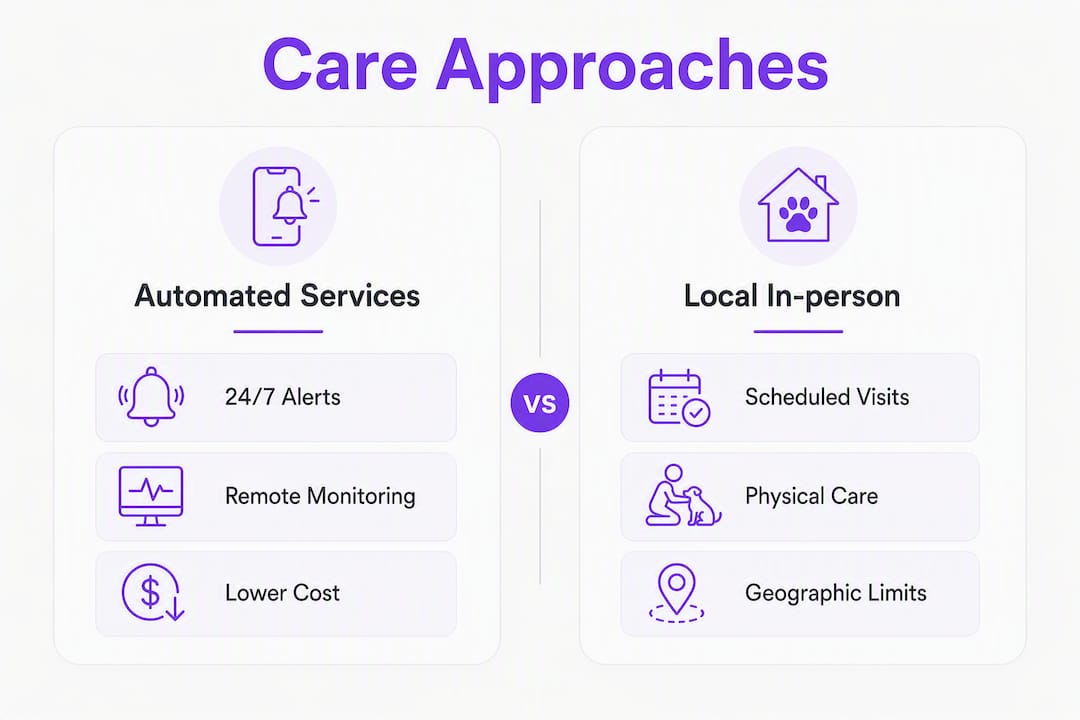
Automated wellness check-in services are the only category that actively monitors you and escalates without requiring you to be conscious or communicative. Automated check-ins preserve continuity of care even when no sitter is scheduled.
Local in-person care covers physical needs during scheduled visits but operates on fixed routes and geographic zones, with no mechanism to detect an owner emergency between visits.
Smart devices let you watch your pet remotely but don’t alert anyone if you stop checking in. Directories and marketplaces connect you to local caregivers, which is helpful for routine care, but they aren’t engineered to escalate automatically. B2B pet business software manages bookings and invoicing for pet professionals and has no relevance to a solo owner’s emergency plan. Major pet retailers sell supplies, not emergency monitoring.
How do you decide which alternative fits your situation?
Start with one rule: if you live alone, automated escalation is non-negotiable. A neighbor who “checks in sometimes” or a sitter who visits Tuesday and Friday can’t help if something happens to you on Wednesday night.
Ask yourself these questions before choosing:
Does this option alert someone if I stop responding? If the answer is no, it can’t serve as your primary safety net. It can supplement, but not replace, an automated system.
Who receives the alert, and what information do they get? A vague “something’s wrong” message isn’t enough. Your emergency contacts need your pet’s feeding schedule, medication details, and vet contact. Formal escalation protocols deliver that automatically.
What’s the coverage gap? Local sitters cover scheduled windows. Smart cameras show you what’s happening but don’t call anyone. Community favors are unreliable under pressure. Many owners trust informal arrangements until an emergency proves those arrangements weren’t documented or tested.
Red flags to avoid:
- No published escalation workflow
- Unclear or no free trial policy
- Only one emergency contact allowed
- No documented support hours or contact method
Pro Tip: The most resilient plan layers an automated check-in service as your primary safety net with a named local contact for hands-on care. Neither alone covers everything a solo owner needs.
What does setup actually look like, and what will it cost?
Onboarding an automated wellness check-in service is faster than most people expect. Here’s a realistic timeline:
- Create your account and start the free trial (5 minutes). No payment required upfront.
- Build your pet profiles (10–15 minutes per pet). Include feeding schedule, medications, vet name and number, and any behavioral notes.
- Add emergency contacts (5 minutes). Name up to 3 contacts and specify how each should be reached: SMS, phone call, or email.
- Configure your check-in cadence (5 minutes). Set how often you want to check in and how long the system waits before escalating.
- Run a live test within 24–72 hours. Simulate a missed check-in and confirm your contacts receive the alert and the pet care details. This step is critical and often skipped.
Pricing follows a monthly subscription model. A free trial lets you validate the full escalation path before any charge. Local sitters, by contrast, typically charge per visit and may add travel fees depending on your distance from their service area.
For a complete emergency planning document to pair with your setup, Mypetssafetynet’s blog has a step-by-step template.
Why Mypetssafetynet is the recommended alternative
Mypetssafetynet was built specifically for the scenario PetProsVT and similar local services don’t address: what happens to your pets if you have a medical emergency and no one knows?
The service delivers:
- Scheduled wellness check-ins by SMS, phone, or email, on a cadence you control
- Automated escalation when you don’t respond, with no manual intervention required
- Pet care instruction cards sent to emergency contacts so they know exactly what your pets need
- Support for up to 5 pets and 3 emergency contacts per account
- US and Canada coverage, with no geographic restrictions tied to a sitter’s route
- A free trial so you can test every feature before subscribing
- Published guides and blog resources covering emergency planning, escalation workflows, and solo-owner pet care
Unlike local pet care services that depend on scheduled visits and physical proximity, Mypetssafetynet operates digitally and continuously. Unlike smart cameras, it doesn’t just observe; it acts. The emergency check-in overview on the site walks through exactly how the escalation path works, which is worth reading before your first test.
For solo owners who want to understand the broader responsibility question, the guide on who checks on pets if an owner is hospitalized addresses it directly.
Key Takeaways
For solo pet owners, automated escalation is the single feature that separates a genuine safety net from a convenience service, and Mypetssafetynet is the only option in this comparison that delivers it fully.
| Point | Details |
|---|---|
| Automated escalation first | Choose a service that alerts contacts automatically; no other approach covers an owner emergency reliably. |
| Layer your plan | Pair an automated check-in service with a named local contact for physical care needs. |
| Test before you trust | Run a live missed-check-in simulation within 72 hours of setup to confirm contacts receive alerts and pet details. |
| Local services have limits | Drop-in sitters and directories provide scheduled care but cannot monitor owner wellness or escalate automatically. |
| Mypetssafetynet | Covers up to 5 pets and 3 emergency contacts with SMS, phone, and email escalation across the US and Canada. |
Why we recommend this approach for solo owners
The conventional advice for solo pet owners is to “find a trusted neighbor.” That’s not wrong, but it’s incomplete. Neighbors aren’t on call. They don’t have your vet’s number or your cat’s medication schedule memorized. And if you’re unconscious, they won’t know to check on you at all.
Automated escalation changes that equation. It removes the dependency on someone remembering to check and replaces it with a system that acts on your behalf. The published guides and structured escalation workflow behind Mypetssafetynet give us confidence in recommending it: the service documents what it does and how, which is more than most informal alternatives offer.
The heuristic we’d leave you with: if you live alone and care for pets, set up automated escalation first. Then add a local contact as a physical care layer. That combination covers both the monitoring gap and the hands-on care gap that no single solution addresses alone.
Ready to protect your pets with a free trial?
Mypetssafetynet gives solo pet owners something no local sitter or smart camera can: a system that checks on you and alerts your chosen contacts when you don’t respond, complete with your pet’s care instructions already attached.
Starting your trial takes minutes. Here’s what to do:
- Sign up at mypetssafetynet.com and create your account during the free trial period.
- Add your pets and emergency contacts so the system knows who to reach and what your pets need.
- Run a test escalation within the first 72 hours to confirm everything works end to end.
Setup guides and support are available directly on the site. If you have questions about how notifications work, the SMS consent and notification details page explains the process clearly.
Sources and further reading
- Mypetssafetynet: Wellness Check-In for Pet Owners — primary service page covering features, subscription model, and free trial
- Automated Check-Ins and Pet Safety: A 2026 Guide — in-depth guide to how automated wellness check-ins work and how they differ from local care
- Services That Notify Others If You Can’t Care for Your Pet — practical escalation strategies and notification workflow examples
- Emergency Pet Care Plan Every Pet Owner Needs — step-by-step emergency planning guide for solo owners
- Pet Care Emergency Document Essentials — template for creating pet care instruction cards and emergency files
- Who Checks on Pets If Their Owner Is Hospitalized? — answers the escalation responsibility question directly
- Pet Care Network for Singles: Your 2026 Guide — guidance on building a local fallback network alongside automated monitoring
- Green Mountain Pet Professionals (PetProsVT) — local in-person pet care service in Underhill, VT; context for understanding the in-person care model
- Pet Pro Search — industry directory connecting owners to local caregivers; useful for finding scheduled care providers