Pet Care Binder Checklist: What to Include and Why

A pet care binder is one place that holds everything a stranger would need to care for your pets if you couldn’t: identification, vet and medication records, daily routines, contacts, and how to get into your home. This checklist covers each section, what to write in it, and how to make sure the right person finds it quickly.
If you live alone, the binder has one extra job. It has to reach your caregiver at the right moment, which is why we pair it with a check-in system later in this guide.
TL;DR
- A good binder has seven parts: pet identification, health records, daily care, emergency contacts, home access, supplies, and a review date.
- Federal and national guidance points to the same basics: records, photos, feeding and medication instructions, and a two-week supply of food and medicine.
- Write as if the reader knows nothing about your pets. Never assume anything is common knowledge.
- A binder only helps if someone knows it exists and is told to open it. Tell your caregivers where it is, and review it at least twice a year.
- MyPetsSafetyNet notifies your emergency contacts with your pet care details if you don’t respond to a check-in.
Table of Contents
- Why a binder matters most when you live alone
- What to buy and how to organize it
- Section 1: The one-page emergency summary
- Section 2: Pet identification
- Section 3: Health and medication records
- Section 4: Daily care instructions
- Section 5: Emergency contacts and caregivers
- Section 6: Home access and household notes
- Section 7: Supplies and evacuation
- Perspective: why a binder alone isn’t enough
- Make sure your binder gets read
- Put your binder to work with automatic check-ins
- Keep it current: a review schedule
- Quick checklist
- FAQ
- Sources
Why a binder matters most when you live alone
Most pet binder guides are written for vacations: a sitter comes, you leave a list, you come back. An emergency is different. You may be in a hospital, unconscious, or simply unable to call anyone. The person who steps in may be a neighbor or relative who has never fed your cat or walked your dog.
That person needs answers without calling you. What does the dog eat, and how much? Which pill does the cat take, and when? Where is the spare key? Who is the vet? A binder answers all of that in one place.
The binder is also useful on ordinary days. Updating it makes you notice that a vaccination is overdue, that a prescription changed, or that a contact moved away.
What to buy and how to organize it
You don’t need anything fancy. A one-inch three-ring binder, a pack of tab dividers, clear sheet protectors, and a pocket folder for loose papers will do. Use a bright color so it’s easy to spot, and keep it in the same place every time.
The CDC recommends keeping important documents in a waterproof container as part of a pet preparedness kit. Sheet protectors inside a binder, stored in a zip-top bag or a waterproof document box, give you the same protection. See the CDC’s pet disaster preparedness kit guidance for its full list.
A simple tab order works well:
- Emergency summary (one page, on top)
- Pet identification
- Health and medication records
- Daily care instructions
- Contacts and caregivers
- Home access and household notes
- Supplies and evacuation
Section 1: The one-page emergency summary
Put this sheet at the very front. A caregiver who is panicking or in a hurry may read nothing else, so it should stand alone.
- Your name, address, and phone number
- Names, species, and a one-line description of each pet
- The two people to call first
- Your vet’s name and phone number
- A line such as “Pets need food morning and evening. Details in tab 4.”
- Where the spare key and carriers are
The ASPCA suggests carrying a wallet Pet Alert Card listing two emergency contacts and keeping an Emergency Contact Sheet visible at home. The summary page can double as that home sheet. Details are in the ASPCA’s guide to making a plan for your pet.
Section 2: Pet identification
Create one page per pet. If a pet is lost, or if someone must prove which animal is yours, this page does the work.
- Name, species, breed, age or birth date, sex, and weight
- Color and markings, plus anything distinctive such as a scar or a missing tooth
- Microchip number and the registry company that holds it
- License or tag numbers
- A recent, clear photo of the pet, ideally one full body and one face
- A photo of you with the pet, which helps show ownership
The CDC recommends recent photographs of each pet for identification, along with proof of ownership or registration. Replace photos whenever a pet’s appearance changes, such as after a haircut, weight change, or as a puppy grows.
Section 3: Health and medication records
This is the section a vet or boarding facility will ask for. Gather it once and keep copies current.
- Vaccination records, with dates and expiration dates
- Current medications: name, strength, dose, how often, and how it’s given (with food, crushed, as a pill pocket)
- Allergies and sensitivities, including food
- Chronic conditions and past surgeries
- Recent visit notes and test results
- Preventive care such as flea, tick, and heartworm products
- Your vet’s address, phone, and after-hours emergency clinic
The CVMA’s code of practice for cats notes that dated health records support prompt access to care and help identify changes in health. You can read it in the CVMA code of practice for the care of domestic cats. That reasoning applies to dogs and other pets just as well.
Ask your vet’s office for printed or emailed copies of records. Most will provide them at a routine visit.
A note on medications: write down exactly what your vet prescribed. Don’t add dosing advice of your own. If a pet takes insulin or another medication where timing or technique matters, ask your vet to demonstrate it to your caregiver or to write the instructions on the page.
Section 4: Daily care instructions
This section is where most binders are thin. The Helping All Little Things guide to preparing a sitter advises giving caregivers clear, detailed instructions and not assuming anything is common knowledge. What feels obvious to you is not obvious to someone else.
For each pet, cover:
- Feeding: brand and type of food, portion size, times, treats allowed, and foods to avoid
- Water: where bowls are kept, and whether the pet uses a fountain
- Bathroom: how often to walk the dog, which door to use, or how to scoop and change the litter box
- Exercise and play: length of walks, favorite toys, and rules for off-leash time
- Behavior: fears (thunder, vacuum, strangers), triggers, and what calms the pet
- Handling: whether the pet bites, scratches, pulls on the leash, or hides when nervous
- Sleep and routine: where the pet sleeps and when the day usually starts
- Other animals: who gets along with whom, and who must be fed separately
The CDC specifically lists feeding instructions for each animal and medication instructions where applicable, so those two lines are non-negotiable.
Write the routine as a schedule
A caregiver under stress follows a timeline more easily than a paragraph. Try this format:
| Time | Task | Notes |
|---|---|---|
| 7:00 a.m. | Feed Biscuit, 1 cup | Slow-feeder bowl; no treats before walk |
| 7:30 a.m. | 20-minute walk | Left out the front door; avoid the dog next door |
| 12:00 p.m. | Let out | Back door; fenced yard |
| 6:00 p.m. | Feed Biscuit, 1 cup | Heart pill hidden in cheese |
| 9:30 p.m. | Final bathroom break | Sleeps in crate in bedroom |
The example is made up, but the structure works for any pet. Make one table per animal.
Section 5: Emergency contacts and caregivers
The ASPCA recommends listing two emergency contacts and choosing caregivers who can step in if needed. It also suggests confirming from time to time that they are still willing and able. People move, change jobs, and have their own emergencies.
For each person, record:
- Full name, relationship to you, and phone numbers
- Address and how far they live from you
- Whether they have a key or access code
- Their role: first call, primary caregiver, backup, or vet liaison
- Whether they’ve met your pets
Splitting roles helps. One person may be able to check on the home within the hour but can’t take a dog for two weeks, while another can host the pets long term. Our guide to pet caregiver roles walks through five assignments you can give. If you’re deciding who to name, pet emergency contacts covers how many to list and how to prepare them.
If a caregiver has never met your pets, arrange an introduction now. See introducing your pet to a caregiver for ways to do it.

Add a written authorization
Some local animal agencies offer forms that cover the case where your contacts can’t be reached. The City of Cincinnati’s Emergency CARE Plan, for example, includes an Emergency Pet Authorization form that can allow local agencies to enter the home and take temporary custody if your emergency contacts cannot retrieve the animals. See the Emergency CARE Plan for how one community handles it. Check whether your own city or county animal services offers something similar.
If you want a longer-term backup, it also helps to know your options in advance, including pet surrender and rehoming options that some local pet care providers offer. Knowing who to call and what they require makes a hard situation less chaotic.
Section 6: Home access and household notes
A caregiver who can’t get in or can’t figure out the house can’t help your pets. The Helping All Little Things guide suggests explaining keys, alarm codes, and tricky locks, and showing where cleaning supplies are kept.
Include:
- Which key opens which door, and where the spare is kept
- Alarm code and how to disarm it (consider writing the code only in a sealed envelope)
- Building entry details: gate codes, doorman or landlord contact, elevator quirks
- Parking and the best entrance
- Where food, leashes, carriers, medications, waste bags, and cleaning supplies are
- Trash day, litter disposal, and how to work the thermostat
- Any hazards: a door that doesn’t latch, a window that opens, a dog-reactive neighbor
Apartment dwellers have extra hurdles such as front desk rules, buzzer codes, and landlord permission. Our articles on an apartment emergency plan for pets and an apartment pet access plan cover those in more depth.
Section 7: Supplies and evacuation
The CDC recommends a two-week supply of pet food, water, and medications in an emergency kit. For a binder, that means listing where the supplies are, not just keeping them.
- Location of the emergency kit, with a short list of what’s inside
- Carriers, crates, leashes, and collars, one per animal
- Veterinary records copy in a waterproof bag
- Pet-friendly places to stay
The American Red Cross advises identifying hotels and motels along your evacuation route that accept pets, and calling ahead if you might need to evacuate. Its pet disaster preparedness guidance also suggests including pets in evacuation drills so they get used to entering and traveling in carriers calmly. A pet who already knows the carrier is far easier for a stranger to move.
For federal preparedness basics, FEMA’s Prepare Your Pets for Disasters is a short, free reference.
Perspective: why a binder alone isn’t enough
We built MyPetsSafetyNet around one question: what happens to your pets if something happens to you and no one knows?
A binder is the right first step, and we encourage every owner to make one. But a binder has a weak point for people who live alone. It sits on a shelf until someone knows to look for it. If you’re hospitalized or can’t call for help, days may pass before anyone notices.
That’s why we designed our service around the moment of silence. You set a check-in schedule by text, phone call, or email. If you don’t respond within your countdown, we escalate and notify your emergency contacts, along with the pet care details you’ve entered, so they can check on you and your pets. It doesn’t require a smartphone. It works with any phone.
We focus on pet care, not just personal safety, and we send instructions to the caregivers you’ve named rather than to emergency services. Think of your binder as the full record and our service as the way it reaches the right people in time.
MyPetsSafetyNet
Make sure your binder gets read
The best-organized binder fails if no one knows it exists. Take these steps once it’s built:
- Tell your contacts where it is. Show them the shelf, and say what the tab colors mean.
- Put a note on the front door or fridge. A sticker or card inside your home that says “Pets inside: see binder, contacts on the fridge” helps first responders and neighbors.
- Carry a wallet card. It should say you have pets at home and list two contacts, as the ASPCA suggests.
- Send digital copies. Photograph or scan the pages and share them with your caregivers.
- Set up an automatic trigger. A scheduled check-in means someone is alerted without you having to do anything.
Our guides on what happens to your pets if you’re hospitalized and pet care if you can’t get home show how these steps play out in real situations. For a broader look at paperwork, see our pet care emergency document essentials and the overview of an emergency pet care plan.
Put your binder to work with automatic check-ins
MyPetsSafetyNet is an automated wellness check-in service for pet owners. You choose how often we contact you by SMS, phone, or email. If you don’t respond, we follow your escalation steps and notify your emergency contacts with your pets’ care details. You can add up to 5 pets and up to 3 emergency contacts, set your own countdown intervals, and create a pet care instruction card to share.
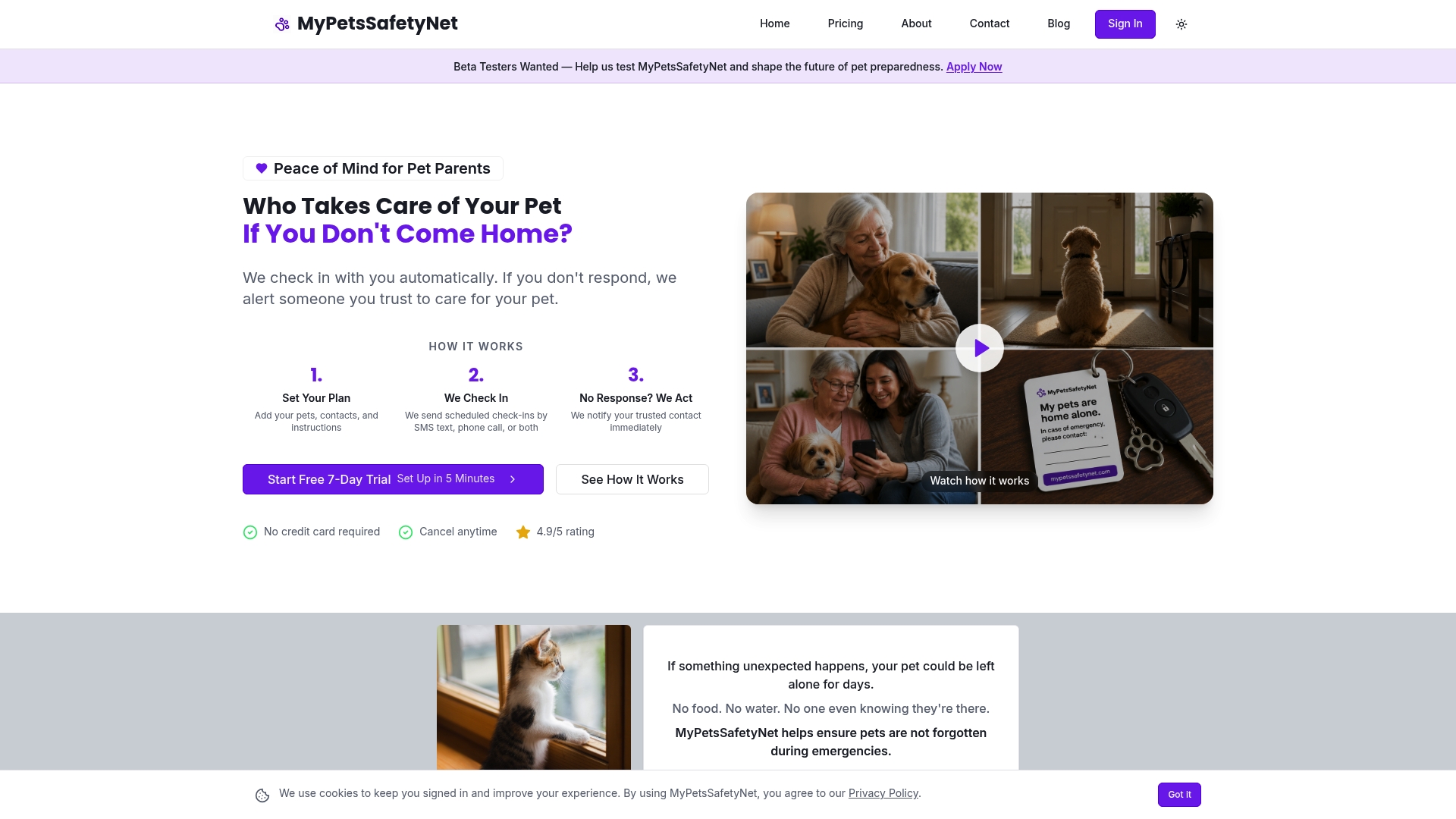
Our setup is designed to take less than 10 minutes, and the details you’ve gathered for your binder map directly onto the profile fields. The plan is $6.99 per month, and you can start with a 7-day free trial with no credit card required. Learn more at MyPetsSafetyNet.
Keep it current: a review schedule
FEMA advises reviewing pet emergency kits regularly so their contents stay fresh. The same applies to the binder. FEMA doesn’t set a schedule for paperwork, so pick one you’ll keep. Many owners find these triggers easy to remember:
- Twice a year: a fixed pair of dates, such as when the clocks change
- After every vet visit: add new records and medication changes
- After any change: new pet, new address, new phone number, a pet’s death
- When a contact’s situation changes: a move, a new baby, a job change
- Each year: replace photos and confirm that caregivers are still willing
Write a “last reviewed” date on the front page. A caregiver who sees a recent date trusts the contents.
Quick checklist
Print this and tick it off as you go.
- [ ] Binder, dividers, sheet protectors, and waterproof container
- [ ] One-page emergency summary at the front
- [ ] Identification page and recent photos for each pet
- [ ] Microchip number and registry
- [ ] Vaccination records and vet contact
- [ ] Medication names, strengths, doses, and schedules
- [ ] Allergies, conditions, and recent test results
- [ ] Feeding, bathroom, exercise, and behavior notes
- [ ] Two or more emergency contacts, with roles
- [ ] Keys, codes, building access, and supply locations
- [ ] Emergency kit with a two-week supply
- [ ] Pet-friendly lodging options
- [ ] Contacts told where the binder is
- [ ] Last reviewed date and next review date
FAQ
What is the most important page in a pet care binder?
The one-page emergency summary at the front. It tells a caregiver who to call, what each pet needs first, and where to find the rest. If someone reads only one page, make it that one.
Should I keep the binder digital, on paper, or both?
Both. Paper works when power or internet is down, and a waterproof container protects it. A digital copy shared with your caregivers means they can read it before they arrive at your home.
How many emergency contacts should I list?
The ASPCA recommends listing two emergency contacts and choosing caregivers who can step in if needed. Many solo owners add a third so someone is likely to answer. Confirm each person is willing, and check again from time to time.
How is a binder different from MyPetsSafetyNet?
The binder holds the details. MyPetsSafetyNet is designed to get those details to your emergency contacts if you miss a check-in. They work best together.
Do I need a binder if I only have one cat?
Yes. A single pet still needs feeding instructions, a vet contact, and someone who knows how to get into your home. A shorter binder is fine. The sections are the same.
Sources
- CDC: Build a Pet Disaster Preparedness Kit
- American Red Cross: Pet Disaster Preparedness and Recovery
- ASPCA: Making a Plan for Your Pet
- FEMA: Prepare Your Pets for Disasters
- Cincinnati Animal CARE: Emergency CARE Plan
- CVMA: Code of Practice for the Care of Domestic Cats
- Helping All Little Things: Preparing a Sitter to Care for Your Pets