Exotic Pet Care Instructions: Write Them So Anyone Can Step In

Good exotic pet care instructions are written for a stranger: someone who has never fed your ferret, lifted your rabbit or seen your guinea pig act normal. They name the species-specific diet, handling, medication and warning signs, and they reach your backup caregiver at the moment you can’t act. If you live alone, that last part matters as much as the writing. We built MyPetsSafetyNet so that if you miss a check-in, your emergency contacts are notified with your pets’ full care details.
This guide shows what to put in the instructions for rabbits, guinea pigs and ferrets, which emergency signs to list, and how to make sure the right person sees the page when it counts.
TL;DR
- Write for someone who has never met your pet: diet amounts, handling, medicines with exact label directions, vet and emergency clinic details, and who may approve and pay for care.
- Rabbits, guinea pigs and ferrets differ sharply. Rabbits and guinea pigs live on hay; ferrets are carnivores. Guinea pigs also need vitamin C every day.
- List the emergency signs for each species, and tell your caregiver to call a vet before giving any home treatment.
- Instructions only help if someone gets them. Name backup caregivers, keep copies where they can find them, and automate the alert for the day you can’t make the call.
- Review the sheet on a schedule, and any time a medication, vet or contact changes.
Table of Contents
- Why exotic pets need their own instructions
- What every exotic pet care sheet should include
- Rabbit care instructions for a backup caregiver
- Guinea pig care instructions for a backup caregiver
- Ferret care instructions for a backup caregiver
- At a glance: three species, three sets of instructions
- Medications, payment and who can approve care
- Build your backup plan in five steps
- The gap most plans leave open: who tells your caregiver?
- How MyPetsSafetyNet delivers your instructions
- Our perspective
- FAQ
- Sources
Why exotic pets need their own instructions
A neighbor can usually walk a dog or scoop a cat’s bowl with a few words of guidance. Rabbits, guinea pigs and ferrets are different. Each species has its own space, bedding and enrichment needs. For example, one exotic pet medical center advises avoiding cedar or pine shavings in small-mammal housing because they can irritate the respiratory system. A well-meaning helper who grabs the wrong bag of bedding or the wrong pellets can cause harm without knowing it.
Exotic pets are also harder to place in a hurry. Not every clinic sees them, and a caregiver in a crisis has no time to find out which one does. Everything your helper needs should be on the page before they ever need it.
That is the idea behind care instructions: they replace everything you would say if you could pick up the phone.
What every exotic pet care sheet should include
Start with what applies to all species. Veterinary and rescue organizations agree on a core set of items. A veterinary emergency-preparedness handout for exotic pets recommends a designated family member or neighbor buddy, written veterinary authorization, emergency contacts, records, medicines, food and water, bowls, a first-aid kit and photographs. The University of Florida’s veterinary hospital likewise recommends both digital and paper medical records, a contact list that includes your veterinarian and a backup caregiver, and current identification and photos.
Turn that into a checklist:
- Identity: species, name, age, sex, color markings, a clear recent photo, and microchip number if your pet has one.
- Your vet and an emergency option: names, phone numbers and addresses for your regular exotics veterinarian and the nearest clinic that actually accepts your species.
- Who decides: which contact may approve treatment, who may transport your pet, and who may enter your home and how.
- Diet: exact foods, amounts and feeding times, plus foods that are never to be given.
- Medications: name, dose, timing, how it is given and where it is stored.
- Housing: cage or enclosure setup, bedding type, cleaning routine, temperature needs.
- Handling: how your pet likes to be held, what frightens it, whether it bites when startled.
- Supplies: where the carrier, food, hay, litter and first-aid kit are kept.
For documents beyond the care sheet, our guide to pet care emergency document essentials walks through what to gather and where to keep it.
Rabbit care instructions for a backup caregiver
Rabbits are the easiest species to get wrong by being kind. A caregiver may offer treats or fruit and reduce the hay, so spell out the proportions.
Diet. Oxbow’s published feeding breakdown for rabbits and guinea pigs puts uniform pellets at 20% of the daily diet, unlimited grass hay at 70%, fresh greens at 8% and treats at up to 2%. Write the actual daily amounts your vet has set for your rabbit, then add one line: hay is always available.

Handling. A rabbit’s spine is delicate. Veterinary guidance says to support the hindquarters to prevent spinal injury, and a UC Davis shelter brochure says to support the back and never lift a rabbit by the ears. If your rabbit dislikes being picked up, say so and tell the caregiver to leave it in the enclosure when possible.
What normal looks like. Note your rabbit’s usual appetite, how many droppings it leaves each day and when it is most active. A caregiver cannot spot a change without a baseline.
Emergency signs to list. UC Davis lists these as emergencies in rabbits: loss of appetite, reduced stool, weakness or depression, pain, head tilt, rolling or flipping. Put them on the sheet in your own words, with the clinic number beside them.
Guinea pig care instructions for a backup caregiver
Guinea pigs share the hay-heavy diet of rabbits, with one extra rule that belongs in bold on the page.
Vitamin C. Guinea pigs have an absolute vitamin C requirement. A Colorado State University Extension pocket pet manual notes that cabbage and kale are vitamin C-rich supplements, and that guinea pigs should eat guinea pig food, not rabbit, hamster or gerbil pellets. A caregiver who finds the wrong bag in your pantry should not use it. List the exact brand, the daily vegetables and how much of each, and say that vitamin C supplementation is only ever to follow your vet’s instructions, since additional supplementation may be necessary for some animals.
Handling. The same shelter brochure describes holding a guinea pig with one hand supporting the chest and the other the hind end. Veterinary guidance adds that they should be handled gently and close to the ground to prevent falls.
Emergency signs to list. The same signs as rabbits apply: loss of appetite, decreased stool, weakness, pain when touched, head tilt, rolling or flipping. If a guinea pig stops eating, your caregiver should treat it as urgent and call the vet rather than waiting to see if it passes.
If you keep more than one small animal, our multi-pet care plan guide shows how to keep each animal’s instructions separate and clear.
Ferret care instructions for a backup caregiver
Ferrets need a very different page. They are carnivores, so nothing written for rabbits or guinea pigs carries over.
Diet. Oxbow’s guidance puts uniform food at 80% of a ferret’s daily diet, with kibble of at least 40% protein and 20% fat. The Colorado State manual says ferrets are fed twice a day or have dry food available all day, and moist food should not stay in the cage because it spoils quickly. Write down which you do, and where the fresh food is.
Temperament. The same manual notes ferrets can be startled by noise or sudden movements and may bite in self-defense because of poor eyesight. Tell your caregiver to speak first, move slowly and hold a wriggly ferret firmly but without squeezing. If yours has a history of nipping, say so plainly.
Vaccines. The manual says ferrets are susceptible to distemper and should get an annual vaccine, and some veterinarians give rabies vaccine at the same visit. Put your ferret’s vaccine dates in the records you leave.
Emergency signs to list. For ferrets, UC Davis lists diarrhea, vomiting, pawing at the mouth, little or no urine despite repeated litter box trips, abdominal pain, depression and lack of appetite. The Merck Veterinary Manual adds difficulty or shallow breathing, seizures, extreme lethargy, choking, heavy bleeding, severe pain, and straining without urinating or defecating, and says failure to eat or drink for 24 hours, bloody urine, uncontrollable bloody or foul-smelling diarrhea, or thick black stools also need immediate veterinary attention.
At a glance: three species, three sets of instructions
| Rabbit | Guinea pig | Ferret | |
|---|---|---|---|
| Diet base | Unlimited grass hay, a measured portion of pellets, fresh greens | Unlimited grass hay, guinea pig pellets, fresh greens | Meat-based ferret kibble, fed twice a day or available all day |
| Special rule | Treats stay small | Daily vitamin C from vegetables | Remove moist food that can spoil |
| Handling | Support the back and hindquarters, never lift by the ears | Chest in one hand, hind end in the other, stay low | Firm hold without squeezing, expect startle biting |
| Urgent signs | No appetite, fewer droppings, head tilt, rolling | No appetite, fewer droppings, weakness, pain | Little or no urine, vomiting, breathing trouble, no food or water for 24 hours |
Use this only as a prompt. Your own vet’s directions for your animal always come first.
Medications, payment and who can approve care
This is the part of a care sheet that is skipped most often, and the part a caregiver needs most in a real emergency.
Medications. Write each medicine’s name, dose, timing and where it is kept, using the exact directions on the label. Technique matters: VCA Animal Hospitals’ guidance on giving medications and feedings to small mammals describes different oral-syringe placement for ferrets than for rabbits and guinea pigs. Ask your vet to show your caregiver how, or write down what your vet showed you. A caregiver should never improvise a dose.
Home treatment. Veterinary guidance is clear that you should not give an exotic pet at-home treatment without first seeking veterinary advice. Put that sentence on the sheet. The same goes for feeding problems: if your household includes fish, a guide on fish that stop eating shows what to try before reaching for a remedy, and the principle holds for every species you keep. Understand the cause first, then act.
Authorization and payment. A caregiver who is not you may not be allowed to approve treatment on the spot. Ask your veterinary practice ahead of time what written authorization and payment arrangements it accepts, and file that paperwork. Then state on the sheet who may approve care, who may transport your pet, and how the bill will be paid.
Calling ahead. UC Davis’s exotics emergency service asks owners to call the exotics care team before arriving, and its hours are limited. Many clinics work the same way. Find your nearest emergency option for exotic pets now, confirm it sees your species, and put its number at the top of the page.

Build your backup plan in five steps
The research on emergency planning for people who live alone points the same direction. Veterinary and animal welfare groups recommend choosing local contacts who can reach your home quickly, keeping a two-week supply of food, medications and supplies where those contacts know to look, and writing detailed instructions on diet, routines and behavior. Here is how to do it.
- Choose your people. Pick at least two caregivers, ideally a neighbor who can arrive fast and a relative or friend as backup. Our guide to pet caregiver roles shows how to split the jobs between them: who checks on you, who takes the pets, who talks to the vet.
- Write one sheet per species. Use the sections above. Keep sentences short and literal. Instead of feed him normally, write the food, the amount and the time.
- Stock supplies. A veterinary preparedness handout recommends at least a week of food and water and a two-week medication supply for each pet. Keep a carrier, bowls, a first-aid kit and recent photos with it.
- Make the home ready. Tell contacts how to get in and where everything is. Our guide on preparing your home for pet caregivers covers access, supplies and signage.
- Keep paper and digital copies. The University of Florida checklist recommends both, and a power outage is exactly when you will want paper. Our piece on keeping digital and paper pet plans explains why.
The ASPCA also suggests a wallet card listing two emergency contacts, a visible contact sheet, and a portfolio with habits, food preferences, conditions, medications and records, shared with everyone in the pet’s care circle. For complicated or expensive pets such as exotics, it suggests considering a pet trust.
The gap most plans leave open: who tells your caregiver?
A perfect care sheet in a drawer does nothing if you collapse in the kitchen on Tuesday and nobody knows. The people who are best prepared are often the ones who live alone, and for them the weak point is not the writing. It is the delay between something happening to you and someone noticing.
A plan for a solo owner needs three things in sequence: a regular signal that you are fine, a defined moment when silence becomes a concern, and a message that reaches your contacts with your pets’ details attached. If you are interested in the broader picture of what happens when an owner is suddenly unavailable, see what happens to your pets if you’re hospitalized.
How MyPetsSafetyNet delivers your instructions
MyPetsSafetyNet is an automated wellness check-in service for pet owners. It sends you scheduled messages by SMS, phone call or email. If you don’t respond, it follows an escalation workflow with countdown intervals you set, then notifies your emergency contacts with your full pet care details.
Here is what that means for your rabbit, guinea pig or ferret:
- Pet profiles and care instructions live in the service for up to 5 pets, so a ferret and two guinea pigs can each have their own diet, handling and medication notes.
- Up to 3 emergency contacts receive the notification, so the neighbor and the relative both know to act.
- A care instruction card generator turns your entries into a clear card you can print and keep with your supplies.
- No smartphone required. Check-ins work with any phone through SMS or calls.
- Setup takes less than 10 minutes, with customizable schedules and intervals.
The Monthly plan is $6.99 per month, and there is a 7-day free trial with no credit card required. You can see the details on the pricing page.
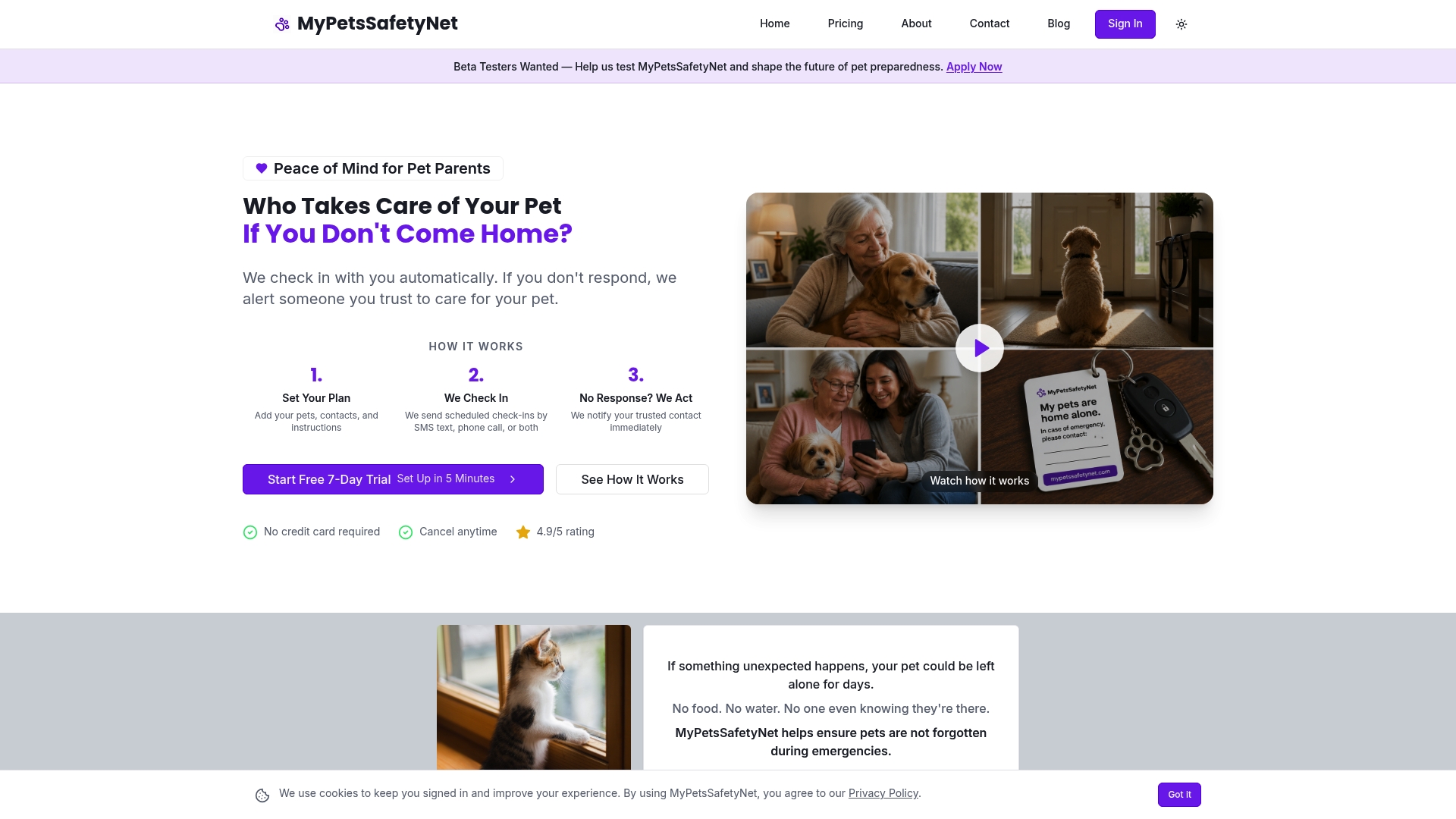
To see how contacts are kept in the loop, read how automatic check-ins keep emergency contacts reachable. If you want a quicker start, our pet emergency plan in under 10 minutes shows the steps.
Our perspective
Most exotic pet owners we hear about already know their animals well. What they lack is a way to get that knowledge out of their heads and into someone else’s hands at the right moment.
That is why we focus on pet care specifically, not just personal safety. A check-in that only alerts a contact tells them something is wrong. A check-in that also hands them your ferret’s feeding schedule, your guinea pig’s vegetables and your rabbit’s vet details tells them what to do.
We also built it so that anyone can use it. You don’t need a smartphone. A text or a phone call is enough, and the instructions go to the named caregivers you chose, with the details you wrote yourself.
Calm planning beats panic. Write the sheet once, set your schedule, and let the plan work in the background.
MyPetsSafetyNet
FAQ
How often should I update my exotic pet’s care instructions?
Review them on a schedule you will keep, and update them whenever a medication, diet, vet or contact changes. Also update after any vet visit that changes your pet’s routine. Keep the last-reviewed date at the top of the sheet so caregivers know it is current.
Can a neighbor with no exotic pet experience look after a rabbit, guinea pig or ferret?
Yes, for a short time, if your instructions are specific and the supplies are ready. Write exact foods, amounts, handling steps and warning signs, and name a second contact. For anything beyond routine feeding, the instruction is to call the vet before giving any treatment.
What should I do if my rabbit or guinea pig stops eating while I’m away?
Treat it as urgent. Loss of appetite and reduced droppings are listed by UC Davis among the conditions that generally warrant immediate emergency care in rabbits and guinea pigs. Your sheet should tell the caregiver to call your exotics vet or emergency clinic right away.
Do I need a different plan for each species?
You need a different care sheet for each species, because the diet, handling and warning signs differ. The emergency contacts, vet details and authorization can be shared across all your pets. A service that holds up to 5 pet profiles lets each animal keep its own instructions under one plan.
Sources
- Emergency Preparedness Plan for Exotic Pets (Lafeber)
- Hurricane Checklist for Companion Animals (University of Florida)
- Small Mammal FAQ (Tree of Life Exotic Pet Medical Center)
- Fortified Foods (Oxbow Animal Health)
- Pocket Pet Manual (Colorado State University Extension)
- Exotic small mammals (UC Davis shelter brochure)
- Exotic Pet Care 101: Housing, Diet, and Safe Handling
- Giving Medications and Feedings to Rabbits and Other Small Mammals (VCA Animal Hospitals)
- New Emergency Service Established for Companion Exotic Pets (UC Davis)
- Emergencies of Ferrets (Merck Veterinary Manual)
- Pet Emergency and Disaster Preparedness (Best Friends Animal Society)
- Making a Plan for Your Pet (ASPCA)
- Picky fish not eating