Welfare Check vs. Wellness Check: Same Visit, Different Plan

There is no difference in practice. “Welfare check” and “wellness check” are two names for the same thing: someone worries about a person, and officers go to find them and see if they’re okay. What matters more if you live alone with pets is what happens after that visit starts, and who is told about your animals. This guide explains how both terms work, what to expect at the door, and how to set up your own automated check-in so your pets are covered even when nobody has noticed a problem yet.
TL;DR
- Welfare check and wellness check mean the same thing: a request for officers to locate a person and evaluate how they are doing.
- Someone else usually starts a police check, after they have already gone unable to reach you for a while.
- A police check is about the person. Your pets’ feeding, medication and caregiver details are not part of it unless you’ve planned for them.
- An automated check-in service can contact you on a schedule and send your pet care details to the people you’ve named if you don’t respond.
- Set up your plan before you need it: two or three trusted contacts, written pet instructions, and a schedule you can keep.
Table of Contents
- Welfare check vs. wellness check: the short answer
- What happens during a police welfare check
- When people request a welfare check
- What a police check doesn’t cover: your pets
- A wellness check-in you control
- How to build your pet emergency plan, step by step
- Try it with a free trial
- Our perspective
- FAQ
- Sources
Welfare check vs. wellness check: the short answer
The Sacramento Police Department’s general order describes a welfare check, also known as a wellness check, as a request for officers to locate someone, evaluate their mental and physical well-being, and update the person who asked. The Morehouse School of Medicine’s public safety page says the same: it is a police service meant to confirm the well-being of someone who may be at risk, usually requested by friends, family or neighbors when a person stops answering their phone or can’t be reached for a long time.
So the words are interchangeable. Some departments say “welfare,” others say “wellness,” and you may also hear “safe and well check.” If you call your local police and use either phrase, the dispatcher will know what you mean.
The word that confuses people is “wellness” in a second sense. Some programs and apps also use “wellness check” for a routine, scheduled message that asks, “Are you okay?” That is a different thing: you are the one who set it up, and it runs before anyone has a reason to worry. The rest of this guide keeps the two apart:
| Police welfare/wellness check | Scheduled wellness check-in | |
|---|---|---|
| Who starts it | A worried friend, relative or neighbor | You, ahead of time |
| When it happens | After someone can’t reach you | On the schedule you choose |
| What it does | Officers locate you and evaluate your condition | You confirm you’re okay, or your contacts are alerted |
| Pet details | Not part of the request unless someone raises them | Can go straight to your named caregivers |
What happens during a police welfare check
Knowing the process helps you plan around it, whether you’re the person asking or the person living alone.
The request. The caller explains their concern and gives details about the person. The International Association of Chiefs of Police notes that officers need discretion on these calls, because the circumstances can vary widely and the first information may be vague. The more specific the caller is (full name, address, medical conditions, when they last spoke), the better.
At the door. Officers go to the address and try to make contact. If you’re fine, they tell the person who asked. Morehouse’s page explains that if someone is found in good health the requester is notified, and if the person is injured or has died, officers call for medical help and inform the requester.
If nobody answers. A welfare check request on its own is not permission to enter a home. Sacramento’s order states that a general welfare check request is not an exception to the Fourth Amendment, the constitutional protection against unreasonable searches. Officers can enter when they have reasonable grounds to believe someone inside is in danger. In that case they typically knock and announce themselves first, as the Morehouse page describes, and they limit their search to the emergency.
What this means for you: a visit can take time to begin and time to resolve. Someone has to notice you’re unreachable, decide to call, and give enough detail. During that gap, your pets may go without food, water or a bathroom break.

When people request a welfare check
UC Davis Police lists the situations where a welfare check may be worth considering: a prolonged inability to reach someone, a significant change in behavior, expressed thoughts of self-harm, suicide or harming others, or unusual circumstances that raise safety concerns. It also tells people to call 911 for life-threatening emergencies.
Who do you call? NYC311’s guidance says that if you can’t reach someone and fear something could be wrong, you should call 911, and that the New York City Police Department can do a wellness check. Other cities handle the routing a little differently, so look for your own police department’s page on welfare checks. If you think someone is in immediate danger, call 911.
A call like this is a good decision for a worried neighbor or relative. It also shows how much the outcome depends on other people. A friend has to notice, and has to know your address and your health conditions. That is a lot to rely on if you live alone.
What a police check doesn’t cover: your pets
A welfare check is designed to find a person and assess how they are doing. Your cat’s insulin schedule, your dog’s walking routine, the name of the neighbor who has a spare key: none of that is part of the request unless somebody already knows it and says so.
Policies do give some attention to animals. The LAPD’s welfare check training bulletin says that when a person who needs immediate medical treatment is taken from the residence, officers secure the residence and, when feasible, ensure pets are left with a responsible adult. The words “when feasible” matter. Officers can only hand your pets to someone if there is someone to hand them to, and if they know who that is.
That is the gap a pet owner living alone needs to fill: a named person, with a key or access, who has the instructions and has been told early.
Three questions to ask yourself:
- If I didn’t answer my phone for 24 hours, who would notice?
- If they noticed, would they know my pets’ feeding, medication and vet details?
- Could they get into my home, or would they have to wait for someone who could?
If any answer is “I’m not sure,” the plan below is worth ten minutes of your time.
A wellness check-in you control
A scheduled check-in turns the wellness check around. Instead of waiting for someone to worry, you confirm on a schedule that you’re okay. If you don’t respond, the people you’ve chosen are contacted.
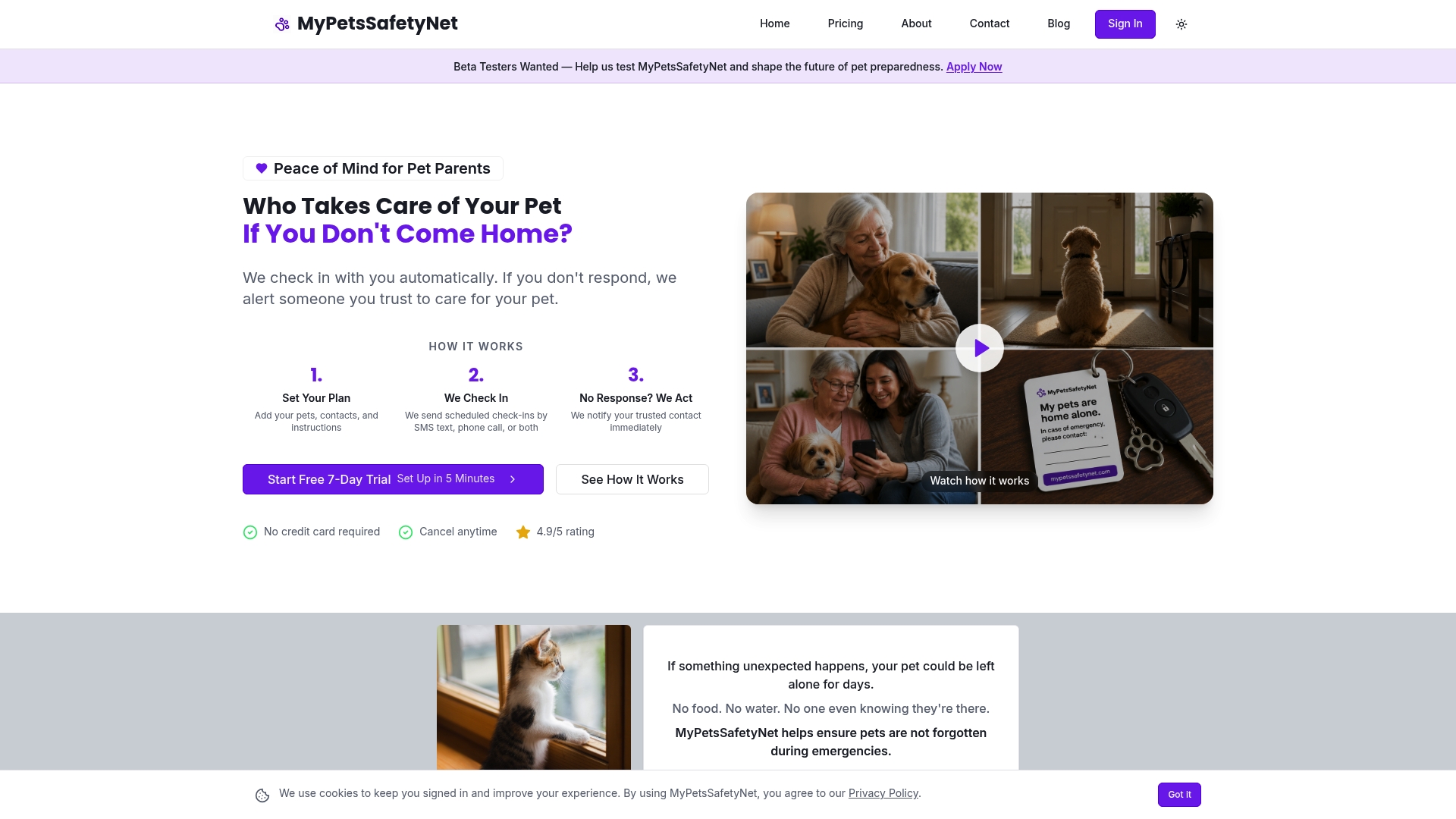
This is what MyPetsSafetyNet does. It sends scheduled SMS, phone or email check-ins and, if you fail to respond, runs an escalation workflow that notifies your emergency contacts with your full pet care details. You can customize the countdown intervals, so you decide how long the system waits before it moves to the next step. It works with any phone through SMS or calls, so you don’t need a smartphone, and setup takes less than 10 minutes.
The key difference from a police visit is that the message goes to the caregivers you named, along with your pets’ instructions, rather than relying on a stranger to find them. It is built for pet care, not just personal safety.

It works alongside the police and 911, not in place of them. If your contacts can’t reach you or are worried about what they find, calling 911 is still the right step, and they’ll have your information ready when they do.
How to build your pet emergency plan, step by step
Here is the routine, with the points where people usually slip.
1. Choose your contacts
Pick people who live nearby, can be reached at different times of day, and are willing to take on your pets. The NADRC’s emergency toolkit, written for people living with dementia but useful for anyone living alone, recommends at least two trusted advocates who know your emergency plan. Where people go wrong is listing one friend and assuming they’ll always pick up. MyPetsSafetyNet lets you add up to three emergency contacts, so a missed call from one doesn’t stop the alert. Our guide on how many emergency contacts to name goes through the thinking.
Ask each person first. A name on a list is not a plan until they have said yes.
2. Write down your pets’ care instructions
For each animal, record what a stranger would need on day one:
- Feeding amounts and times, and where the food is kept
- Medications, doses and timing
- Vet name and phone number
- Behavior notes (shy with strangers, escapes through the door, doesn’t like other dogs)
- Litter, walking and crate routines
- Microchip details
The service manages pet profiles and care instructions for up to five pets and includes a pet care instruction card generator, so this information is stored once and sent with the alert. If you have more than one animal, write each one’s needs separately. Mixed-up details are the usual failure here.
3. Make sure your caregivers can get in
A contact who knows what to do but can’t enter your home is no help. Arrange a key, a lockbox or a building contact, depending on where you live. Our pages on preparing your home for pet caregivers and on apartment access plans cover the practical details.
4. Set your check-in schedule and countdown
Choose a time you can reliably respond to, such as after your morning coffee. Then decide how long the system should wait after a missed check-in before contacting someone. Make it short enough to matter for your pets, and long enough that a forgotten phone doesn’t trigger an alarm every week. You can adjust both intervals in MyPetsSafetyNet and pick the channel that suits you: text, phone call or email.
5. Add the signs that matter for your animals
Your plan covers you, but your animals can show you when something is off, too. Changes in eating, sleeping or activity are worth noticing, and a guide on dog behavior changes explains what is normal and when a call to the vet is sensible. Keep your vet’s number in your pet’s profile so a caregiver has it from the first message.
6. Share and review the plan
The NADRC toolkit suggests writing your plan with the people you trust, keeping it somewhere easy to find, such as on the refrigerator, and sharing it with your medical provider at least once a year. Put a reminder in your calendar to review your contacts and your pets’ details every year, and after any move, new pet or new medication.
If you also want a full evacuation or shelter plan, the NADRC toolkit suggests checking whether your local emergency shelter accepts pets, and making a list of boarding facilities and veterinarians who could house animals in an emergency. Our guide to an emergency pet care plan walks through that too.
Try it with a free trial
MyPetsSafetyNet is $6.99 per month on the monthly plan, and it starts with a 7-day free trial, no credit card required. You can set up your pets, your contacts and your schedule in under 10 minutes and see how the check-ins feel in your daily routine.
If you live alone and your pets depend on you, it is a simple way to make sure the right people know when you can’t answer. Start at MyPetsSafetyNet.
Our perspective
Most people think about welfare checks only when something has already gone wrong. A neighbor hasn’t seen you, a relative hasn’t heard from you, and someone makes a call. That call is the right thing to do, and we’re glad it exists.
But when we built MyPetsSafetyNet, we started from a different question: what happens to a pet in the hours before anyone has noticed? Pets can’t dial a phone. They need food, water and care on a schedule, and their owner is often the only person who knows the details.
That’s why our service is designed around the pet as much as the person. A check-in message arrives by SMS, phone or email, so no smartphone is needed. If you don’t respond, your emergency contacts are told, and they receive your pet care details directly, so they know what to do when they arrive.
We think a good plan has three parts: people who’ve agreed to help, instructions they can follow, and a way for them to find out early. Setting that up takes under 10 minutes, and it lets you stop worrying about the what-ifs.
MyPetsSafetyNet
FAQ
Is a welfare check the same as a wellness check?
Yes. Police departments use both terms for a visit to find a person and evaluate their well-being, and Sacramento’s general order treats them as one service. A scheduled “wellness check-in” from an app or service is a separate thing: it’s a routine you set up yourself.
Can police enter my home during a welfare check?
Not on the request alone. Officers can enter without permission when they have reasonable grounds to believe someone inside is in danger, according to Morehouse School of Medicine’s guidance. They typically knock and announce themselves first, and they limit what they do to the emergency.
Who should I call to request a welfare check?
Call 911 if you believe the person is in immediate danger. For other concerns, contact your local police department. NYC311 and similar city services can point you to the right number. Have the person’s full name, address, medical conditions and the time you last heard from them ready.
Will anyone look after my pets if I’m found unable to care for them?
Only if someone knows about them. Police policies like the LAPD’s bulletin say officers ensure pets are left with a responsible adult when feasible. Naming contacts ahead of time, and giving them your pets’ care details through a check-in service, makes that handoff possible.
Sources
- Sacramento Police Department, General Order 582.01: Conducting Welfare Checks
- Welfare Checks, Morehouse School of Medicine Public Safety
- Welfare Checks, International Association of Chiefs of Police
- Welfare Check, UC Davis Police Department
- Wellness Check, NYC311
- Welfare Checks Training Bulletin, LAPD (October 2025)
- Emergency Preparedness Toolkit for People Living with Dementia, NADRC (2022)
- Dog Behavior Changes: What’s Normal, What’s Not, and When to Call the Vet