Hospital Admission Pet Alerts for Solo Owners, Ready in 10 Minutes

Hospital admission pet alerts notify the people you trust when a hospital stay leaves you unable to care for your pets. The next step is simple: name one authorized agent, give that person written authorization and your pet details, and set up an automated alert. The AVMA advises designating an authorized agent, while Ready recommends planning for your pet’s care. Our service can help you set up an automated alert.
TL;DR:
- Name one authorized agent, give your veterinarian a signed treatment authorization in advance, and specify which major procedures require your direct consent.
- Naming a caregiver may not cover emergency costs; arrange payment authorization, a payment method, or spending limits with your clinic before an emergency.
- Set a response window and add at least one backup; monthly test alerts confirm contacts still receive messages and remain willing to act.
- Put pet instructions, medication details, the veterinarian’s number, and home access information in the alert, but keep full payment details in protected storage.
Table of Contents
- Who should you appoint as your authorized caregiver?
- What belongs in your emergency pet packet?
- How do automated alerts and escalation work?
- Your quick readiness checklist
- Why automation plus one agent closes the planning gap
- How we help you put this checklist into action
- FAQ
- Sources
Who should you appoint as your authorized caregiver?
Start with one person. The AVMA advises you to designate a specific authorized agent who can act for you if you are hospitalized and cannot be reached. Without that name and written consent, clinics may face delays or be unable to perform life-saving treatments.
Pick someone who can get into your home, reach your vet, and handle payment questions if they come up. Then give that person what they need to act:
- A signed veterinary medical treatment authorization. Share it with your vet in advance so care is not held up.
- An agent contact list. Include your vet, any backup caregivers, and a family member who should hear about your admission.
- A microchip alternate contact. Add your agent’s number so the registry can reach someone if you cannot be reached.
- A clear limit on treatments. The AVMA notes you should tell your agent which treatments, such as major surgery, you do not want approved without your direct consent.
If more than one person will help, name a single final decision-maker. Clinics need one clear point of contact, and the AVMA flags unclear authority among several caregivers as a common pitfall. Our guide to pet caregiver roles shows how to split the jobs without splitting the authority.
What belongs in your emergency pet packet?
Think of the packet as everything a stranger would need to care for your pet in your absence. Keep it in one spot at home and tell your agent exactly where it is. Our pet care emergency document essentials guide goes deeper on each item.
- Records. Collect vaccination records, medical history, your vet’s contact details, recent photos, and proof of ownership. The Red Cross recommends keeping vaccination records and proof of ownership ready.
- Medication details. Write down each drug, the dose, the schedule, and where it is stored. Keep an appropriate supply on hand if your vet allows it.
- Payment arrangements. The AVMA notes that clinics often need upfront payment authorization for costly emergency treatment, and naming a caregiver is not always enough. Provide a signed consent form and set spending limits or a payment method with your clinic ahead of time.
- Home access. Leave a spare key with your agent. Note where food, medications, leashes, and carriers are kept.
- ID and microchip. Confirm your chip registration is current and add your agent as an alternate contact. Make sure collars carry tags.
- A one-page care sheet. Feeding times, quirks, and habits. Our guide on how to write pet care instructions for caregivers walks you through it.
Pro Tip: Give your clinic’s front desk a copy of the signed treatment authorization now, and ask them to note your agent’s name in your pet’s file.
How do automated alerts and escalation work?
An automated alert can help address a potential weak link in a plan: someone has to remember to call. Instead, the system reaches out to you on a schedule. If you do not respond, it contacts the people you named.

Look for a service that offers the channels you need, such as text messages, phone calls, or email. Scheduled wellness check-ins prompt you to confirm you are fine. When a check-in goes unanswered, escalation passes the alert to your primary contact, then to your backups.
Here is what to set up:
- Primary and backup contacts. Add your authorized agent first, then at least one person who can step in if the agent does not answer.
- Response window. Choose a countdown that fits your life. A shorter window means faster help, and a longer one means fewer false alarms.
- Message content. Include pet care instructions, your vet’s number, and how to get into your home, so the first message is already useful.
- Secure storage for sensitive details. Do not send full payment details by text or email. Keep them in a protected file and tell your contacts how to reach it.
- A live test. Ask your contacts to confirm they received the alert and know what to do next.
The Ready.gov guidance recommends checking periodically that your backup is still able and willing to act, and a test alert is the easiest way to do exactly that.
Pro Tip: Write your alert message as if the reader has never met your pet. Name, feeding times, medications, and where the packet sits are all it takes.
Your quick readiness checklist
You can work through the basics, then keep things current with short reviews. For a broader template, see our emergency pet care plan.
- Pick one authorized agent and ask them to say yes.
- Leave a spare key with that person.
- Fill out a one-page pet info sheet and share a copy.
- Set one automated alert that reaches your primary contact.
- Each month, test the alert, check medication and food supplies, and confirm your vet and microchip details.
- Once a year, walk your agent through the packet and introduce them to your vet.
Why automation plus one agent closes the planning gap
A plan for a hospital stay can look complete on paper. The trouble is that a plan depends on someone remembering to carry it out on the worst day. A friend may not know you were admitted. A family member may be at work. The plan sits in a drawer.
That is the case for automation. An alert does not forget, panic, or wait for a good moment. Paired with one authorized agent, it turns a good intention into a message that lands in the right hands. We built our service around this idea: multiple contacts with escalation, pet care instructions, and delivery by text and phone calls, with no smartphone required. In our view, the best plan is the one that still works when you cannot.
— MyPetsSafetyNet
How we help you put this checklist into action
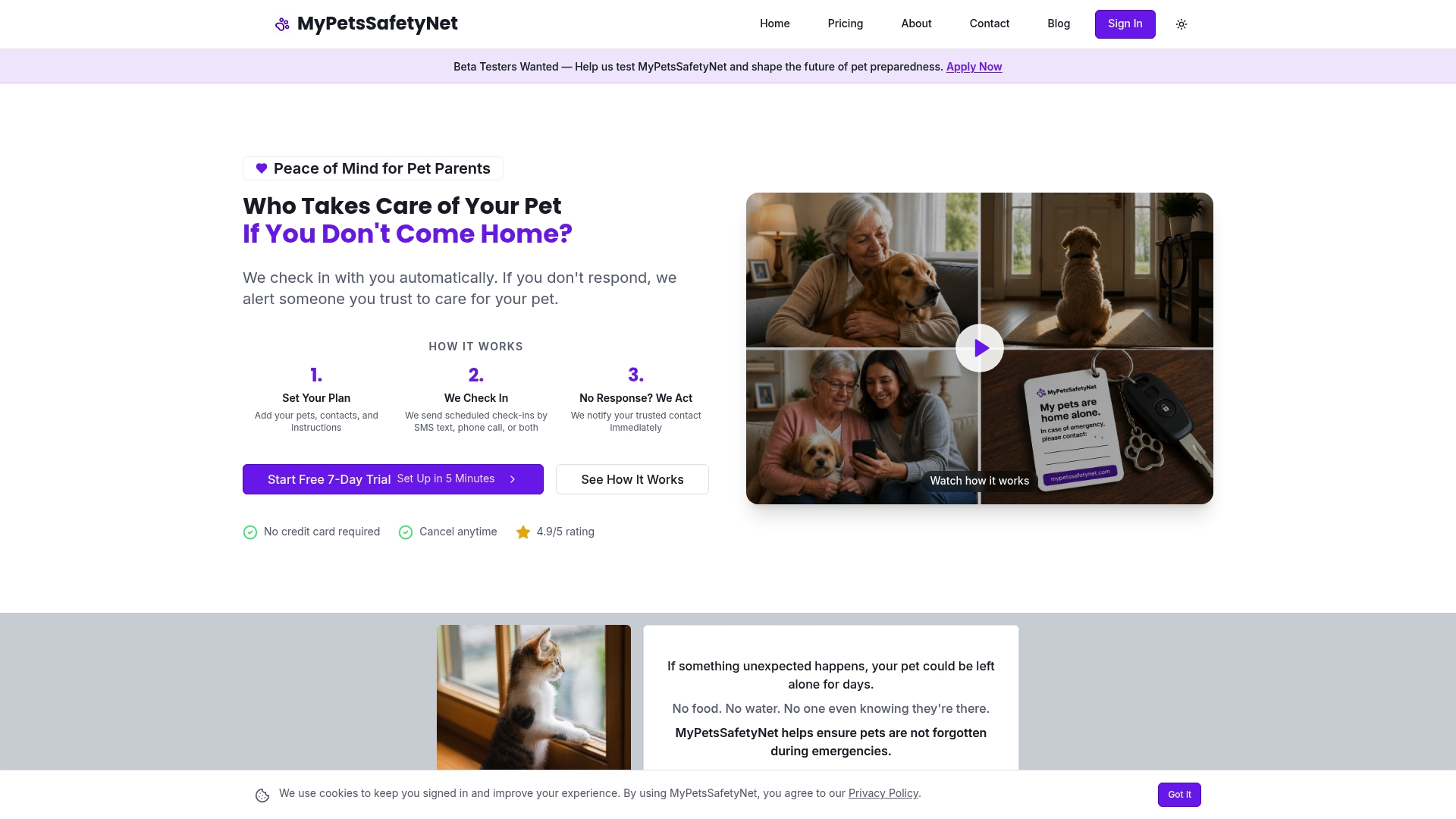
Our subscription turns the steps above into something that runs on its own. Here is how it maps to your checklist:
- Automated wellness check-ins replace the “someone has to remember” problem.
- Escalation to backups passes the alert along if your first contact does not respond.
- Pet profiles and care instructions travel with the alert, so your caregiver knows what to do.
- Works with any phone, including text and calls, with no smartphone needed.
We aim to make setup straightforward, and the Monthly plan costs $6.99 per month. If you would rather start small, make a free pet card to share with your caregiver today.
FAQ
What are hospital admission pet alerts?
They are automated messages that notify your chosen caregivers when you are hospitalized or cannot respond. The alert carries your pet’s care details so someone can step in quickly.
Who should I name as my authorized agent?
Choose one person who can reach your home, contact your vet, and make decisions if needed. The AVMA recommends designating a specific authorized agent and informing them of your pet’s medical conditions and your vet’s contact details.
Does my caregiver need written permission to approve vet care?
Often, yes. The AVMA advises pre-signing a veterinary medical treatment authorization and sharing it with your vet in advance, which helps prevent delays in care.
How often should I test my alerts?
Check them monthly. A quick test confirms your contacts still receive messages and know what to do, which matches the Ready.gov advice to verify that your backup remains willing and able.
Sources
- Ensuring your pet is protected when you’re away | American Veterinary Medical Association
- Ready
- Pet Preparedness Month: Make Pets Part of Your Emergency Plans