Pet Welfare Checklist for Travelers: Solo Owner’s 2026 Guide

The fastest, most reliable way to protect your pet while traveling is to set up an automated wellness check-in with a verified escalation plan before you leave. That means a scheduled daily check-in, a complete pet profile, at least one same-day responder who has physical access to your home, and a tested notification timeline. Without all four, even the best intentions can leave your pet without care for days.
Your minimum must-haves before any trip:
- Scheduled automated check-in (daily SMS, phone, or email prompt)
- Complete pet profile with feeding, meds, vet contacts, and supply locations
- At least one verified primary responder who can reach your home within hours
- A backup contact in case the primary is unavailable
- A confirmed home-access method (spare key, lockbox, or door code)
- A tested escalation timeline so you know alerts actually go through
Pro Tip: Set aside 10 minutes right now: sign up for Mypetssafetynet, add one emergency contact, create a basic pet profile, and schedule your first check-in. You can refine the details later, but getting the system active before your trip is what matters most.
Safety experts identify the “dual crisis” as the top risk for solo pet owners: an owner’s medical emergency that simultaneously becomes an animal welfare crisis because no one knows to check on the pet. Automated daily check-ins narrow that window from days to hours, giving your contacts time to act for both you and your pet.

Table of Contents
- What’s your pre-travel pet welfare checklist?
- How do automated wellness check-ins actually work?
- How do you choose and prepare the right emergency contacts?
- How do you test the system before you travel?
- What privacy and home-access considerations apply in the United States?
- What should your pet profile and instruction card include?
- What should an emergency contact do after receiving an alert?
- What does Mypetssafetynet offer?
- How do you choose the right automated check-in platform?
- Should you tell your neighbors about your emergency plan?
- What are your backup options if the automated system fails?
- How do you coordinate with vets and boarding facilities in advance?
- How do you prevent the “dual crisis” through ongoing contact verification?
- Key Takeaways
- Why this checklist matters more than most pet owners realize
- Your pet deserves a safety net before your next trip
- Useful sources and further reading
What’s your pre-travel pet welfare checklist?
A solid checklist for pet travelers follows a clear sequence. Work through it in three phases.
7+ days before departure
- Enroll in an automated wellness check-in service and configure your check-in schedule
- Add at least two emergency contacts and confirm they know they’re listed
- Build your pet profile: ID, microchip number, feeding schedule, medications, behavior notes, vet contacts, and supply locations
- Grant home access: hand over a spare key, set a lockbox code, or share a door code
- Identify a backup veterinary clinic or pet boarding facility in case your regular vet is unavailable
- Store a printed pet care card on your refrigerator and a digital copy in a shared cloud folder
48 hours before departure
- Run a test check-in and simulate a non-response to confirm the escalation fires correctly
- Verify all contacts are reachable and have reviewed the pet profile
- Restock medications, food, and supplies for at least one week beyond your expected return
- Confirm your neighbor or nearby trusted person knows you’ll be away
Day of departure
- Send your emergency contacts your travel itinerary and expected return date
- Confirm your check-in schedule is active and set to the correct time zone
- Leave the printed pet care card visible and the supply cabinet unlocked
Pro Tip: Store your digital pet profile in a shared Google Drive or Dropbox folder and give your emergency contacts view access. If your phone is unavailable, they can pull up every detail on their own device.
How do automated wellness check-ins actually work?
The system works as an early-warning trigger, not a physical response team. Here’s the typical sequence:
- Scheduled prompt: The service sends you an SMS, phone call, or email at your chosen time
- Response window: You have a set window (often 15–60 minutes) to confirm you’re okay
- Automated retry: If you don’t respond, the service sends one or more follow-up prompts
- Contact notification: After the retry window closes without a response, your emergency contacts receive an alert with your pet care details
- Escalation: Contacts are expected to call you, then proceed to your address if there’s no answer
A realistic timeline: if your check-in is scheduled for 8:00 AM and you have a 30-minute response window with one retry, your contacts could receive an alert by 9:00 AM and be at your door within the hour. That’s the difference between a pet going without care for one hour versus two or three days.
The service’s role is clear: it creates the signal. Your contacts provide the physical response. Daily check-ins create the trigger that activates the rest of your plan, rather than leaving discovery to chance.
A note on realistic expectations: Automated wellness check-in services are early-warning systems. They alert people; they do not dispatch responders. A well-prepared contact list is what converts an alert into actual pet care.
How do you choose and prepare the right emergency contacts?
The ASPCA recommends separating two distinct roles: a same-day responder and a long-term guardian. They don’t need to be the same person, and treating them as interchangeable is one of the most common planning mistakes.
Same-day responder: Someone local who can physically reach your home within a few hours, is reachable by phone during the day, and is willing to care for your pet short-term. A neighbor, nearby friend, or family member in the same city works well.
Long-term guardian: The person who would take permanent or extended custody of your pet if you were incapacitated for weeks or permanently. This is an estate planning decision, separate from emergency response.
Before listing anyone as a contact, ask them directly: “If you got an alert that I hadn’t checked in, would you be able to go to my place within two hours?” Explicit consent matters. A common planning pitfall is naming contacts who are unaware they’re designated or who don’t have access to your home.
Document the following for each contact:
- Their full name, phone number, and email
- Confirmation they have a spare key or your lockbox code
- A signed or written acknowledgment that they’re your designated responder
Pro Tip: Keep a laminated card with your emergency contacts’ names and phone numbers on your refrigerator alongside your pet care card. First responders are trained to check there.
How do you test the system before you travel?
Testing once before every trip takes about 20 minutes and confirms the entire chain works.
- Schedule a test check-in for a time when you’re home and your contacts are available
- When the prompt arrives, deliberately do not respond
- Watch for the retry prompt and continue not responding
- Confirm your contacts received the escalation alert and that it included your pet profile details
- Call your contacts and ask: Did the alert arrive? Was the pet profile readable? Do you have everything you need to access my home?
- Walk through the access method together (lockbox code, spare key location) to confirm it works
After the drill, update anything that failed: a contact who didn’t receive the alert, an outdated door code, or a pet profile missing a medication. Periodic verification is a recurring task, not a one-time setup. Run a full test at least once every six months and after any major life change (new address, new pet, new contact).
Pro Tip: Ask your contacts to screenshot the alert they receive during the test. That screenshot confirms the notification format, the pet details included, and the contact information displayed, so there are no surprises in a real emergency.
What privacy and home-access considerations apply in the United States?
Granting someone access to your home and personal information requires a few practical steps.
What to share with emergency contacts:
- Your home address and access method (key location, lockbox code, or door code)
- Your pet profile (feeding, meds, vet contacts)
- Your travel itinerary and expected return date
- Your veterinarian’s name and phone number
What to protect:
- Financial account information (never needed for pet care)
- Passwords or sensitive personal data beyond what’s required for pet access
For access, a combination lockbox mounted near your door is the most practical option for US pet owners. It avoids the risk of a lost key and lets you change the code remotely if needed. Written consent from your contact, even a simple text message confirming their role, creates a clear record.
For long-term or legally enforceable arrangements, such as a pet trust or durable power of attorney for pet care, consult a licensed attorney in your state. Requirements vary by state, and informal agreements may not hold up in a formal dispute.
Pro Tip: Use a free password manager like Bitwarden to store your lockbox code and share it securely with your emergency contacts. They can access it from any device without you needing to text sensitive codes.
What should your pet profile and instruction card include?
A complete pet care emergency document covers two layers: immediate care (first 24 hours) and extended care. Good templates separate these so a short-term responder isn’t overwhelmed with long-term records.
| Field | Details to Include |
|---|---|
| Pet name, species, breed, age | Basic ID for any responder or vet |
| Microchip number | Required for vet records and lost-pet recovery |
| Feeding schedule | Brand, quantity, frequency, and any food allergies |
| Medications | Name, dose, timing, and storage location |
| Behavior notes | Fear triggers, aggression history, comfort items |
| Primary vet | Name, clinic, phone, address |
| Emergency vet clinic | 24-hour clinic name and address |
| Pet insurance | Provider name and policy number |
| Supply locations | Food, leash, carrier, litter, medications |
| Owner contact | Your phone, travel destination, return date |
Where to store copies:
- Printed card on the refrigerator or taped to the inside of the front door
- Digital copy in a shared cloud folder (Google Drive, Dropbox, or iCloud)
- Uploaded to your automated check-in service’s pet profile section
What should an emergency contact do after receiving an alert?
When a contact receives a notification, every minute counts. Here’s the step-by-step sequence:
- Confirm the alert is from your automated check-in service (check sender name or number)
- Call the owner immediately; try twice with a two-minute gap between attempts
- If there’s no answer, proceed to the owner’s address without waiting
- Use the spare key or lockbox code to enter
- Locate the pet and assess its condition: water, food, visible injury, or distress
- If the pet needs medical attention, contact the primary vet or 24-hour emergency clinic listed on the pet care card
- If entry is blocked or the pet is inaccessible, call local animal control for assistance
- Text or call the owner’s backup contact to coordinate ongoing care
Carry a photo of the pet care card on your phone before any trip begins. If a vet asks for authorization to treat, the owner’s name, pet insurance policy number, and a written note from the owner (even a photo of a signed card) will help the clinic proceed quickly.
What does Mypetssafetynet offer?
Mypetssafetynet is built specifically for solo pet owners who need an automated safety net while traveling or living alone. The wellness check-in service covers every element of the checklist above.
| Feature | Details |
|---|---|
| Automated check-ins | Scheduled SMS, phone call, or email prompts |
| Escalation workflow | Automated alerts to contacts after missed response |
| Pet profile management | Up to 5 pets with full care instructions |
| Emergency contact management | Up to 3 verified contacts per account |
| Printable instruction card | Generated from your pet profile, ready to print |
| Subscription model | Monthly subscription with a free trial available |
What to do first:
- Sign up and start the free trial
- Add your primary emergency contact and confirm they’re aware
- Create a pet profile for each pet
- Schedule your first check-in and run a test before your trip
The service doesn’t replace a physical responder, but it guarantees the alert goes out automatically, even if you’re unconscious or unreachable.
How do you choose the right automated check-in platform?
Not every check-in app is designed with pet owners in mind. When evaluating options, focus on these criteria:
Reliability: Does the service send alerts via multiple channels (SMS, phone, and email)? A single-channel service can fail if one method is blocked or delayed.
Pet profile support: Can you store feeding schedules, medication details, and vet contacts directly in the platform so contacts receive everything they need in the alert?
Contact capacity: Some services support only one emergency contact. For solo pet owners, at least two contacts is the practical minimum.
Escalation customization: You should be able to set your own response window and retry intervals rather than accepting a fixed default.
Trial availability: A free trial lets you test the full escalation flow before committing to a subscription.
Mypetssafetynet meets all five criteria and is designed specifically for the solo pet owner use case, including travel scenarios.
Should you tell your neighbors about your emergency plan?
Yes, and it takes less than five minutes. A nearby neighbor who knows you’re traveling and has your emergency contact’s phone number adds a layer of redundancy that no app can replicate.
Tell your neighbor:
- Your travel dates and expected return
- The name and phone number of your primary emergency contact
- That your pet is home and being monitored via an automated check-in service
- Where your spare key or lockbox is located (if you trust them with that information)
You don’t need to share your full pet profile with a neighbor. Their role is simple: if they notice something unusual (lights on for days, mail piling up, sounds of distress), they know who to call. That one phone number can close the gap between an automated alert and a physical response.
What are your backup options if the automated system fails?
Automated services depend on internet connectivity and functioning phone networks. Build at least one backup layer.
Practical backup methods:
- Ask a trusted contact to check in with you manually every 24–48 hours via text
- Set a calendar reminder for a trusted person to call you if they haven’t heard from you by a set time
- Leave a written note with your neighbor listing your emergency contact’s number
- Register your pet with a local animal welfare organization that offers emergency pet care programs
If you’re traveling internationally or to a remote area with limited connectivity, increase your check-in frequency before departure and notify your contacts of potential gaps in communication. A satellite communicator like a Garmin inReach can serve as a backup for remote travel, though it requires a separate subscription.
How do you coordinate with vets and boarding facilities in advance?
Contact your veterinary clinic before you travel and do three things:
- Confirm your emergency contact is authorized to bring your pet in for treatment and make basic care decisions in your absence
- Provide the clinic with your contact’s name and phone number in writing
- Ask the clinic to note in your pet’s file that you’ll be traveling and that your contact is authorized
For boarding facilities, the same authorization applies. Provide a written note (signed and dated) that names your contact and states they have permission to pick up, drop off, and authorize routine care for your pet during your travel dates.
If your regular vet is closed on weekends or evenings, identify the nearest 24-hour emergency animal hospital now and add it to your pet profile. Your emergency contact shouldn’t have to search for a clinic at midnight.
How do you prevent the “dual crisis” through ongoing contact verification?
The “dual crisis” happens when an owner’s emergency goes undetected long enough that the pet is also in distress by the time anyone arrives. Safety experts frame automated wellness check-ins as the primary tool for preventing this, because they shorten the detection window from days to hours.
But the check-in is only as good as the contacts behind it. Personal circumstances change: people move, change phone numbers, or become unavailable. A plan that was solid six months ago may have a gap today.
Schedule a contact verification every six months:
- Confirm each contact’s current phone number and email
- Reconfirm they’re willing and able to respond
- Update your lockbox code if it hasn’t changed recently
- Review your pet profile for any changes (new medications, new vet, updated feeding schedule)
Treat this like a smoke detector test. It takes 15 minutes, and it’s the one task that keeps the entire system functional.
Key Takeaways
An automated wellness check-in with a verified escalation plan is the single most effective way for solo pet owners to protect their pets during travel.
| Point | Details |
|---|---|
| Automated check-in is the trigger | A daily check-in shortens the detection window from days to hours when an owner is unresponsive. |
| Contacts need explicit consent and access | Verify each contact has your home access method and knows they’re designated before you travel. |
| Test the full chain before every trip | Simulate a missed check-in at home to confirm alerts fire, contacts receive them, and access works. |
| Pet profile covers two layers | Include immediate care details (feeding, meds, vet) and extended care records in every profile. |
| Mypetssafetynet supports up to 5 pets and 3 contacts | The service covers automated check-ins, escalation, pet profiles, and printable instruction cards on a monthly subscription with a free trial. |
Why this checklist matters more than most pet owners realize
Solo pet owners carry a quiet but real risk that most emergency planning guides underestimate. The gap isn’t usually a lack of caring people in your life. It’s the absence of a reliable signal that tells those people something is wrong. A neighbor who assumes you’re just busy, a friend who figures you’ll call when you’re ready, a family member who doesn’t want to intrude: these are the conditions that turn a manageable medical event into a crisis for your pet.
Automated wellness check-ins close that gap by removing the assumption. The system doesn’t wait for someone to notice. It sends the alert, attaches your pet’s care details, and puts the decision to act in your contact’s hands within hours, not days.
The 2026 guidance resources on the Mypetssafetynet Pet Safety Blog reflect what safety practitioners and veterinary professionals consistently recommend: the plan that works is the one that’s been tested, not just written. Run the drill. Update the contacts. Your pet can’t ask for help, but your system can.
Your pet deserves a safety net before your next trip
Peace of mind while traveling starts with one concrete step: an active, tested automated check-in that alerts your contacts the moment something seems wrong. Mypetssafetynet gives you scheduled SMS, phone, or email check-ins, a full pet profile with a printable instruction card, and escalation to up to 3 emergency contacts for up to 5 pets, all on a monthly subscription with no long-term commitment.
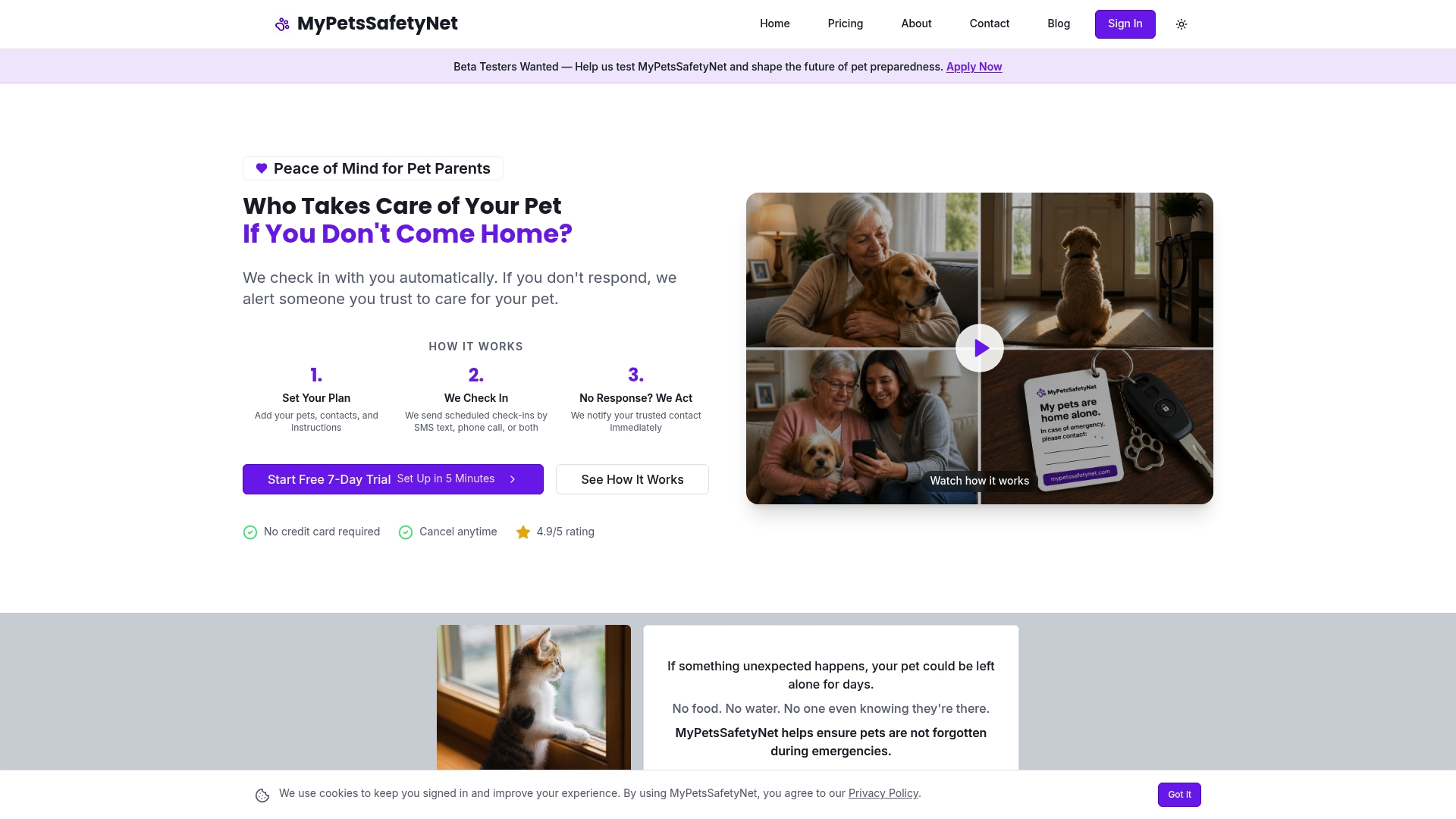
Start with the free trial, add your primary emergency contact, build your first pet profile, and run a test check-in before you leave. That’s the whole first session. Start your free trial at Mypetssafetynet and know your pets are covered, no matter what happens while you’re away.
Useful sources and further reading
| Source | Why it’s worth reading |
|---|---|
| ASPCA: Making a Plan for Your Pet | Authoritative guidance on separating short-term responders from long-term guardians in emergency pet planning |
| I’m Alive: Safety for Pet Owners Living Alone | Explains the “dual crisis” risk and why daily check-ins are the primary prevention tool for solo owners |
| AloneAssist: Pet Care Plan for Emergencies | Practical framework for building a pet care plan, including contact consent and access requirements |
| PetNPrep: Emergency Pet Care Plan | Ready-to-use template separating immediate (first 24 hours) and extended care information |
| AllBreedNorth: Pet Guardian Protocol | Covers periodic contact verification and why plans that are never tested fail in real emergencies |
| Mypetssafetynet: Wellness Check-In Service | Service overview for solo pet owners, including features, escalation workflow, and how to run a test |
| Mypetssafetynet: Emergency Pet Care Plan | Step-by-step guide to building and storing a complete pet care emergency document before travel |