Adopting a Dog or Cat When You Live Alone: A Practical Guide

Yes, you can adopt a dog or a cat when you live alone, and many people do it well. What matters is matching the pet to your schedule, budget and health, and naming a backup person before the pet comes home, so someone knows what to do if you’re ever suddenly unable to care for your animal. We built MyPetsSafetyNet for that last step: it checks in with you on a schedule and, if you don’t respond, alerts your emergency contacts with your pet’s care details.
TL;DR
- Living alone doesn’t disqualify you. Shelters ask about it, but they mostly want to know who cares for the pet when you can’t.
- Time away from home is the main test: a dog needs breaks every few hours, while an adult cat, or two, usually copes better with a full workday.
- Budget for routine costs and for an emergency vet bill of $1,750 or more.
- Choose your emergency caregivers and write down your pet’s routine before adoption day.
- An automated check-in can alert those caregivers if you don’t answer, even if you have no smartphone.
Table of Contents
- Is it a good idea to adopt a pet when you live alone?
- Dog or cat: which suits a solo household?
- What shelters ask a person who lives alone
- What it really costs
- Build your backup plan before the pet comes home
- How an automated check-in covers the gap
- Start a backup plan for your new pet
- Our perspective
- FAQ
- Sources
Is it a good idea to adopt a pet when you live alone?
It can be one of the best decisions you make. A pet brings routine, company and a reason to get up in the morning. The catch is that you are the only person who notices when something goes wrong. Nobody else in the house will feed the dog, let it out or see that you haven’t come out of the bedroom.
That doesn’t mean you should hold back. It means the adoption decision has two halves: whether the pet suits your daily life, and what happens to the pet on your worst day. Most guides cover the first half. This one covers both.
One Health’s guide for pet parents lists the questions to answer first: whether you can afford pet and veterinary costs, how long you’ll be away, who will care for the pet in your absence, and how many years you’re willing to commit. Work through them honestly, on paper if it helps.
A quick readiness checklist
- How many hours a day will the home be empty?
- Can you pay for routine care and an unexpected emergency?
- Does your lease or housing allow the pet you want?
- Can you handle the physical side: walks, lifting, litter boxes, a pet that pulls on the leash?
- Who steps in if you are in the hospital for three days?
- Will you still want and be able to care for this animal in 10 or 15 years?
If you can answer the last two with a name and a plan, you are in a stronger position than many adopters with larger households.
Dog or cat: which suits a solo household?
The honest answer depends on your hours. Dogs are social animals and need company, exercise and bathroom breaks. Animal Humane Society notes that dogs generally need more time with caretakers than other pets, though some dogs don’t mind alone time, and that cats and small animals tend to be more independent, especially with a companion.
There are some useful rules of thumb from shelters:
- Napa Humane says that people away more than six hours a day may not have enough time for a puppy or kitten. If everyone in the home is away more than eight hours most days, a dog may not be appropriate and an adult cat or two may be a better choice.
- A 2026 guide from a veterinary hospital says most dogs shouldn’t be alone more than 4 to 6 hours without a break, and that this is a welfare issue rather than a guilt trip.
If you work full time and want a dog
It’s possible, but you need a midday plan. The same veterinary guide puts a midday dog walker at $20 to $35 per visit, or daycare at $25 to $50 per day, roughly $400 to $700 a month for five days a week. Add that to your budget before you fall for a puppy’s photo. Many solo owners find an adult dog with a calm temperament easier than a puppy, which needs frequent breaks and training.
If you’re leaning toward a cat
Most cats are content to nap while you work, as long as they have scratching posts and toys. But don’t assume a cat is low-effort. Best Friends Animal Society points out that many cats are social and need daily play and petting, and that indoor cats generally live longer and healthier lives.

American Humane suggests considering two cats, since they can give each other the exercise, stimulation and social contact you can’t provide during the workday. Also think about the long haul: cats can live 12 years or more, and the minimum standard is daily care or a reliable plan for someone else to provide it when you’re away.
Match the pet to your body, too
This matters most if you are older or have a disability. Animal Humane Society advises that high-energy pets do best with active caretakers, larger animals need more support in everyday activities and emergencies, and small animals can require extra dexterity and careful handling. A calm adult dog or cat is often a better fit than a young, athletic one. Listings that use words like “calm,” “low-activity” or “a quiet home” are worth a closer look.
| Your situation | Often a good fit | Plan around |
|---|---|---|
| Home most of the day, active | Adult dog, medium energy | Daily walks, a backup for illness |
| Away 8+ hours most days | Adult cat, or a bonded pair | Play time every evening, a caregiver who has a key |
| Limited mobility | Calm adult cat or small, calm dog | Lifting, leash handling, litter and food storage |
| Frequent travel | Cat with a reliable sitter | Care instructions the sitter can follow |
This table is a starting point. A shelter adoption counselor can help you match personality to lifestyle, and American Humane recommends using that help.
What shelters ask a person who lives alone
Many people worry that living alone will count against them. In practice, applications ask about it because they want to know the full picture. The Washington Area Humane Society’s application, for example, asks whether you live alone, rent or own, what pets you have, what your finances look like, how long the pet will be alone, and what your plans are if you can no longer care for the pet. That shelter also says it picks the best fit among up to three qualified applications rather than the first one received, and may turn away an unsuitable home.
Two practical points follow from the policies shelters publish:
- Renters need paperwork. Beaver County Humane Society asks renters to bring a copy of their lease approval and valid photo ID when scheduling a meet-and-greet.
- Move quickly once approved. Some shelters expect approved adopters to be ready to pick up the animal within 72 hours, so set up the basics first.
The question “what is your plan if you can’t care for the pet?” is the one solo applicants can answer best with something concrete: named caregivers, written instructions and an automatic way to alert them. It shows a shelter you’ve thought about it.
What it really costs

Costs vary widely by animal, age and region. MetLife Pet Insurance’s 2026 guide puts average annual ownership at $1,400 to $5,300 for a dog and $850 to $3,100 for a cat, and says an emergency vet visit can run $1,750 or more, with diagnostics or surgery reaching $5,000 or higher. The ASPCA’s own estimates, cited by its pet insurance arm, are lower for basic care: about $700 a year for a cat and $600 to $900 for a dog, plus roughly $600 (dog) or $400 (cat) in first-year setup costs.
The gap between those figures is the point: your costs depend on the animal and on what goes wrong. Two habits help:
- Open a separate pet savings account. The ASPCA’s insurance arm suggests automatic transfers and a cushion of three to six months of pet care expenses.
- Choose a vet before adoption day. American Humane recommends picking a veterinarian first, booking a visit within the first few days, and saving the closest 24-hour animal hospital’s number. Shelter adoptions often already include spay or neuter, first vaccines and a microchip.
For a solo owner, budget also has to cover the human side of the plan: a walker, a sitter or a caregiver’s expenses if you are hospitalized.
Build your backup plan before the pet comes home
This is the step most adoption guides skip, and it is the one that matters most when you live alone. If you fall, collapse or are admitted to the hospital, your pet may go without food, water or a bathroom break until someone realizes something is wrong.
The ASPCA breaks planning into two parts: create a pet plan, then select caregivers. Here is how that looks in practice.
1. Write down your pet’s routine
The ASPCA suggests a Pet Portfolio with habits, food preferences, medical conditions, medications and vet records, with copies given to everyone in the pet’s circle of care. It also suggests a wallet Pet Alert Card listing two emergency contacts. Our care instruction card generator is designed to turn your pet’s details into a card your caregivers can follow, and you can store profiles for up to 5 pets.
2. Choose caregivers who can actually reach your home
New York City’s emergency guidance says to choose a trusted person with house keys who knows your home, your pet and your emergency plan. A neighbor or friend can step in during a hospitalization without becoming the pet’s permanent guardian, according to the ASPCA. If you live in an apartment, our guide to an apartment access plan for solo and disabled owners covers how to make sure a caregiver can get in.
How many people should you name? We cover that in how many emergency contacts a solo pet owner needs. Our service holds up to 3 emergency contacts.
3. Keep emergency information where responders will see it
The New York guidance recommends keeping contacts, including veterinarians, in the pet’s go bag, updating the Rescue Alert sticker at your entrance every six months, and packing a photo, medical records, identification information, a first-aid kit and at least three days of food and water.
4. Check in with your caregivers
The ASPCA advises checking in with your caregivers periodically to confirm they’re still willing and able. People move, change jobs and change phone numbers. If you can’t name anyone, it says local humane societies will often help place an animal if they know in advance that you live alone.
5. Make sure someone is told when you can’t tell them yourself
A written plan only works if somebody triggers it. When you live alone, that is the weak point: no one may know you need help for hours or days. This is where an automated check-in does the work a housemate would.
How an automated check-in covers the gap
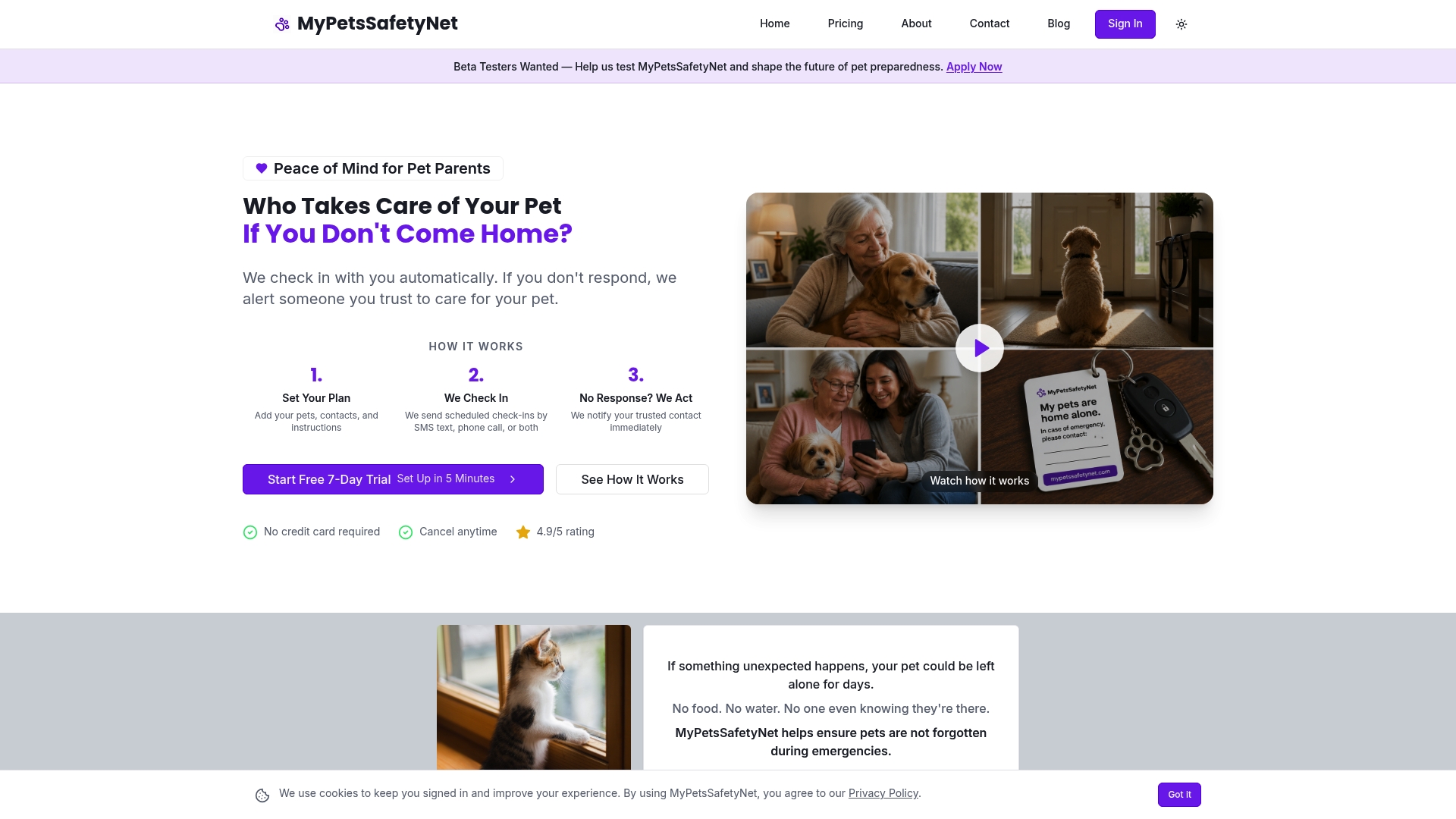
MyPetsSafetyNet sends you a scheduled message by SMS, phone call or email. If you respond, nothing happens. If you don’t, an escalation workflow runs on a countdown interval you set, and your emergency contacts are notified with your pet’s full care details, so they can check on you and look after your animal.
A few facts about how it works:
- No smartphone required. It works with any phone through SMS or calls, which suits owners who don’t use apps.
- Setup takes less than 10 minutes, with customizable schedules and escalation.
- Care details go to named caregivers, not to emergency services.
- It’s built around pets, not only personal safety.
If you want to see how contacts are handled when someone doesn’t pick up, read how check-ins enforce 2 to 4 emergency contacts. If you have a dog walker, our dog walker emergency contact guide shows how to include them. And if you worry about a planned hospital stay, see hospital admission pet alerts for solo owners.
Start a backup plan for your new pet
The Monthly plan is $6.99 per month and begins with a 7-day free trial, with no credit card required. Setting it up before adoption day means your pet’s care instructions and caregivers are ready the first night they’re home. You can see the plan on our pricing page.
If you’re still choosing between a dog and a cat, finish that decision first using the sections above, then set up the plan. It takes less time than assembling the pet’s bed.
Our perspective
When you live alone, a pet’s safety depends on one person: you. We built MyPetsSafetyNet because that thought worries many solo pet parents, especially older adults and people with health conditions.
We believe the right time to plan is before adoption, when you’re calm and the choices are still easy. Choose the pet that fits your hours and your body. Name the people who would step in. Write down what your pet eats, when, and what to watch for.
Then take away the part that depends on luck. A plan on paper doesn’t help if nobody knows to use it. That’s why our check-ins reach you by SMS, phone or email, with no smartphone required, and why they tell your caregivers what your pet needs, not just that something may be wrong.
A pet gives a lot to someone who lives alone. A backup plan lets you enjoy that without worrying about the worst day.
MyPetsSafetyNet
FAQ
Can I adopt a dog if I live in an apartment and live alone?
Often yes, but you need landlord approval if you rent, and shelters may ask for a copy of your lease approval. Smaller, calmer adult dogs generally suit apartments better than large, active breeds. Plan midday breaks so the dog isn’t left alone more than 4 to 6 hours.
Can I adopt a cat if I live alone and work full time?
Usually, yes. An adult cat, or a pair, tends to manage a workday better than a dog, and two cats can keep each other company. You’ll still need daily play time and a plan for someone to care for the cat if you’re away or ill.
Can living alone stop me from being approved?
It shouldn’t on its own. Applications ask about it to understand your time, finances and backup plans. Shelters may decline a home that isn’t suitable, so a clear answer to “what happens if you can’t care for the pet” helps.
How long should a dog be left alone?
A veterinary hospital’s 2026 guide says most dogs shouldn’t be alone more than 4 to 6 hours without a break, and puppies need breaks more often. A walker, daycare or trusted neighbor can cover the middle of your day.
What happens to my pet if I’m hospitalized suddenly?
That depends on whether someone knows. Name caregivers with a key, write down your pet’s routine and set up an automated check-in so they’re alerted if you don’t respond. Our hospital admission alerts guide explains this in detail.
Sources
- A Pet Parent’s Guide to Caring for Your Dog or Cat (One Health)
- Choosing the Right Pet (Napa Humane)
- So You Want to Adopt a Cat (MSPCA-Angell)
- Picking a Pet (Best Friends Animal Society)
- Pet Parent Guide (American Humane)
- How to be the perfect adopter (Animal Humane Society)
- Cat or Dog? Which Pet Best Suits Your Lifestyle (Genius Vets)
- Important Adoption Facts (Washington Area Humane Society)
- Pre-Adoption Application (Beaver County Humane Society)
- How Much Do Pets Cost? (MetLife Pet Insurance)
- Hidden Costs of Pet Parenting (ASPCA Pet Health Insurance)
- How to Save Money on Pet Care (ASPCA Pet Health Insurance)
- Should I Get a Dog or Cat as My First Pet? (Bestie Paws)
- Making a Plan for Your Pet (ASPCA)
- Ready New York: Pets (NYC Emergency Management)