Pet Caregiver Contact Limit: The Rule Solo Owners Need
Set a pet caregiver contact limit of one primary caregiver plus 2 to 3 backups, and pair it with a response window of 2 to 6 hours before anyone escalates to your veterinarian. That’s the whole rule. It’s short enough to remember and wide enough to catch a real emergency without burning out the people you’re counting on.
This works because it balances two competing risks: waiting too long to get help, and asking too many people to stay on call. Three backups plus a vet gives you redundancy without turning your phone list into a group chat nobody checks.
- Primary caregiver: first call, first responder
- Backup 1 and Backup 2: contacted if the primary doesn’t respond
- Veterinarian: authorized to act if no human contact responds in time
Pro Tip: Pick one backup, in advance, who is comfortable authorizing emergency vet care. Don’t leave that decision for the moment everyone’s phone is ringing.
Key Takeaways
A short, written response window paired with 2 to 3 backup contacts and a veterinarian is the single most reliable safeguard for solo pet owners.
| Point | Details |
|---|---|
| Set the contact limit | Name one primary caregiver, 2 to 3 backups, and your veterinarian, no more. |
| Match window to severity | Use 0 to 2 hours for urgent symptoms, 2 to 6 hours for serious ones, 24 hours for routine check-ins. |
| Write authorization in advance | Put transport and treatment consent in writing so a vet can act without waiting for you. |
| Protect caregiver goodwill | Define off-limit hours and split essential tasks from optional ones to prevent burnout. |
| Automate the enforcement | Mypetssafetynet enforces the response window and escalation chain automatically, logging every notification. |
Table of Contents
- What Does a Recommended Pet Caregiver Contact Setup Look Like?
- Who Should Be on the List, and What Do You Expect From Them?
- How Long Should You Wait Before Escalating?
- What Should You Authorize Backups to Do?
- How Do You Set Limits Without Burning Out Your Caregivers?
- How Do You Write Instructions Caregivers Will Actually Use?
- How Does Automation Take the Pressure Off This Plan?
- Why This Rule Exists
- Ready to Put Your Contact Limit Into Practice?
- Frequently Asked Questions
- Sources
What Does a Recommended Pet Caregiver Contact Setup Look Like?
A workable setup names four roles and nothing more. Adding a fifth or sixth contact doesn’t add safety. It adds confusion about who’s supposed to act first.
- Primary caregiver — the person who checks on you and your pet first, ideally within your set response window.
- Backup 1 — contacted automatically if the primary doesn’t respond within the window.
- Backup 2 (optional but recommended) — a second layer for when Backup 1 is traveling, sick, or simply doesn’t pick up.
- Veterinarian — contacted directly once all human contacts are unresponsive, with prior authorization already on file.
The escalation rule itself should be one sentence you can paste straight into your care plan: “If [primary] does not respond within [X hours], contact [Backup 1]. If no response within [X hours] after that, contact [Backup 2], then [veterinarian], who is authorized to proceed with emergency care.” Professional guidance on emergency planning consistently points to this same structure: a defined response-time window and contact hierarchy that removes guesswork exactly when guesswork is most dangerous.
Who Should Be on the List, and What Do You Expect From Them?
Not everyone who loves your pet is qualified to be a backup. Choose contacts based on a few concrete traits, not just affection.
- Reliability: answers calls and texts consistently, even at odd hours.
- Proximity: lives close enough to reach your home or the vet within the response window.
- Vehicle access: can transport your pet if a clinic visit is needed.
- Comfort with animals: knows how to handle your pet calmly, including administering medication if required.
Assign roles explicitly. One person checks in and reports back. Another handles transport. A third makes veterinary decisions if you’re unreachable. Neighbors work well for check-ins; family or close friends often make better decision makers; paid pet sitters can fill any role if you brief them the same way.
How Long Should You Wait Before Escalating?
Not every situation deserves the same clock. A limping dog and a diabetic cat that missed insulin are not the same emergency, and your response window should reflect that.
- Urgent (collapse, seizure, suspected poisoning, labored breathing): escalate within 0 to 2 hours.
- Serious (missed medication for a chronic condition, vomiting, limping, refusing food): escalate within 2 to 6 hours.
- Routine (owner hasn’t checked in but no known symptoms): escalate within 24 hours.
The escalation sequence stays the same regardless of severity, only the timing shifts: primary contact, then Backup 1, then Backup 2, then the veterinarian, then an emergency clinic if the owner is still unreachable. Written escalation steps and pre-granted contact authority consistently shorten decision time in emergencies, which matters most in the urgent tier, where minutes affect outcomes.
What Should You Authorize Backups to Do?
A backup who shows up but can’t legally act is nearly as stuck as no backup at all. Put these authorizations in writing ahead of time.
- Permission to transport your pet to a named clinic.
- Consent for emergency treatment up to an agreed dollar limit, so a vet doesn’t have to wait for your approval.
- Permission to share medical records with backups and the vet.
You don’t need a lawyer to draft this. A plain-language note works: “I authorize [name] to approve emergency veterinary treatment for [pet] up to $[amount] if I am unreachable.” Store a scanned copy with your pet’s profile and share it directly with each contact, not just the vet. Using specific, direct language in these instructions builds trust and improves compliance between everyone involved, from backups to the clinic staff reading your note for the first time.
How Do You Set Limits Without Burning Out Your Caregivers?
Backups who feel on call around the clock stop answering. Set boundaries early, not after someone burns out.
- Define hours when you won’t expect responses to nonurgent messages.
- Separate essential tasks (feeding, medication, transport) from optional ones (grooming, training, long walks) backups aren’t obligated to do.
- Rotate check-ins between backups instead of leaning on one person every time.
Explicit boundaries around availability and clear delegation of nonessential tasks are exactly what prevents caregiver burnout in long-term pet care arrangements.
Pro Tip: Check in with backups every few months, not just when you need them. A quick “still good to be my backup?” text keeps the plan honest.
How Do You Write Instructions Caregivers Will Actually Use?
Your instructions only help if someone can find and follow them under stress. Keep the template compact:
- Pet ID (name, breed, weight, microchip number)
- Medical needs and medication schedule
- Feeding instructions
- Emergency symptoms specific to your pet
- Primary contact and backups, with roles labeled
- Veterinarian contact and clinic address
- The escalation rule, written out in one sentence
For a wallet or ID card, keep it to essentials: “[Pet name] has [condition]. Medication: [name, dose, time]. Emergency contact: [name, phone]. Vet: [clinic, phone].” For a longer caregiver sheet, expand each line into two or three sentences with specifics. Clients and caregivers alike retain only about 10 to 20% of instructions given verbally, so written instructions aren’t optional, they’re the whole point. Store the document somewhere backups can reach instantly: cloud storage, a printed folder by the door, or a dedicated pet profile built for exactly this purpose.
How Often Should You Test and Update the Plan?
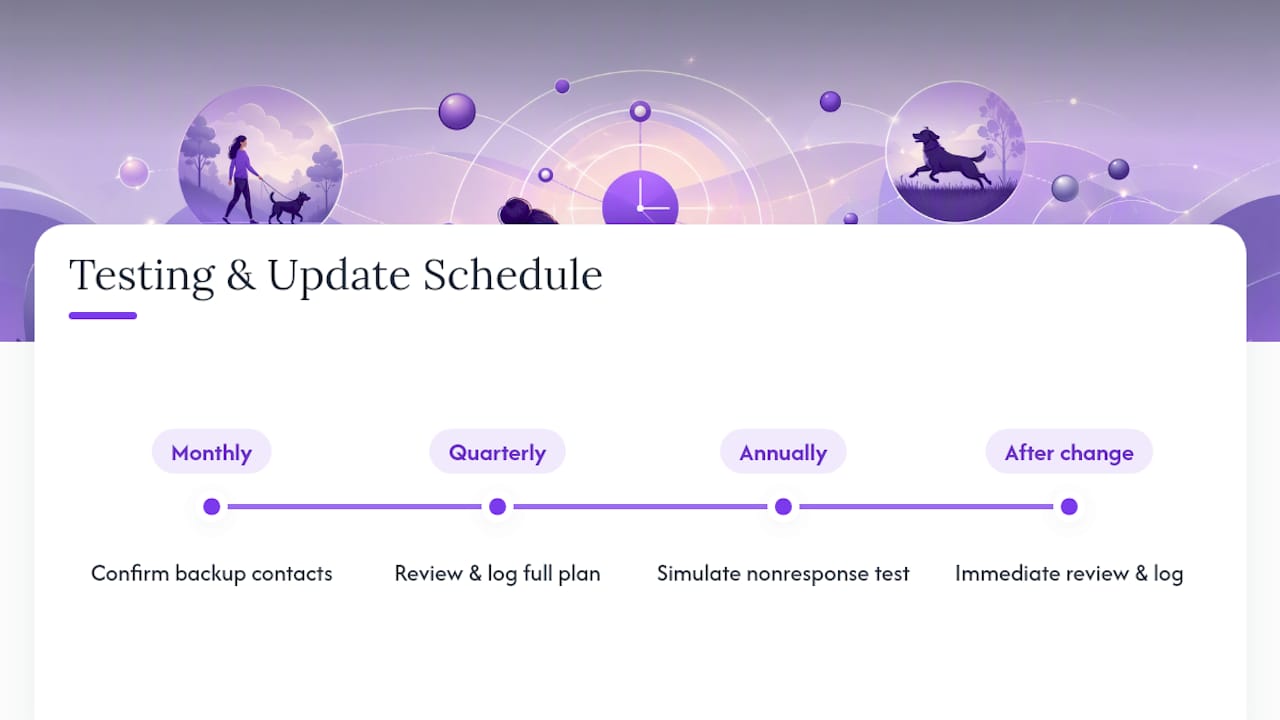
Run a quick monthly check: confirm backups’ phone numbers still work and that they still agree to their role. Simulate a nonresponse once a year to see if the escalation chain actually functions. Review the whole plan every quarter, or immediately after any medical change, move, or new caregiver, and log every update so nobody is working from an outdated version.
How Does Automation Take the Pressure Off This Plan?
A manual contact list depends on someone remembering to call the next person on time, every time. That’s the weak point most plans have. An automated wellness check-in service closes it by enforcing the response window itself: scheduled check-ins, a countdown timer, and automatic escalation to backups and then a veterinarian if you don’t respond.
- Centralized pet profiles hold your care instructions and authorization notes in one place.
- Countdown intervals enforce the response window without anyone needing to track time manually.
- Notification logs record who was contacted and when, so there’s no ambiguity later.
This is precisely the gap services that notify others are built to close for solo pet owners, cutting the number of phone calls you personally need to coordinate.
Why This Rule Exists
We built this rule after seeing the same failure pattern repeat: too many contacts and nobody acts first, or too few and one missed call leaves a pet waiting. A clean limit fixes both. Keep it humane. This is about your pet’s welfare, not a rigid checklist. If transport is likely, choose backups who live close enough to actually get there.
Ready to Put Your Contact Limit Into Practice?
Writing the rule down is one thing. Enforcing it every single day, without relying on your own memory or a backup’s attentiveness, is another. Mypetssafetynet is built specifically for that gap: instead of hoping someone notices you’ve gone quiet, the service checks in on your schedule and automatically notifies your primary and backup contacts, with your pet’s care instructions attached, the moment you miss a response window.
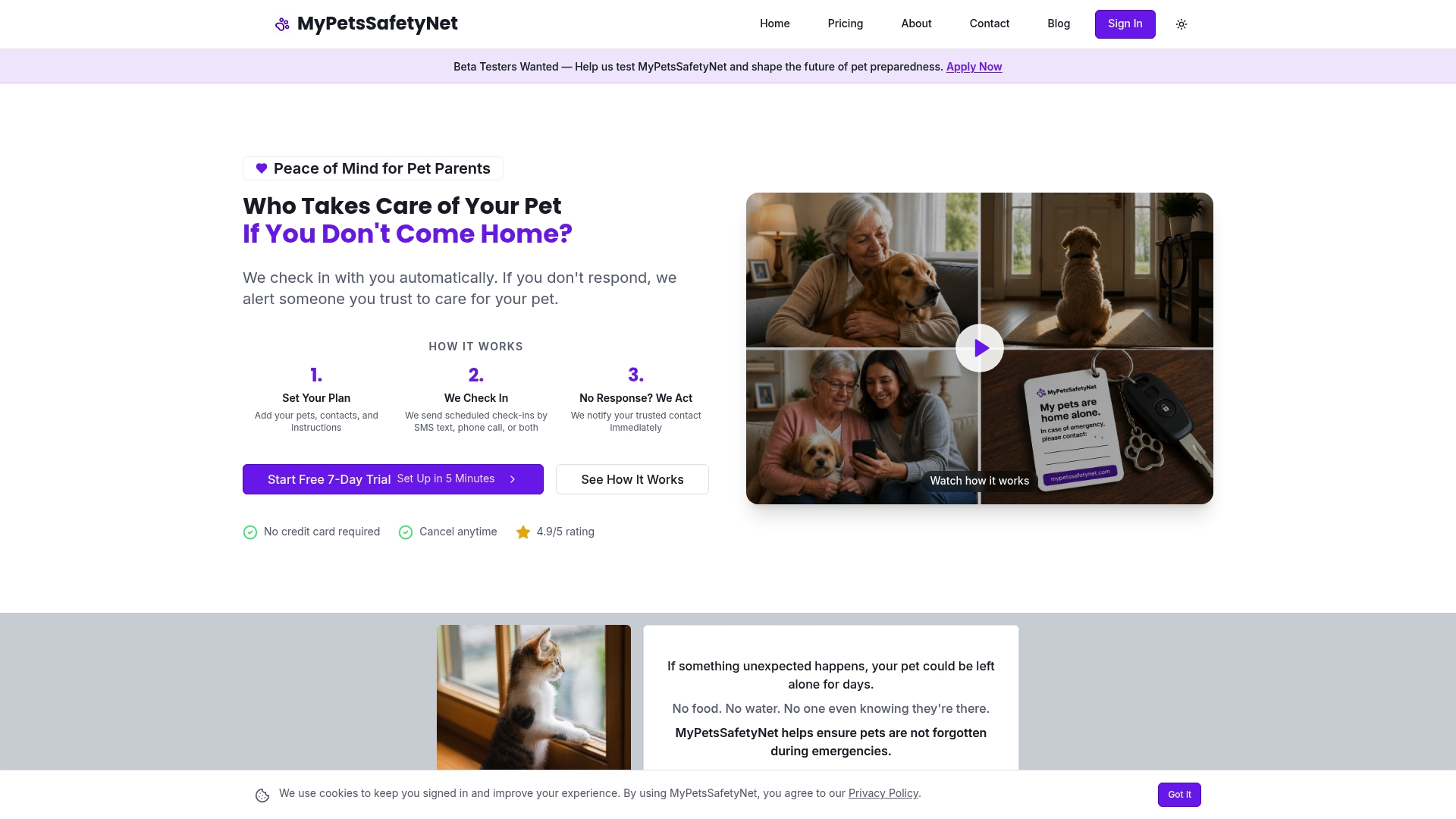
Setting it up takes a few minutes. Create a profile, add up to five pets and three emergency contacts, and set your countdown interval to match the response window that fits your situation. From there, the escalation happens automatically, no manual phone tree required. If you want to start simple, generate a free pet care card first at Mypetssafetynet and add the full check-in system when you’re ready.
Frequently Asked Questions
How many emergency contacts should a pet caregiver plan include? Two to three backup contacts plus your primary caregiver and veterinarian covers most situations without overloading any one person.
What is a reasonable response window before escalating? It depends on severity: 0 to 2 hours for urgent symptoms like seizures, 2 to 6 hours for serious but non-life-threatening issues, and up to 24 hours for routine check-ins.
Can I authorize a backup to approve veterinary treatment if I’m unreachable? Yes. A short written note authorizing treatment up to a set dollar amount, shared with your backups and vet, is usually enough to avoid delays.
How do I prevent my backup caregivers from burning out? Set clear hours when you won’t expect nonurgent responses, separate essential tasks from optional ones, and rotate check-ins so no single person carries the full load.
How often should I update my pet’s emergency care plan? Review it quarterly, or immediately after any medical change, move, or change in caregivers, and confirm your contacts’ phone numbers still work each time.
Sources
These sources shaped the recommendations above, each supporting a specific part of the plan.
- Communicating with clients: Using the right language to improve care (AVMA)
- Sample contract language and guidance on emergency contacts and escalation
- Veterinary Client Communication Guide | PetChart