Solo Pet Owners: ICE Pet Card Plus Automated Alerts for Up to 5 Pets

An ICE pet card is a wallet-sized alert telling responders or caregivers that pets are waiting at home and who to call. Print one now and slide it behind your driver’s license. The AVMA, Ready, and MyPetsSafetyNet all offer free templates, so there’s no reason to leave this undone.
TL;DR:
- A wallet-sized ICE pet card should include pet names, home address, primary and backup caregivers, veterinarian contact, and critical medical notes for quick identification.
- Placement behind your driver’s license, in your car, or on household stickers ensures responders are likely to find and read the card during an emergency.
- Redundancy through microchipping, multiple contacts, and regular updates to your plan is essential to cover failures of a physical card.
- Automated backup services can keep emergency contacts informed and escalate communication if the physical card is overlooked or becomes inaccessible.
- Using free templates from AVMA or Ready combined with durable, laminated cards and a comprehensive emergency plan enhances pet safety during crises.
Table of Contents
- What an ICE Pet Card Is and When It Helps
- Exactly What to Put on Your ICE Pet Card
- Where to Get or Make an ICE Pet Card
- How to Store the Card So Someone Actually Finds It
- Building a Full Pet Emergency Plan Around the Card
- The Overlooked Weakness in Most ICE Pet Card Advice
- A Free Pet Card, Plus an Automated Backup That Never Sleeps
- Trusted Downloads for Building Your Pet Emergency Kit
- Sources
- FAQ
What an ICE Pet Card Is and When It Helps
An ICE pet card (“In Case of Emergency”) is a small-printed card listing your pets, their care needs, and who to contact if you can’t get home. Picture a car accident, a sudden hospital admission, or a fall that leaves you unable to speak for yourself. Paramedics check your wallet for ID, not your phone, which may be locked, dead, or lost at the scene.
That’s exactly the gap a physical card closes.
- A police officer searching your wallet for identification spots the card immediately.
- Hospital intake staff scanning your belongings for emergency contacts see it too.
- A neighbor who finds you unresponsive doesn’t need to guess whether pets are inside.
Your phone might have the same information buried in a notes app, and your pet’s microchip might list a vet’s number. But a locked screen and a chip scanner that nobody at the scene owns won’t help your dog get fed tonight. A card in your wallet requires no technology, no password, and no assumption that anyone thinks to look for a chip.
Exactly What to Put on Your ICE Pet Card
Keep the card focused. A responder skimming it in seconds needs the essentials, not your pet’s full medical history. Fill in these fields in order of priority:
- Pet names and count. List every pet by name so nobody misses one hiding under the bed.
- Home address. Include this even if it seems obvious. Someone unfamiliar with you may need it to send help.
- Primary and backup caregiver names and phone numbers. List at least two people, since your first contact might not answer right away.
- Veterinarian name and phone number. This matters most if a pet has an ongoing condition.
- Critical medical notes. Note essential medications, brief dosing details, and any allergies.
- Access notes. Name a keyholder rather than describing where a spare key is hidden.
- Indoor-only status. Flag this so a caregiver doesn’t accidentally let a cat outside.
- Microchip note. A simple “microchipped, registered” line reassures whoever finds the card that the pet can be traced if needed.
Pro Tip: Never write your alarm code or full security system password on the card. If it’s lost or stolen, you’ve handed a stranger the keys to your house along with the location of your pets.
Where to Get or Make an ICE Pet Card
You have two paths: download a free template or buy a preprinted item built for durability. Both work. The right choice depends on how much time you want to spend.
- The AVMA’s downloadable pet emergency card is a standardized PDF sized for a wallet slot, already formatted with the fields veterinarians consider essential.
- Budget101’s free printable offers a two-page wallet-card layout with exact sizing and printing instructions, ideal if you want something ready in one sitting.
- Laminated wallet cards survive years in a wallet without smearing; keyfobs work well if you carry keys everywhere but skip a traditional wallet; window or door stickers announce pets to first responders entering a home.
- For printing, use cardstock (65 to 110 lb weight holds up far better than printer paper), align both sides carefully if double-sided, and laminate afterward. A basic home laminator sheet costs under a dollar and doubles the card’s lifespan.
Whichever version you choose, keep the layout simple enough to read in five seconds under stress.
How to Store the Card So Someone Actually Finds It
A perfectly filled-out card does nothing sitting in a drawer. Placement determines whether it gets seen at all.
- Slide it directly behind your driver’s license, alert side facing out, so anyone checking your ID sees it first.
- Keep a duplicate in your car’s emergency-info holder or glove compartment.
- Post a “Pets Inside” sticker on a front window or door, paired with a fridge copy near your exit, so firefighters or neighbors checking on you spot it fast.
Give copies to at least one neighbor and one family member, and tell them exactly where the wallet copy lives. Update every card the moment a phone number, medication, or caregiver changes. A card with an old contact number is nearly as useless as no card at all.
Pro Tip: Take a photo of your finished card and text it to your backup caregiver. If your physical copy is ever lost or damaged, they’ll still have every detail on hand.
Redundancy matters here. Combine the card with a collar tag, a registered microchip, and a household sticker so at least one signal reaches someone, no matter how the emergency unfolds.
Building a Full Pet Emergency Plan Around the Card
A wallet card is one layer of protection, not the whole plan. Ready.gov and the ASPCA both stress that physical backups matter because phone networks and internet access often fail exactly when you need them most, which is why pairing your card with a microchip and a written plan closes the gaps a single card can’t cover on its own.
Start with your microchip. Confirm the registration is current and list an out-of-area contact who won’t be affected by the same local emergency.
Next, assemble two kits: a shelter-in-place kit with food, water, and medication for at least a week, and a grab-and-go bag with a leash, carrier, and copies of vaccination records in a waterproof sleeve. The ASPCA’s disaster preparedness checklist covers both in detail.
Then round out the plan:
- Set up a buddy system with a trusted friend who has a spare key and knows your pets’ routine.
- Research pet-friendly shelters or boarding options in your area before you need them, not during a crisis.
- Review every contact number, medication note, and printed card every six months, since caregivers move and prescriptions change more often than people expect.
A card gets someone’s attention. The plan behind it is what actually gets your pets fed, walked, and safe until you’re back.
The Overlooked Weakness in Most ICE Pet Card Advice
Most guides treat the ICE pet card as the finish line. Print it, laminate it, done. That’s incomplete advice, and it leaves a real gap: a wallet card only works if someone finds your wallet in time, checks it, and then successfully reaches a caregiver who happens to be available.
That’s three points of failure, not one.

The conventional advice rarely addresses what happens when your first contact doesn’t pick up, or when hours pass before anyone thinks to check your ID. A printed card has no follow-up mechanism. It can’t escalate. It can’t try a second number if the first one goes to voicemail.
That’s the real limitation worth naming, and it’s why a physical card works best as one part of a layered system rather than the entire system. Solo pet owners in particular should prioritize redundancy over polish. A simple card, correctly placed, paired with a plan that keeps trying until someone answers, beats a beautifully designed card that just sits in a wallet hoping to be noticed. Get the basics right first. Build the backup second.
— MyPetsSafetyNet
A Free Pet Card, Plus an Automated Backup That Never Sleeps
A wallet card depends on someone finding it. MyPetsSafetyNet’s approach adds a second layer that doesn’t wait to be discovered. Beyond the free printable pet card generator, the service sends scheduled wellness check-ins by SMS, phone, or email, and if you don’t respond, it automatically notifies your named emergency contacts with full care instructions for each pet.
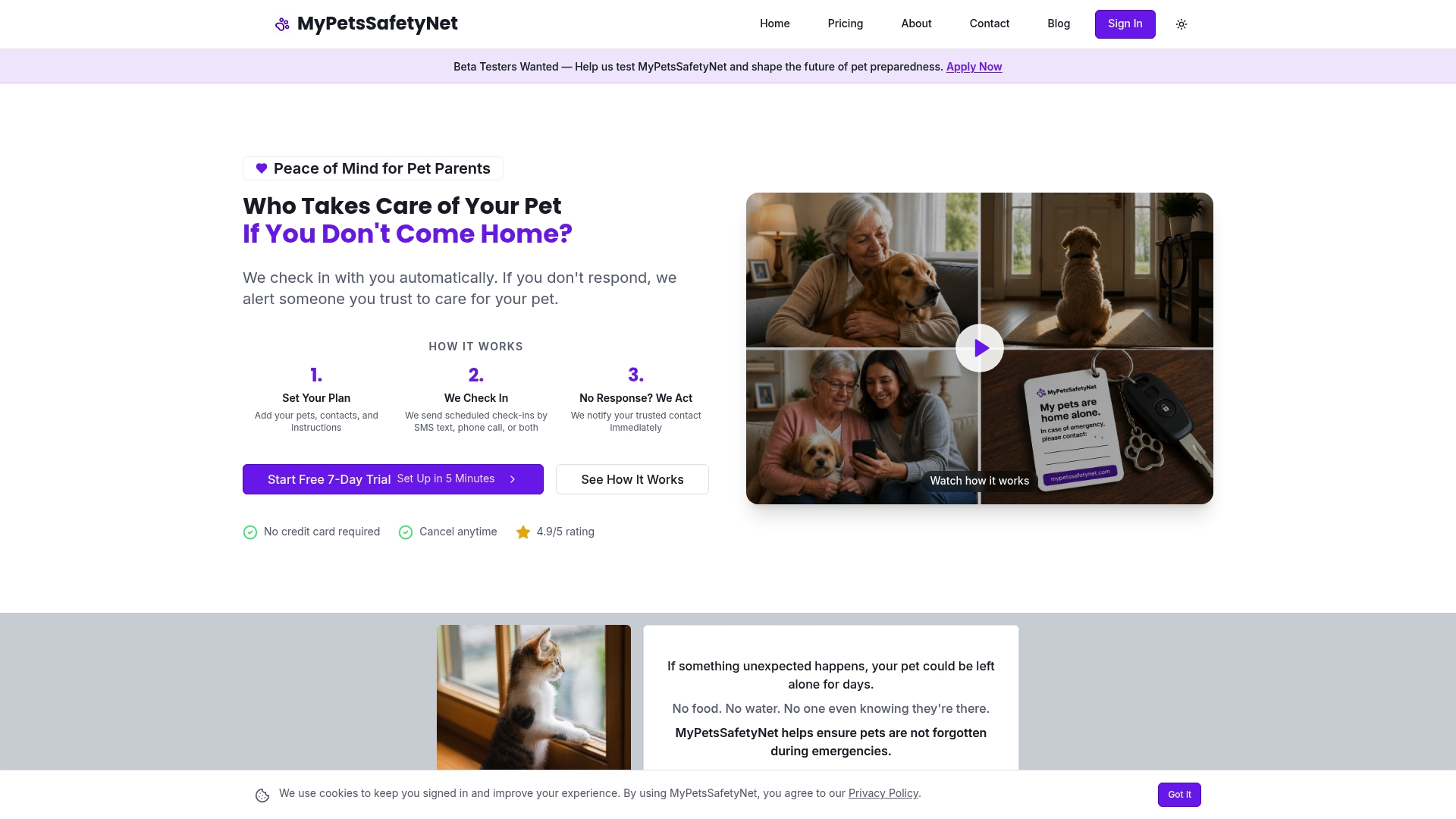
That escalation workflow is the piece a paper card can’t offer on its own. If your first contact doesn’t answer, the system keeps working instead of stopping. It fits solo pet owners, people managing health conditions, and anyone who wants an automated backup running quietly behind their physical card. Setup takes a few minutes, works with any phone since no smartphone is required, and covers up to five pets and three emergency contacts.
Download your free pet card today, then check the $6.99-per-month plan with a 7-day free trial if you want the automated check-ins running alongside it.

Trusted Downloads for Building Your Pet Emergency Kit
Skip the guesswork and pull directly from sources built for this exact purpose:
- The AVMA’s pet emergency card PDF gives you a ready-to-print, wallet-sized template.
- Ready walks through building a full family emergency plan that includes pets.
- The ASPCA’s disaster preparedness guide covers evacuation planning, microchipping, and kit contents.
- Budget101’s printable wallet card includes exact print and placement instructions if you want something DIY.
Sources
- AVMA pet emergency contact card (downloadable PDF)
- Ready
- ASPCA — Disaster preparedness for pets
- Budget101 — Free emergency pet wallet card printable
FAQ
What Is an ICE Card?
An ICE card, short for “In Case of Emergency,” is a small printed card carried in a wallet that lists critical contact and medical information for use if the carrier can’t speak for themselves. For pet owners, an ICE pet card extends that idea to list pets, caregivers, and vet contacts so animals aren’t forgotten during a personal emergency.
What Should I Do If My Pet Passes Away While My Emergency Plan Is Active?
Update your ICE pet card and any registered contacts immediately to remove that pet’s information, since an outdated card can confuse responders or caregivers during a future emergency. If other pets remain in your care, double check that their section of the card, along with your emergency contact list, still reflects accurate feeding and medication details.
What Should I Do Right After a Pet-Related Emergency Happens?
Contact your named backup caregiver first, since they should already know where your ICE card and spare key are kept. Then update your vet and any emergency contacts listed on the card so everyone has current information, and consider reviewing your full emergency plan to see what worked and what needs improvement.
Will First Responders Always Check for an ICE Pet Card?
Most police officers and EMTs are trained to check a wallet for ID and emergency information, but there’s no guaranteed protocol requiring them to look for a pet-specific card. That’s why placing it directly behind your driver’s license, alongside a Pets Inside sticker on your door or window, gives you the best odds of it being noticed.
Does MyPetsSafetyNet Charge for the Pet Card?
The pet card generator itself is free to use and download. The automated wellness check-in service, which adds scheduled alerts and emergency contact notifications, is available for $6.99 per month after a 7-day free trial.