First Responder Pets: Solo Owner Playbook for 2–4 Caregiver Alerts

An automated pet welfare service checks in on you by SMS, call, or email on a schedule you set, and if you miss too many responses, it notifies caregivers you’ve named and hands them a full profile for your pets. That’s the core promise: a dependable, repeatable way to get help to your animals fast when you can’t reach out yourself. One provider built specifically around this need.
TL;DR:
- Response windows can be customized, but caregivers are typically notified in order, not all at once, after missed check-ins.
- A detailed pet profile should include identification details, medical info, feeding routines, signed care authorization, and a two-week supply of food and medication.
- The service notifies caregivers promptly but does not guarantee that pets will be accepted at shelters, nor does it secure veterinary appointments or boarding spaces.
- Testing caregiver response and updating contact and pet information regularly improves reliability, with quarterly drills recommended.
- Caregivers should be verified beforehand, familiar with pet routines, and provided with printed care instructions, especially since alerts do not replace emergency dispatch.
Table of Contents
- How these services work: check-ins, triggers, and their limits
- Emergency pet profile checklist: what to record for each pet
- How to choose and set up an automated check-in service for your pets
- After a failed check-in: what caregivers should do next
- Limitations and safety notes worth planning around
- Caregiver readiness: recruiting and rehearsing the people who’ll act
- Why we built this for solo pet owners
- Try MyPetsSafetyNet for your own pets
- Sources
- FAQ
How these services work: check-ins, triggers, and their limits
The mechanics are simple by design. You set a check-in schedule, choose how you want to be reached (text, phone call, or email), and confirm you’re okay with a quick response. Miss that window and a grace period starts, giving you a buffer before anything escalates.
If you don’t respond within that grace period, the system moves to your emergency contacts in the order you set, sending each one a message that includes your pet’s care summary so they know exactly what they’re walking into.
- Response windows and grace periods are configurable to suit different schedules.
- Escalation typically follows an ordered list of two to four contacts rather than blasting everyone at once.
- Test alerts let you confirm your caregivers actually receive and understand the message before you ever need them.
- These tools are not a 911 dispatch service and don’t guarantee shelter space or an open veterinary bed.
That last point matters. The alert gets a person moving toward your pets. What happens after that depends on preparation you do ahead of time.
Emergency pet profile checklist: what to record for each pet
A caregiver arriving at your home for the first time needs more than an address. They need a profile that answers every question they’ll have in the first five minutes.
- Identification: legal name, breed, color, distinguishing marks, current photos, and microchip number.
- Medical details: conditions, medications with exact doses and times, your regular vet’s contact, an emergency clinic’s contact, and proof of rabies vaccination.
- Daily care notes: feeding amounts and times, where the carrier and leash live, and any handling quirks a stranger should know about before opening the crate.
- Signed veterinary authorization naming who can make care decisions, along with any spending limits for treatment.
- A two-week supply baseline of food and medication, plus where the first-aid kit and house keys are kept.
The CDC’s preparedness checklist calls for exactly this kind of documentation: vaccination records, medical summaries, prescriptions, and a two-week supply of food and medication kept on hand. A pet profile template built for wellness checks can save you from filling this out from scratch.
Pro Tip: Keep a printed copy of the profile in the same drawer as your pet’s carrier, not just saved on your phone, since a caregiver may not have your passcode.

How to choose and set up an automated check-in service for your pets
Not every check-in tool fits every household, so weigh a few things before you commit.
- Delivery channels: does it reach you by text, call, and email, or just one?
- Grace period flexibility: can you set a window that matches your routine instead of a fixed default?
- Multi-contact escalation: does it notify more than one person, in an order you control?
- Full pet-instruction support: can it hold care details, not just a phone number to call?
- Ease of updates: can you change vet info or medication doses in minutes when something changes?
- Test mode: can you run a dry alert to confirm your setup actually works?
Once you’ve picked a service, the setup itself is quick. Add two to four confirmed caregivers, upload a profile and photo for each pet, record your vet and emergency clinic details, set your escalation timing, and run a test alert before you rely on it. Keep a printed copy of your authorization forms in a caregiver packet, since not everyone will have reliable phone access the moment they need the details. An automated check-in explainer walks through this setup in more detail.
After a failed check-in: what caregivers should do next
Once escalation starts, your named caregiver gets a message with your pet’s profile, your address, notes on how to get in, your vet’s contact, and specific instructions for that visit. What they do with it follows a clear sequence.
- Try to reach you directly first, in case the missed check-in was a simple mix-up.
- Use a prearranged key or lockbox to enter lawfully, never by forcing entry.
- Check on each pet and follow the medical instructions in the profile, including any medication schedule.
- Call the vet or arrange transport if a pet needs care beyond basic attention.
- Call 911 only if there’s evidence of a medical emergency involving you, not for pet-only concerns, since these alerts route to people, not to emergency dispatch.
- Note the time of each action taken, in case questions come up later about what happened and when.
The AVMA’s guidance on authorized agents recommends naming one person with final decision authority and putting that authorization in writing, which avoids delays when several caregivers are involved.
Limitations and safety notes worth planning around
An alert gets a person to your door. It doesn’t guarantee what happens after that, and a few gaps are worth closing yourself.
- Many evacuation centers turn pets away, so CDC guidance on evacuation centers recommends identifying pet-friendly shelters or boarding options ahead of time.
- Your caregiver’s availability and capacity aren’t guaranteed by the alert itself, and no service secures a boarding spot or a vet appointment for you.
- Never suggest or attempt entry without a prearranged key, lockbox code, or signed authorization on file, both for legal reasons and for your caregiver’s safety.
- Keep a running list of local pet-friendly shelters and boarding facilities, and update it alongside your pet’s profile.
Caregiver readiness: recruiting and rehearsing the people who’ll act
The alert only works as well as the people it reaches. Choosing the right caregivers, and keeping them ready, is the part most owners skip.
- Pick people who already know your pet, live close enough to arrive quickly, and can physically manage a carrier or leash.
- Confirm willingness directly rather than assuming a family member or neighbor is available; ASPCA’s planning guidance treats this confirmation step as essential, not optional.
- Reconfirm caregivers whenever your situation changes, a move, a new pet, a caregiver’s own relocation, and at least once a year regardless.
- Run a quarterly test alert and one live rehearsal a year where a caregiver actually walks through your home access and the care packet.
Pro Tip: A test alert that succeeds doesn’t mean the job is done. Ask your caregiver afterward if they actually know where the leash, food, and keys are, since that’s where most real gaps show up.
Give each caregiver a printed or digital copy of the care packet, and list a backup contact method in case their phone is unreachable. Guides like the one on naming pet emergency contacts go deeper on how to pick and brief this group.

Why we built this for solo pet owners
We started MyPetsSafetyNet around one question: what happens to your pets if something happens to you and no one’s there to notice? Our answer was to build a service that notifies your emergency contacts promptly and hands them the pet-specific instructions they need immediately, not a generic alert that leaves them guessing.
That focus shapes everything we publish, from an emergency pet care plan walkthrough to a pet profile template built for exactly this use case. We also cover the harder edges, like what happens if you’re hospitalized and who actually shows up to check on your animals.
If you already have a plan on paper, take ten minutes this week to run a test alert. If you don’t, that’s the gap worth closing first.
— MyPetsSafetyNet
Try MyPetsSafetyNet for your own pets
MyPetsSafetyNet gives you scheduled check-ins by text, call, or email, escalation to caregivers you name, and pet profiles that carry the exact instructions those caregivers need. It works with any phone, no smartphone required, and setup takes less than 10 minutes.
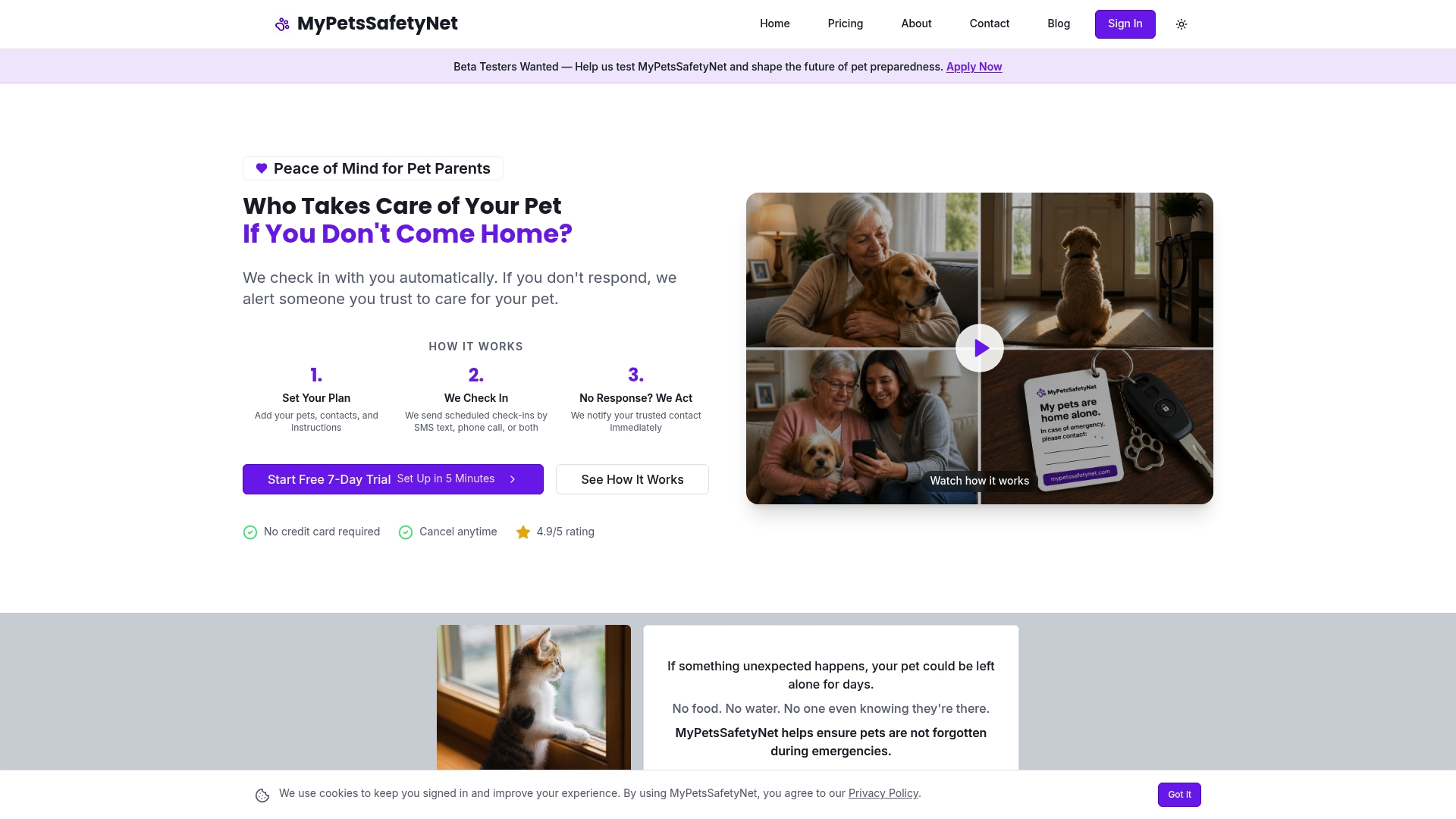
You can start with a 7-day free trial and no credit card required, then move to the Monthly plan priced as published by the provider once you’re set up. If you want to see the service in action first, visit MyPetsSafetyNet to review how the check-ins and alerts work before you commit.
Sources
- Ensuring your pet is protected when you’re away | American Veterinary Medical Association
- Emergency preparedness kit for pets | CDC
- Making a plan for your pet | ASPCA
FAQ
What is an automated pet welfare check-in service?
It’s a scheduled check-in system that contacts you by text, call, or email and notifies caregivers you’ve named if you don’t respond within a set window. The alert includes your pet’s care profile so the caregiver knows exactly what to do when they arrive.
Who should I name as a pet emergency caregiver?
Choose someone who already knows your pet, lives close enough to respond quickly, and has agreed in advance to the role. ASPCA planning guidance recommends confirming willingness directly rather than assuming a neighbor or relative is available.
Do these alerts replace calling 911 in an emergency?
No. An automated pet check-in service notifies the people you’ve named, not emergency dispatch, and it’s not a substitute for calling 911 if you or someone else needs urgent medical help. Caregivers handle the pet side; emergency services handle the human side.
What should I include in a pet’s emergency profile?
Include identification and microchip details, medications with doses and times, vet and emergency clinic contacts, feeding instructions, and a signed veterinary authorization naming a decision maker. The CDC’s preparedness kit guidance lists these same categories, along with a two-week supply of food and medication.
Will an evacuation shelter take my pet if I’m not there?
Not always. CDC guidance on evacuation centers notes that many evacuation centers don’t accept pets, so it’s worth identifying a pet-friendly shelter or boarding option in your area ahead of time.