Set Up Automated Wellness Alerts in 10 Minutes for Disabled Pet Owners

An automated wellness check-in service is the practical safeguard for disabled or solo pet owners: it contacts you on a schedule and, if you don’t respond, notifies the caregivers you’ve named with the pet-care details they need. The immediate step is simple. Schedule your check-ins and name at least two emergency contacts who can act fast.
TL;DR:
- Automated check-ins ensure caregivers are alerted within hours of a missed response, reducing pet unattended time significantly.
- System configuration should include multiple contacts, with regular testing every six months or after changes, to prevent gaps in response.
- Clear, detailed instructions for pets with disabilities, including mobility aids and medication routines, improve care accuracy during emergencies.
- Many systems support basic phones via SMS and calls, removing the need for smartphones and making setup accessible to more owners.
- Reconfirm caregiver availability periodically and keep pet care documentation current to maintain reliability of the safety plan.
Table of Contents
- What disabled pet owner alerts are and why they matter
- Who benefits most and what to realistically expect
- How automated alerts work: triggers, channels, and escalation
- Build your support network and pet-care documentation
- Set up and test your automated check-in service
- Special care instructions for pets with mobility limits or disabilities
- How MyPetsSafetyNet approaches alerts for disabled pet owners
- Getting started with MyPetsSafetyNet
- FAQ
- Sources
What disabled pet owner alerts are and why they matter
A disabled pet owner alert is an automated wellness check-in that escalates to named caregivers when you miss a response, delivering your pet’s care instructions along with the notification. This is distinct from a service-animal alert or a lost-pet notification system. Those solve different problems; this one is built around a single question: who feeds, waters, and medicates your pet if something happens to you today?
Formal automation beats informal promises because promises fade and schedules slip. A neighbor who says “call me if you need anything” rarely gets a call when you’re the one who’s unresponsive. An automated system doesn’t wait to be remembered. It acts on a clock.
Ready recommends building a support network where at least one person holds an extra key and knows how to use lifesaving equipment or administer medication, which is exactly the structure an automated check-in is designed to trigger.
The benefits compound quickly:
- Your pet spends less time unattended because caregivers are alerted within hours, not days.
- Your pet’s routine stays intact because feeding and medication schedules are written down, not guessed at.
- Caregivers act with confidence because they have instructions in hand, not just a phone call asking them to improvise.
Who benefits most and what to realistically expect
These alerts are built for adults who live alone with a disability, a mobility limitation, a chronic medical condition, or a reliance on daily medical devices like oxygen concentrators or dialysis equipment. If a fall, seizure, or sudden hospitalization could leave you unable to respond to a phone for hours, this system closes that gap.
Realistic outcomes look like this:
- Pets spend less time unattended because a named caregiver is notified instead of waiting for someone to notice something is wrong.
- Caregivers arrive faster because they already know where the key is and what the pet needs.
- Emergency rehousing becomes less common because a plan, not panic, decides what happens next.
None of this works if your contact list goes stale. A caregiver who moved last year or no longer has a spare key is a gap in the plan, not a safety net.
Pro Tip: Put a reminder on your calendar every few months to text each caregiver and confirm they’re still willing and able to help.
How automated alerts work: triggers, channels, and escalation
The mechanics are straightforward once you see the sequence. You set a check-in schedule, the system reaches out on that schedule, and if you don’t respond within a set window, it escalates.
- The service sends a scheduled check-in through your chosen channel at the time you set.
- You confirm you’re okay within the response window, and the cycle resets.
- If you miss the window, the system retries, then alerts your primary contact.
- If the primary contact doesn’t respond either, it moves to your backup contacts.
- Once a caregiver is reached, they receive your pet’s care details along with the alert, and a physical welfare check can follow.
Channels typically include SMS, automated phone calls, email, and voice alerts, which matters because not every disabled or elderly pet owner has or wants a smartphone. A system that works over a basic phone line removes a real barrier to adoption.
Ready.gov’s caregiver preparedness guide advises testing the full escalation chain, simulating real conditions so every participant knows their role and can reach the property quickly. That single test run is often the difference between a plan that works and one that only looks good on paper.
Pet-care instructions themselves are stored in a profile tied to your account and released to caregivers only when the alert fires, which keeps sensitive details like medication dosages and home access notes private until they’re actually needed. For a closer look at how this pairs with broader health monitoring, see our automated pet safety check-ins overview.
Build your support network and pet-care documentation
A good support network has structure, not just names. Recruit deliberately, then document everything so a stressed caregiver can act without guessing.
- Name a primary contact who lives nearby and can respond within an hour or two.
- Add at least two backup contacts in case the primary is unreachable.
- Include one out-of-town contact who can coordinate by phone even if local contacts are delayed.
- Give each person a key or access code, and confirm they know how to use it.
- Walk each contact through your pet’s feeding schedule, medication routine, and vet information before an emergency, not during one.
Documentation turns a willing caregiver into an effective one:
- Write an Emergency Pet Care Sheet listing feeding times, medications, vet contact, and microchip number.
- Keep a wallet-sized pet alert card and a door-posted version for first responders.
- Store food, meds, and supplies in one obvious, labeled location.
FEMA’s caregiver preparedness guide recommends creating, sharing, and practicing these plans with your support network rather than assuming everyone remembers the details from a single conversation. The ASPCA’s guidance on making a plan for your pet backs this up, noting that a visible, written pet-care sheet significantly improves how quickly and well a pet is cared for when an owner is incapacitated.
Pro Tip: Laminate your Emergency Pet Care Sheet and tape a copy inside a kitchen cabinet near the pet food, where any caregiver will see it immediately.
For more on choosing how many contacts to name and why redundancy matters, see our guide to emergency contact numbers.

Set up and test your automated check-in service
Configuration starts with two decisions: how often you check in, and how long the system waits before escalating.
A common setup looks like a daily morning check-in with a two-hour response window, though some owners with higher medical risk prefer twice-daily check-ins with a shorter window. Our custom check-in interval guide walks through sample configurations for different needs.
Escalation messages should be specific, not vague. A workable template reads: “This is an automated alert. [Owner name] has not responded to a wellness check. Please check on them and their pet, [pet name]. Spare key location: [location]. Feeding schedule and medication details are attached.”
Testing is not optional. Run a scheduled test, confirm each contact actually receives and understands the alert, and practice the access procedure at least once so nobody is fumbling with a lockbox during a real emergency.
| Maintenance task | Recommended frequency |
|---|---|
| Re-confirm caregiver availability | Every 6 to 12 months |
| Update pet medical or care details | Whenever anything changes |
| Run a full escalation test | Every 6 months |
| Review response window settings | Annually or after a health change |
- Keep your pet profile current whenever a medication, vet, or feeding schedule changes.
- Treat a missed test the same way you’d treat a missed real alert: investigate why.
Special care instructions for pets with mobility limits or disabilities
Pets with disabilities need a different kind of documentation than a healthy, mobile animal. If your pet uses a wheelchair, ramp, sling, or other mobility aid, your care sheet should describe exactly how to use it, not just that it exists. A caregiver who has never lifted a dog with hip dysplasia into a sling needs a sentence or two of instruction, not a guess.

Medication routines for pets with chronic conditions, like insulin for a diabetic cat or anti-seizure medication for a dog with epilepsy, need exact dosages, timing, and what happens if a dose is missed. Behavioral notes matter too: a deaf dog that startles easily, or a blind cat that needs furniture kept in a consistent layout, benefits from a caregiver who knows these details before they walk in the door.
List any specialized equipment and where it lives: ramps, orthopedic bedding, hearing-aid-style collars, or mobility harnesses. Note any vet or specialist who manages an ongoing condition, since a regular vet visit schedule is easy for a temporary caregiver to miss entirely.
If your pet wears a GPS tracking collar for roaming or escape risk, note that in the care sheet as well. Devices like the HAVEN Freedom GPS dog collar can alert a caregiver if a pet with mobility or behavioral challenges wanders off during a transition period, adding a layer of location awareness alongside your wellness check-in plan.
How MyPetsSafetyNet approaches alerts for disabled pet owners
We built our check-in and escalation system around the gap disabled and solo pet owners actually face: not a lack of concern from caregivers, but a lack of structure. Our service runs scheduled check-ins, manages escalation to named contacts, stores pet profiles with care instructions, and works without a smartphone, since SMS and phone calls are supported alongside app-based alerts.
We designed voice-based check-ins specifically for owners who rely on medical devices or have limited dexterity, so responding doesn’t require navigating a touchscreen under stress. Our free pet-care card and blog resources walk through documentation step by step, and we continue to publish detailed setup guides as more owners share what’s worked for their households.
— MyPetsSafetyNet
Getting started with MyPetsSafetyNet
Setting up your safety net takes less than 10 minutes, and a free trial is available so you can test the full escalation flow before paying anything.
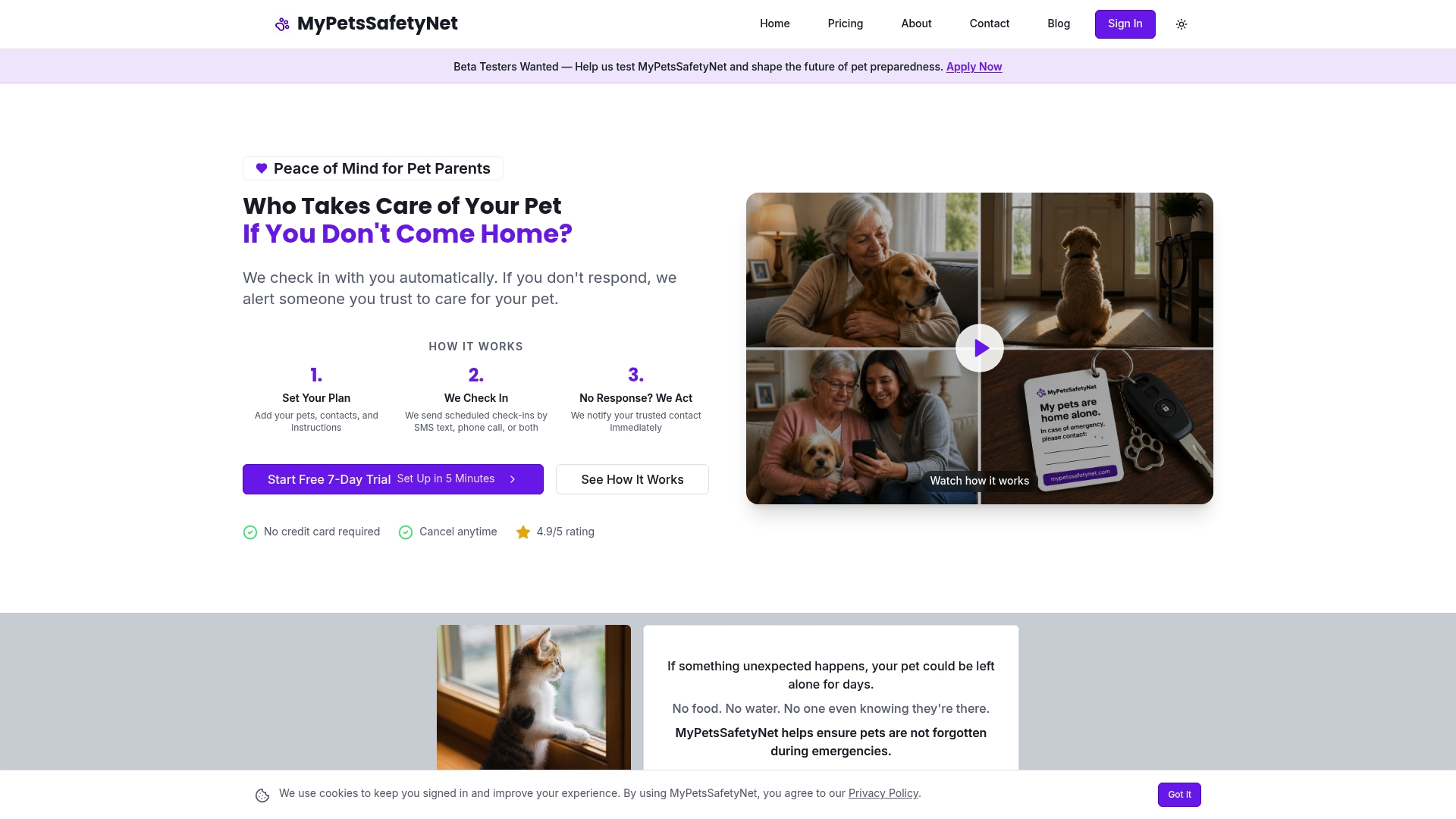
Before activating escalation, gather a few things:
- Names and phone numbers for your primary and backup emergency contacts.
- Your pet’s feeding, medication, and vet information.
- A spare key location or access code for each caregiver.
- Your free printable pet alert card filled out and posted where it’s visible.
Our Monthly plan is available after your trial, with up to 5 pets and 3 emergency contacts included. Use the trial week to run a real test: schedule a check-in, miss it on purpose, and confirm your contacts actually get the alert with your pet’s details attached.
FAQ
What exactly happens if I miss a wellness check-in?
The system retries the check-in, then alerts your primary emergency contact with your pet’s care details attached. If that contact doesn’t respond, it escalates to your backup contacts in order.
Do I need a smartphone to use an automated pet alert service?
No. Many services, including ours, support SMS and automated phone calls, so a basic phone works for both receiving and responding to check-ins.
How many emergency contacts should I name for pet care alerts?
Most guidance recommends a primary contact plus at least two backups, including someone out of town who can coordinate by phone. Our emergency contacts guide walks through sample scripts for each role.
How often should I confirm my caregivers are still available?
Plan to reconfirm every 6 to 12 months, and immediately after any major life change for you or your contacts. A caregiver who moved or changed their schedule is a gap in your plan until you catch it.
What should a pet-care emergency sheet include?
It should list feeding times, medication dosages and schedule, vet contact information, microchip number, and the exact location of supplies and keys. The ASPCA’s pet planning guidance offers a template to start from.