Avoid Days of Delay for Solo Pet Owners With Unresponsive At Home Pets

An automated wellness check-in service checks in on you by phone, text, or email on a schedule you set, and if you don’t respond, it notifies your named caregivers with your pet’s care details so they can step in fast. You get a safety net that catches the gap between “something’s wrong” and “someone finds out.” It’s not a replacement for 911: it’s the layer that makes sure your pets aren’t forgotten while help is on the way.
TL;DR:
- Automated check-ins can be scheduled multiple times a day with response windows of several hours before escalation to caregivers occurs.
- Building a comprehensive pet-care packet with current documents, medications, behavior notes, and emergency authorizations is essential for quick caregiver response.
- Naming two to four nearby, willing emergency contacts and confirming their availability annually ensures reliable coverage during emergencies.
- Call 911 immediately for active medical emergencies or immediate danger; automated check-ins are not a substitute for urgent rescue services.
- MyPetsSafetyNet offers a low-cost plan with a free trial, supporting up to three emergency contacts and customizable check-in schedules to suit individual needs.
Table of Contents
- How automated wellness check-ins and escalation workflows work
- Prepare your pet-care packet: documents, meds, and supplies to assemble now
- Choosing, confirming, and documenting emergency caregivers and escalation rules
- When to call 911 or request a welfare check vs relying on automated check-ins
- Home readiness: visible rescue stickers, entry options, and safe arrival logistics
- Why a pet-focused automated check-in matters
- Getting started with automated pet wellness check-ins
- Sources
- FAQ
How automated wellness check-ins and escalation workflows work
The idea is simple: you set a schedule, the service checks in, and you confirm you’re okay. Miss enough check-ins and it escalates to the people you’ve named in advance.
Most systems let you choose the check-in frequency, the response window, and whether prompts arrive by SMS, phone call, or email. That flexibility matters if you don’t own a smartphone or prefer a simple phone call over a text message.
Here’s a typical sequence: you get a prompt, you have a set window to respond (say, a few hours), and if you don’t, the system tries again before escalating. Once escalation triggers, your named caregivers receive an alert along with your pet’s profile: feeding schedule, medications, vet contact, and any behavior notes they’ll need on arrival.

These services are a proactive verification layer, not a monitoring camera or a medical device. They won’t detect a fall or a seizure. What they do is close the silence: if you go quiet, someone finds out in hours instead of days, and that person arrives already knowing how to care for your pet, not guessing. Pairing this with other safety tools, like a medical alert system or a check-in from a neighbor, builds a fuller picture of coverage rather than relying on one method alone.
Prepare your pet-care packet: documents, meds, and supplies to assemble now
A caregiver showing up to an unfamiliar home with an anxious pet and no information wastes time you don’t have. A pet-care packet solves that before it becomes a problem.
The CDC’s guidance on pet disaster kits recommends keeping waterproof copies of key documents so they survive water damage or a rushed grab on the way out the door. At minimum, your packet should include:
- Proof of ID and microchip number, plus the chip registry’s contact information.
- Current vaccination records and any known allergies or chronic conditions.
- A written medication list with exact dosages and timing.
- A feeding schedule, including portion sizes and any dietary restrictions.
- Brief behavior notes: whether your pet bites, hides, or needs a slow approach from strangers.
A signed veterinary treatment authorization deserves its own line item. The AVMA notes that without one, a clinic may not be able to legally treat your pet or make payment decisions on your behalf, since the person standing in the exam room isn’t the owner on file. That single signed form can be the difference between fast treatment and a caregiver stuck on hold.
Round out the packet with two weeks of food and water, a labeled carrier or leash, and one comfort item like a blanket or toy.
Pro Tip: Keep one copy in a waterproof pouch by your front door, one on a wallet-sized card in your bag, and a digital copy uploaded to your check-in service profile so it’s shareable the moment it’s needed.
Choosing, confirming, and documenting emergency caregivers and escalation rules
The right caregivers are the ones who live nearby, have said yes, and are actually capable of handling your pet, not just the first names that come to mind. Most guidance points to naming two to four emergency contacts, which gives you a backup if your first choice is unreachable.
- Pick contacts who are close and willing. A cousin two states away can’t feed your cat tonight.
- Confirm consent directly, and don’t assume a family member is on board just because they’re family. The ASPCA recommends checking in periodically to make sure your chosen caregivers are still available and willing, ideally at least once a year.
- Set a clear order, a primary contact and a secondary, with a defined escalation timeline between them.
- Tell caregivers what to do on arrival, including where the packet is and who to call first.
- Keep the list in three places: your check-in service profile, a wallet card, and the home packet itself.
When to call 911 or request a welfare check vs relying on automated check-ins
An automated check-in service tells your caregivers something’s wrong. It doesn’t send help itself, and it’s not built to.
If you or someone else observes an active medical emergency, a fall with visible injury, or any sign of immediate danger, call 911 first. That’s true regardless of whether a check-in system is also in place. Automated alerts work in the background for the times no one is watching; they’re not a substitute for reporting what you can see right now.
When a caregiver can’t reach you and can’t get into your home, requesting a police welfare check is the next step. According to IACP guidance on welfare checks, officials need your address, relevant medical information, and whether pets are present, along with any access instructions like a lockbox code. Giving them this upfront saves time once they’re on-site. Automated check-ins and welfare checks work together: one raises the alarm, the other gets someone through the door.

Home readiness: visible rescue stickers, entry options, and safe arrival logistics
Getting someone to your door is only half the job. They need to get in and know what they’re dealing with once inside.
- Place a rescue alert sticker on a front window or door, listing the number and type of pets inside, as recommended by the FDA’s pet disaster guidance.
- Keep a spare key with a nearby neighbor or in a lockbox, and record the access code in your pet packet and check-in profile.
- Label your pet’s carrier or collar with any medical cautions, like “does not get along with other dogs” or “needs muzzle for vet visits.”
- Store your signed veterinary authorization where a caregiver will actually look, not buried in a drawer.
For dog owners worried about a pet escaping during a chaotic arrival, containment options like the HAVEN invisible fence add another layer of security without needing a subscription.
Why a pet-focused automated check-in matters
Most safety planning focuses on the person. Pets get an afterthought, if they get mentioned at all. That gap is what MyPetsSafetyNet was built to close, for solo pet parents, elderly pet owners, and disabled owners living independently who need more than a generic wellness call.
The service maps directly to the checklist above: pet profiles hold feeding and medication details, escalation reaches your named caregivers automatically, and a printable pet-care card puts the essentials in one place. Setup is built to be quick, and support is there if you get stuck. The goal isn’t just knowing you’re okay. It’s making sure your pet is never the one left waiting.
— MyPetsSafetyNet
Getting started with automated pet wellness check-ins
You’ve built the packet, picked your caregivers, and figured out your escalation rules. The last step is putting it on autopilot instead of relying on memory. MyPetsSafetyNet turns your pet-care packet and contact list into scheduled check-ins that notify your named caregivers automatically if you go quiet, with your pet’s details attached.
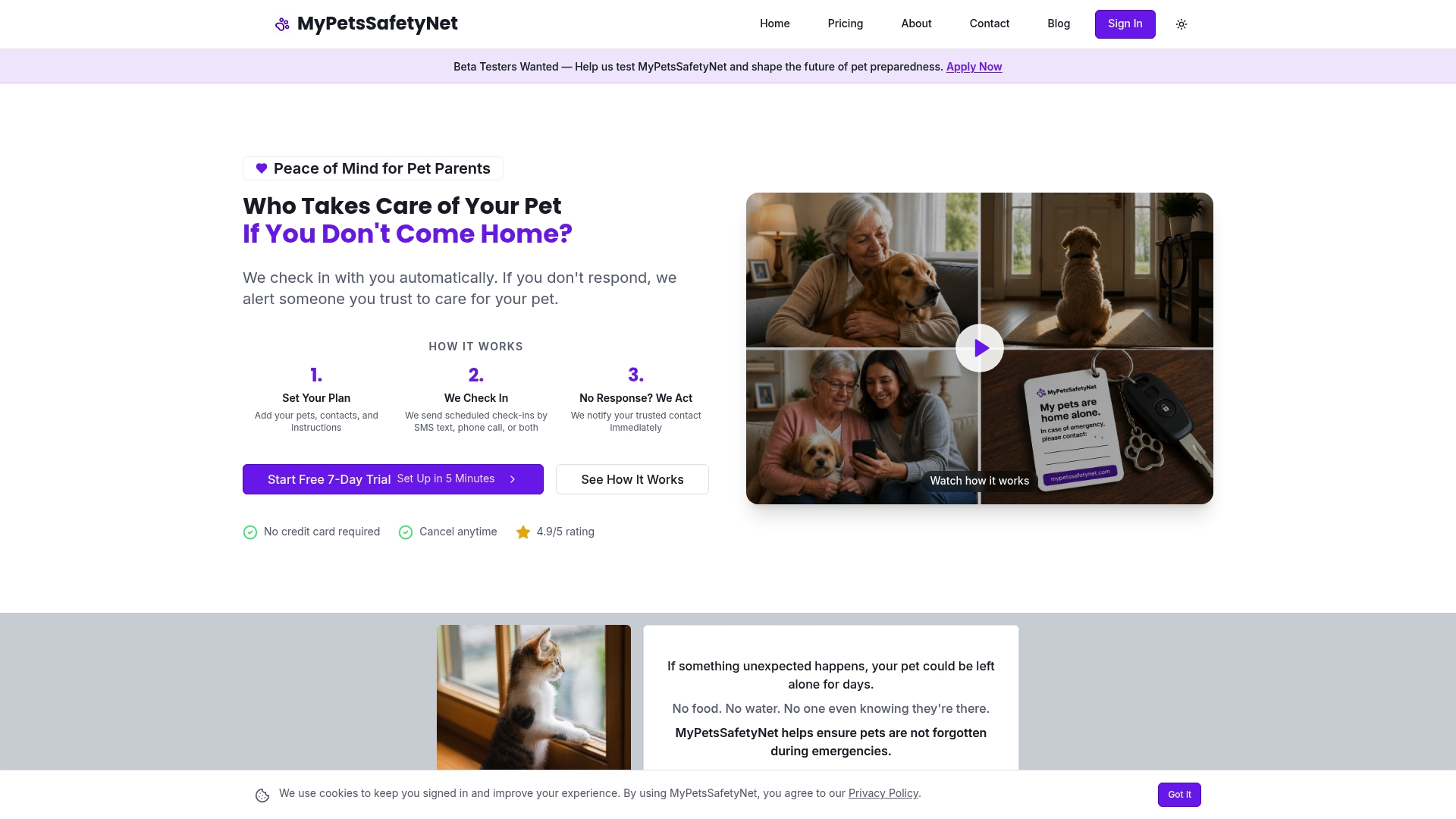
- Sign up for a 7-day free trial, no credit card required.
- Add up to 5 pets and up to 3 emergency contacts, with customizable check-in schedules.
- Send a test check-in in your first 10 minutes to confirm notifications reach your contacts correctly.
Plans are available with pricing and details provided on the pricing page. If you want to start smaller, grab the free wallet-sized pet card first and build from there.
Sources
- Build a Pet Disaster Preparedness Kit | Healthy Pets, Healthy People | CDC
- Making a plan for your pet | ASPCA
- Ensuring your pet is protected when you’re away | AVMA
- Welfare checks guidance | IACP (International Association of Chiefs of Police)
- Take care of your pets before disaster strikes | FDA
FAQ
How fast will my caregivers be notified if I don’t respond?
Notification timing depends on the check-in schedule and response window you set, which can range from a few hours to longer intervals. Once the window passes without a response, the system escalates automatically to your named caregivers with your pet’s care details.
Do I need a signed veterinary authorization form?
Yes. The AVMA notes that without a signed authorization, a veterinary clinic may not be able to treat your pet or make payment decisions when someone other than the registered owner brings them in.
Should I call 911 instead of relying on an automated check-in?
Yes, always call 911 for an observed medical emergency or immediate danger. Automated check-ins are a background safety layer for when no one else is watching, not a replacement for emergency response.
How many emergency contacts should I list?
Most guidance recommends naming two to four emergency contacts so you have a backup if your primary contact is unreachable. MyPetsSafetyNet supports up to 3 emergency contacts per account.
What does MyPetsSafetyNet cost?
MyPetsSafetyNet’s monthly plan is $6.99 per month, with a 7-day free trial and no credit card required to start. Full pricing details are available on the pricing page.