Pet Owners’ Alert Quiet Hours: Silent First, SMS in 15 to 30 Minutes

Yes, you can and should set quiet hours for pet alerts, and you should pair them with a tiered escalation so only urgent events break the quiet window. Pick a nightly window now, such as 10:00 p.m. to 7:00 a.m., then build a simple ladder: silent nudge, then SMS or call, then your emergency contact. We built MyPetsSafetyNet to help pet owners manage emergency escalation, and the sections below show you how to set it up.
TL;DR:
- Choose a window that matches the main contact’s sleep schedule, then shift it for night work, after surgery, guests, or a newly adopted pet.
- Use a silent nudge first, an owner text or call after 15–30 minutes, and an emergency contact after 60–120 minutes; adjust for health risks.
- Mark missed wellness checks as exceptions, set retry intervals, confirm emergency contacts have agreed, and test every escalation stage before relying on the system.
- Local noise rules vary, and some areas count 15 minutes of continuous barking or 30 minutes in a day as a violation; check local limits.
Table of Contents
- What quiet-hour windows work for most households?
- How do you set thresholds and a tiered escalation?
- How do you configure quiet hours across apps and devices?
- Why do neighbors and local rules matter for pet noise?
- How can you test and refine your quiet-hours plan?
- Why do we favor user-defined quiet hours and layered escalation?
- Try the quiet-hours and escalation workflow with us
- FAQ
- Sources
What quiet-hour windows work for most households?
Start with a default and adjust from there. Most people do well with one of these windows:
- 10:00 p.m. to 7:00 a.m. suits households with a standard workday and a regular bedtime.
- 11:00 p.m. to 6:00 a.m. fits early risers who want alerts back on before the morning routine.
- Midnight to 8:00 a.m. works for night owls or anyone who wakes later.
Treat these as starting points, not rules. If you work nights, flip the window so your sleeping hours are quiet instead of the clock’s idea of night. If adults in your home sleep on different schedules, choose the window that covers whoever is the main contact for alerts.
Temporary situations deserve temporary schedules. After a pet’s surgery, you may want alerts to stay on all night because you need to know about restlessness. With house guests, you might widen the quiet window so a nudge never lights up a phone in a shared room. A new pet needs extra patience too: the 3-3-3 rule describes an adopted pet’s adjustment as three phases, the first 3 days, 3 weeks and 3 months, so expect more noise and more alerts early on.
Finally, match quiet hours to your pet’s routine. A dog who naps hard at midday can have a short afternoon quiet window, and a cat who prowls at dawn may need a later start to your morning alerts.
How do you set thresholds and a tiered escalation?
A tiered model keeps small events small. Instead of one alarm that treats every event the same, you give each level of concern its own response. That is how you avoid alert fatigue: when every ping is urgent, none of them feel urgent, and people start ignoring them.
Here is a practical ladder you can adapt:
- Silent nudge, immediately. A quiet notification that logs the event without a sound. No one wakes up.
- Owner SMS or call after about 15 to 30 minutes. If the event continues or you have not responded, a text goes out. Keep this tier inside your quiet window only for events you truly would want to know about.
- Emergency contact after about 60 to 120 minutes. If you still have not responded, the person you trust gets the message, with your pet’s care details attached.
These timings are examples, not fixed standards. Shorten them if your pet has a health condition, and lengthen them if your alerts mostly come from harmless noise.
Add a buffer zone, too. Some places define nuisance barking by time. In Delaware, for instance, a proposed 15-minute continuous or 30-minute daily limit shows how specific such rules can get. Set your own escalation timing comfortably below thresholds like those, so you can step in and correct the problem before a neighbor ever has to.
Pro Tip: Make your first tier completely silent, then review how often it fires before you decide whether the second tier needs to be earlier or later.

How do you configure quiet hours across apps and devices?
Labels differ from app to app, but the settings are nearly always the same. Look for “quiet hours,” “do not disturb,” “escalation,” or “backup contacts,” and map them to this checklist.
Terms to look for in any app or device:
- Quiet hours or do not disturb: the schedule that mutes routine alerts.
- Escalation or alert levels: where you define what happens after no response.
- Backup or emergency contacts: the people who are notified at the final tier.
- Retry intervals: how long the system waits before trying you again.
- Exceptions or priority alerts: the events allowed to break through quiet hours.
Now work through the setup in order:
- Set your quiet window using one of the schedules above.
- Define each escalation stage and the wait time before it triggers.
- Add your emergency contacts, then confirm each person has agreed to be on the list. If privacy matters to you, our post on emergency contact privacy for pet owners covers what to consider.
- Set retry intervals so a missed first message is not the end of the line.
- Mark critical alerts, such as no response to a check-in, as exceptions that cut through quiet hours.
- Run a quick test of each stage before you rely on it. Our guides on time-based alert contacts and custom check-in intervals give timing examples you can borrow.
If your app offers voice alerts, think about how a spoken message might affect someone during sleeping hours. Our overview of voice pet alerts explains how audible alerts can fit into a quiet-hour plan.
A calm home helps too. A dedicated quiet space gives a pet somewhere to decompress, and the ASPCA’s adoption tips recommend one. Pets who settle easily trigger fewer alerts. Even your houseplants can matter: a pet who chews something harmful may vocalize in distress, so a guide to pet-safe houseplants is a smart read.
Why do neighbors and local rules matter for pet noise?
There is no universal quiet-hours law for pets. Rules vary by city, county and state, and many places simply call excessive or continuous noise a nuisance without naming a number. Where numbers exist, they can be tight: some areas treat barking for 15 minutes straight or 30 minutes total in a day as a violation. Always check with your local authorities for the definition that actually applies to you.
That context is why reasonable alert settings matter. If your system tells you about noise early, you can act before a complaint ever exists. The American Kennel Club’s advice on barking neighbors lays out a sensible order of steps that works from either side of the fence:
- Talk to your neighbors first, in a friendly way, before anything formal happens.
- Document incidents with dates and times so you have facts instead of impressions.
- Try informal fixes and mediation before involving the authorities.
- Escalate to a formal complaint only after those attempts fail.
Layered escalation supports all of this. Your gentle first tier catches a noisy night early, your second tier gets you out of bed in time to help, and the paper trail shows you took the issue seriously. That combination lowers the chance of a formal complaint ever being filed.
How can you test and refine your quiet-hours plan?
Run a short experiment before you trust your setup:
- Simulate a harmless event and confirm it produces a silent nudge only.
- Skip your response on purpose and confirm the second tier fires on time.
- Let it reach the final tier with your emergency contact’s knowledge, and confirm they are notified.
Log what happens over time, noting any false alarms or late alerts, then tighten or loosen the timings. If a pet keeps triggering alerts at the same hour, that is a behavior or health question for your veterinarian or a trainer, not a settings problem.
Pro Tip: Tell your emergency contacts about the test in advance so a practice alert never turns into a real scare.
Why do we favor user-defined quiet hours and layered escalation?
We started MyPetsSafetyNet because we kept asking what happens to a pet when an owner who lives alone has an emergency. That question shapes how we think about alerts. We believe quiet hours belong to you, because only you know when your household sleeps. We also believe quiet hours should never silence a real emergency, which is why layered escalation makes sense to us: routine events stay quiet, and a missed check-in moves up the ladder to SMS, a call and your emergency contacts. We encourage you to test the cadence in your own home and adjust it until it fits.
— MyPetsSafetyNet
Try the quiet-hours and escalation workflow with us
Our service automates scheduled wellness check-ins, customizable countdown intervals, and escalation that reaches your emergency contacts with full pet care details if you do not respond. It works with any phone, since check-ins arrive by SMS, call or e-mail, and setup is designed to be straightforward.
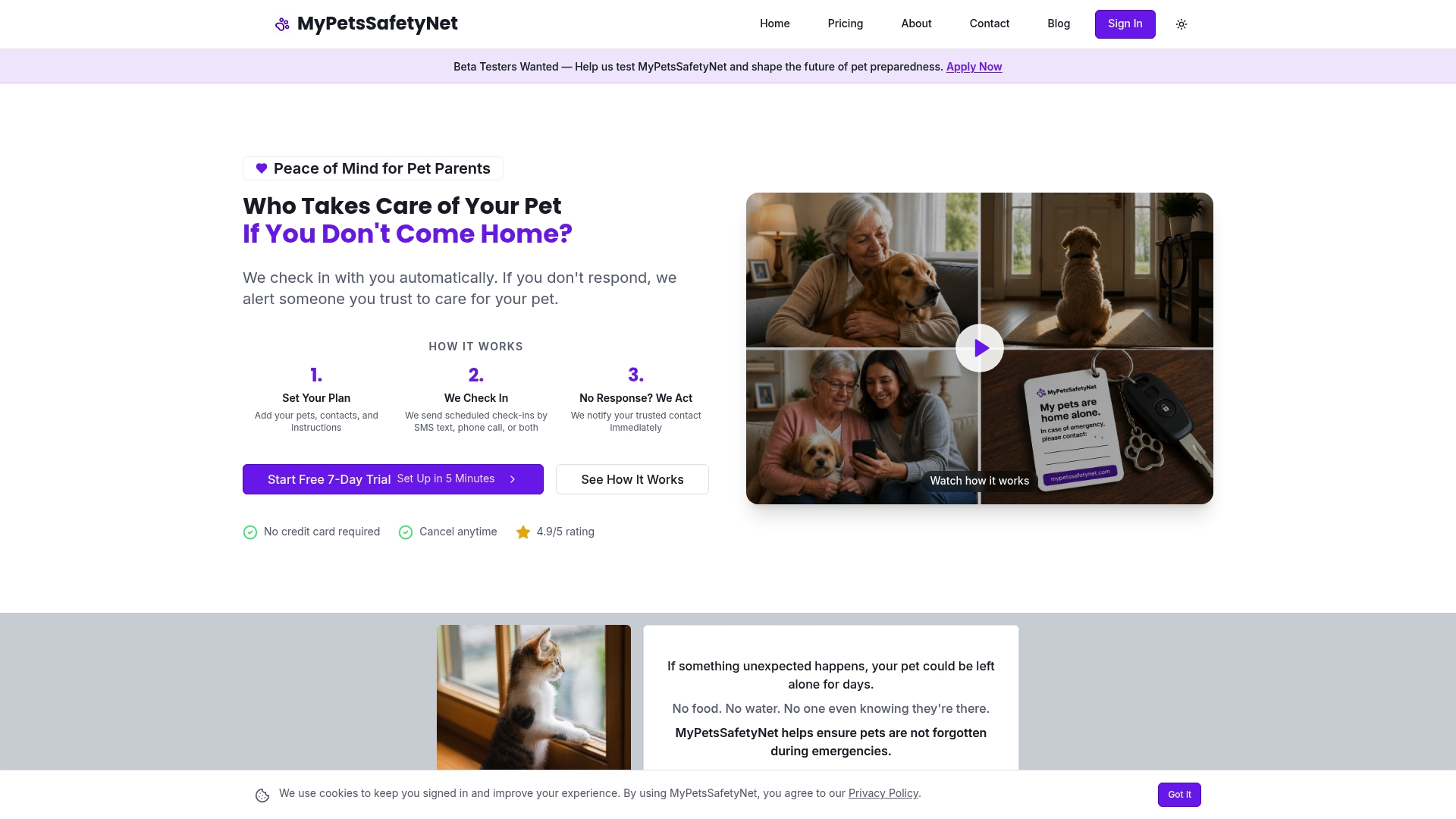
- Start the free trial, no credit card required, on our pricing page, where the Monthly plan is $6.99 per month.
- Prefer a lower-commitment test? Generate your pet card and see how your pet’s care instructions look to a caregiver.
- Add up to 5 pets and 3 emergency contacts, then run the three-step test above.
Pick your quiet window tonight and let us handle the escalation.
FAQ
Can you set quiet hours for pet alerts?
Yes, and it is a good idea. Choose a window that matches your sleep schedule, and keep an exception for critical alerts such as a missed check-in so real emergencies still reach you.
What time is dog barking considered a nuisance?
There is no single time that applies everywhere. Some jurisdictions use duration instead, such as 15 minutes of continuous barking or 30 minutes in a day, so check your local rules.
What is the 3-3-3 rule for animals?
It describes how an adopted pet adjusts over 3 days, 3 weeks and 3 months. Expect more stress and noise early, then steadier behavior as routines settle.
How long can a dog bark before it is a problem?
It depends on where you live. Where a limit exists, it is often a short continuous stretch or a daily total, so set your alert buffer comfortably below your local threshold.