Solo Pet Owners: 10 Minute Time Based Alert Contacts with Templates

Time-based alert contacts are the named people your phone or an automated service reaches out to when a scheduled wellness check goes unanswered, along with the exact instructions they need to care for your pets. The right first move is simple: pick two contacts, at least one local with a key or access code, and run a live test this week. Ready.gov and MyPetsSafetyNet both build their guidance around the same principle: a plan nobody has tested is just a hope.
TL;DR:
- Choosing at least one local contact with a spare key and one remote backup ensures reliable pet care when a scheduled check-in is missed.
- Confirming contacts’ access, preferred contact methods, and device capabilities before setting up the alert chain prevents communication gaps during emergencies.
- Testing the entire alert process on a non-emergency day verifies local contact’s ability to locate keys, find pet supplies, and follow instructions effectively.
- Customizing alert frequency based on health risks—ranging from daily to hourly checks—aligns visits with individual needs and reduces false alarms.
- Regularly reviewing and updating contact information, pet records, and plan details every three months keeps the system prepared for changes.
Table of Contents
- How Do You Set Up Scheduled Wellness-Check Alerts?
- What Should Your Pet Emergency Record Include?
- How Do You Choose and Test Your Emergency Contacts?
- What Are Realistic Alert Schedules and Message Templates?
- Why a Pet-Focused Alert Workflow Matters
- Start Your Free Trial With MyPetsSafetyNet
- Official Guidance Worth Bookmarking
- Sources
- FAQ
How Do You Set Up Scheduled Wellness-Check Alerts?
Building a working alert chain takes about ten to fifteen minutes once you have your contacts lined up. The order matters, because skipping a step now means confusion later, right when your contacts need clarity most.
- Pick your contacts and get their consent first. Aim for two to three people: a nearby neighbor or friend with a spare key, and an out-of-area backup who can make calls or coordinate if the local person is unreachable. Ask them directly if they’re willing, not just able. Ready calls this a buddy system, and it only works if both buddies say yes ahead of time.
- Collect working phone numbers and confirm SMS is okay. Not every contact wants text alerts, and not every phone supports them the same way. Confirm each person’s preferred method before you lock in the schedule.
- Choose your check-in cadence. A generally healthy adult living alone might choose one check-in a day. Someone managing a chronic condition or recovering from surgery might want twice-daily alerts, or even hourly windows overnight.
- Set your fail window. This is the grace period between a missed response and escalation. Fifteen to thirty minutes works for most people; tighten it if you’re at higher medical risk.
- Build your escalation order. Local contact first, out-of-area contact second. Each contact should get clear instructions: check for the owner, confirm pets have food and water, secure them if needed, and call the vet if something looks wrong.
- Attach your pet-care documents to each contact profile. Link the emergency kit location, feeding instructions, and vet contact so nobody is guessing when they arrive.
Pro Tip: Test your escalation order on a day when nothing is wrong. A dry run on a calm Tuesday tells you more than any amount of planning on paper.
What Should Your Pet Emergency Record Include?
Your contacts can’t help your pets with good intentions alone. They need a record that answers every question before they ask it, and the ASPCA’s pet planning guidance treats this as the backbone of any workable plan.
- Identification: a recent photo, microchip number, proof of ownership, and any distinguishing marks or scars.
- Medical details: existing conditions, medications with exact dose and frequency, known allergies, and current vaccination records.
- Logistics: where keys are hidden, crate location, food brand and storage spot, and step-by-step access instructions for the home.
- Emergency numbers: your regular vet, the nearest emergency clinic, and the ASPCA Animal Poison Control Center.
Store this record in three places. Ready.gov’s evacuation-kit guidance recommends a digital copy on your phone, a printed version in a waterproof bag, and a version your contacts can already see or access without needing to ask you for it. A quarter of the value in an emergency record disappears the moment nobody but you knows where to find it.
How Do You Choose and Test Your Emergency Contacts?
Not every willing friend makes a good emergency contact. Proximity and access beat good intentions almost every time, and the AVMA’s guidance on animal care coverage backs a simple hierarchy: local person with a key first, out-of-area backup second.
- Screen for access, not just availability. Someone ten minutes away without a key is less useful than someone twenty minutes away who already has one.
- Talk to your vet about an authorized agent. The AVMA recommends naming someone who can approve treatment decisions if you’re unreachable, since a willing neighbor can’t always make medical calls on your behalf.
- Add your backup contact to your pet’s microchip registry. This matters if your pet gets separated from home during a crisis.
- Run a full test. Trigger an alert, let it go unanswered on purpose, and confirm your local contact gets reached, finds the key, and locates the kit. Practicing this handoff, per AVMA’s disaster guidance, catches gaps that look fine on paper but fall apart in practice.
- Reconfirm quarterly. Phone numbers change. Vets change. Willingness changes.
Pro Tip: Ask your local contact to physically walk to your door during the test, not just answer a phone call. A locked door they can’t open defeats the entire plan.
What Are Realistic Alert Schedules and Message Templates?

Your cadence should match your actual risk, not a generic default. A low-dependency schedule means one check-in daily, usually for someone in good health with a stable routine. A moderate schedule means two check-ins a day, often for someone managing a condition that could change quickly. A high-dependency schedule means checks every two to four hours, including overnight, for someone recovering from surgery or managing a serious medical event.
A sample message to your local contact might read: “I haven’t confirmed I’m okay. Please go to [address], key is [location], check on [pet name], food is in [location], and call [vet name] at [number] if anything seems wrong.” Keep it short enough to read in ten seconds standing on a porch.
- Print a one-page pet care card with feeding instructions, vet contact, and key location.
- Keep a copy near your main entrance where a contact can grab it fast.
- Tighten your check-in interval after surgery, a new medication, or a heat wave that puts pets at higher risk.
- Review the whole plan every three months, even if nothing has changed.
Why a Pet-Focused Alert Workflow Matters
Generic wellness apps check on you. They rarely think about your pets at all, which leaves a gap exactly where solo, elderly, and disabled owners need coverage most. MyPetsSafetyNet was built around that gap: when a check-in goes unanswered, it calls your named contacts, not 911, and hands them pet-specific instructions instead of a vague “check on this person” alert.
The system works over SMS or phone calls, so a smartphone isn’t required. Consent settings let you control exactly who gets contacted and how. If you haven’t tested your own chain yet, start small: download a free pet care card, confirm your local contact still has a key, and run one test alert this week.
— MyPetsSafetyNet
Start Your Free Trial With MyPetsSafetyNet
Most emergency planning advice stops at “make a list.” MyPetsSafetyNet actually runs the list for you: scheduled check-ins go out automatically, and if you miss one, your named contacts get called or texted with real pet-care instructions, not just a generic “are you okay” message.
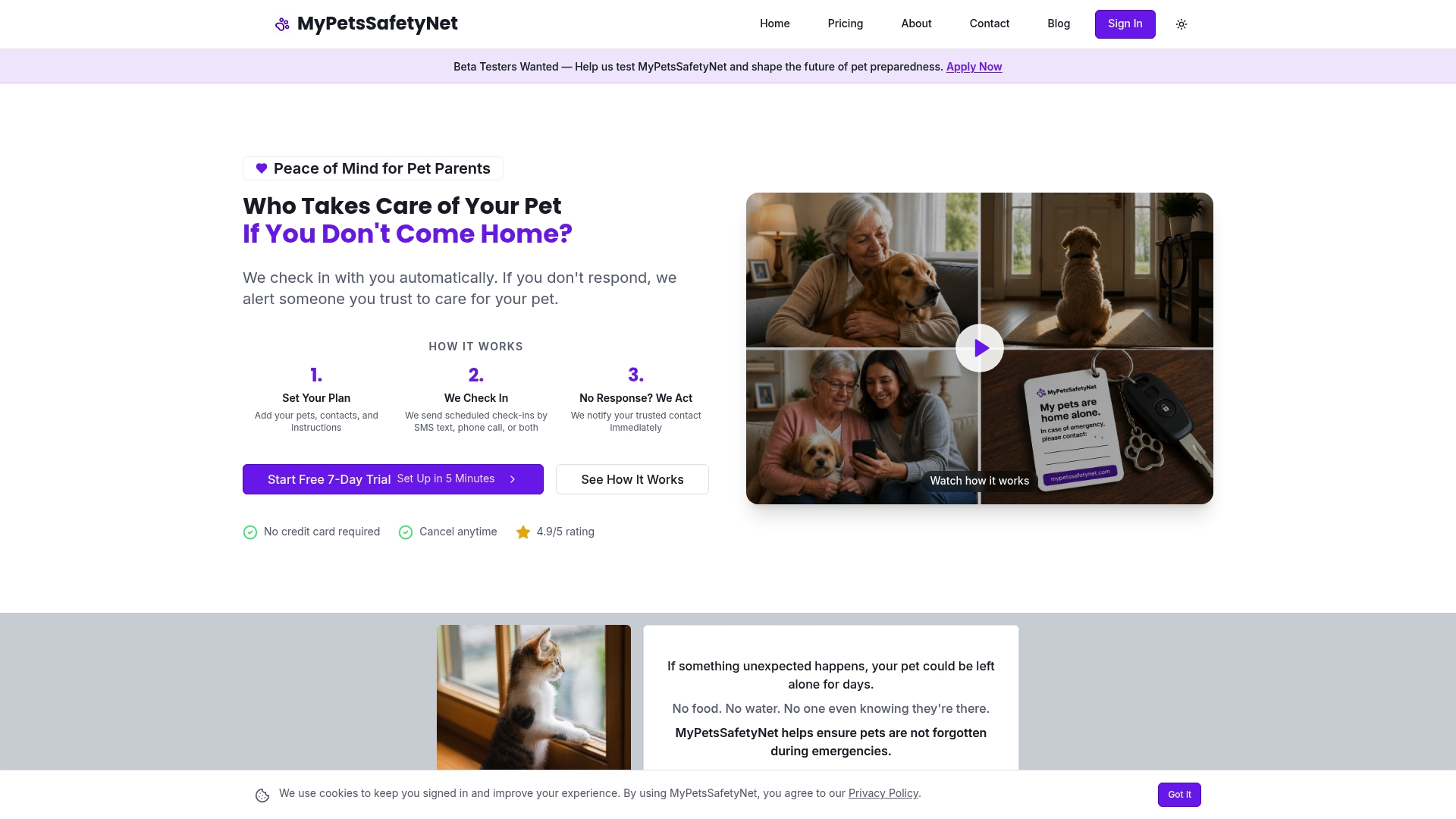
Setup takes under ten minutes, works with any phone through SMS or calls, and covers up to five pets and three emergency contacts with built-in escalation. No credit card is required to start the 7-day free trial, and monthly plans run $6.99 per month after that. If you want to test the waters first, grab the free printable pet card and see exactly what your contacts would receive. Either way, the next step is the same one this article has pushed from the start: stop planning and run a real test.
Official Guidance Worth Bookmarking

For checklists you can verify yourself, start with Ready.gov’s pet disaster preparedness guidance, the ASPCA’s pet planning resources, and the AVMA’s guidance on animal care while you’re away. Each one offers downloadable templates worth keeping alongside your own pet care card.
Sources
- Ready
- Make a plan for your pet | ASPCA
- Who’s in charge of your animal’s care while you’re away? | AVMA
FAQ
What Counts as a Time-Based Alert Contact?
A time-based alert contact is a named person who gets notified automatically if you miss a scheduled wellness check, along with instructions for feeding, medicating, or securing your pets. Most plans use at least one local contact and one out-of-area backup.
How Often Should I Schedule Wellness Checks?
It depends on your health and daily routine. A generally healthy adult might choose one check-in daily, while someone managing a medical condition often benefits from checks every two to four hours.
Does MyPetsSafetyNet Require a Smartphone?
No. MyPetsSafetyNet works through SMS or phone calls, so it fits owners without smartphones or reliable data plans.
How Much Does MyPetsSafetyNet Cost?
MyPetsSafetyNet’s monthly plan is $6.99 per month, and new users can start with a 7-day free trial that requires no credit card.
How Do I Test My Alert Contact Chain?
Trigger a real alert, let it go unanswered on purpose, and confirm your local contact can reach your home, find the key, and locate your pet’s emergency kit. The AVMA recommends practicing this full handoff before an actual emergency happens, not during one.