How Long Can a Dog Be Left Alone? Hours by Age, Plus Cats

Most healthy adult dogs can be left alone for about four to six hours, and up to six to eight hours at the outside, as long as they can relieve themselves and aren’t stressed. Puppies, seniors and dogs with medical conditions need less. Cats are more flexible: a healthy adult cat is usually fine for eight to 12 hours. Below you’ll find the numbers by age, the signs your pet isn’t coping, and what to set up so your animals are looked after if you ever can’t get home.
TL;DR
- Healthy adult dogs: plan for 4 to 6 hours, and treat 6 to 8 hours as the ceiling, with a chance to go to the bathroom.
- Puppies and senior dogs need shorter stretches. Puppies roughly one hour per month of age, seniors about 4 to 6 hours.
- Healthy adult cats can manage 8 to 12 hours. Past 24 hours, someone should visit daily.
- Watch for barking, pacing, accidents and destruction. These can signal your pet isn’t coping.
- If you live alone, name caregivers and set up a check-in so someone knows when something is wrong.
Table of Contents
- How long can an adult dog stay home alone?
- Hours by age and life stage
- What changes the safe amount of time
- How to tell your dog isn’t coping
- How long can a cat be left alone?
- Making a long day shorter
- When the issue isn’t a long day, but not coming home
- Perspective: why a check-in belongs in every solo owner’s plan
- How MyPetsSafetyNet helps
- FAQ
- Sources
How long can an adult dog stay home alone?
The most common vet guidance puts a comfortable range for an adult dog at four to six hours. Dr. Virga, quoted by the American Kennel Club, recommends no more than six to eight hours alone without a chance to relieve themselves. A veterinarian quoted by Newsweek says an adult dog can usually wait six to eight hours between bathroom trips, but healthy adults shouldn’t be left longer than six hours.
In real life, many people work eight-hour days. Oakwood Veterinarian notes that 4 to 6 hours is typically fine for most adult dogs and that many owners leave pets for up to 8 hours while at work. The line most sources draw is 10 to 12 hours in a single stretch. Bark and Whiskers calls that too long and says dogs need a chance to relieve themselves every four to six hours.
The number is not only about the bladder. Dr. Virga also points out that dogs are social animals, and spending all of their day alone is too much for their behavioral needs. A dog who is alone for eight hours, then gets a walk, play and company, is in a very different situation from a dog who is alone most of every day.
Hours by age and life stage
Age changes the answer more than anything else. Use this as a starting point, then adjust for your own dog.
| Life stage | Typical maximum alone | Notes |
|---|---|---|
| Young puppy (8 to 12 weeks) | 1 to 2 hours | Frequent bathroom trips and feeding needed |
| Puppy (3 to 6 months) | About one hour per month of age | AdoptAPet says up to a maximum of about six hours |
| Adult dog (6 months to about 8 years) | 4 to 6 hours comfortably, up to 6 to 8 | Needs a bathroom break and exercise |
| Senior dog (8 years and older) | 4 to 6 hours | Adjust to health and mobility |
The puppy and senior figures above follow a published breakdown by Rover (2024) that is summarized in AKC’s coverage. Newsweek’s veterinarian adds that dogs past 11 years shouldn’t be left longer than six hours. AdoptAPet also notes that senior dogs may need their time adjusted depending on health.
Puppies
A puppy’s bladder control is limited, and a puppy that’s left too long either has an accident or learns to hold it uncomfortably. Build up alone time gradually in short sessions rather than jumping to a work-day length.
Senior dogs
Older dogs often need to go out more often, and stiff joints can make waiting harder. If your senior dog has started having accidents, talk to your veterinarian before assuming it’s a behavior issue.

What changes the safe amount of time
Veterinarian Jennifer Fryer, quoted by Newsweek, lists bladder control, energy level, separation anxiety, age, breed and medical conditions such as diabetes, hypothyroidism, kidney disease and Cushing’s disease as factors. Wendy Hauser, also quoted there, adds activity level.
In practice, ask yourself these questions:
- Can your dog hold it? Dogs with kidney disease or diabetes often need more frequent trips outside.
- Is your dog calm when you leave? Anxious dogs may not handle even short absences well.
- Has your dog had exercise first? A tired dog usually settles more easily.
- Is the home safe? Water, safe chews and a comfortable temperature matter more the longer you’re gone.
- Is your dog crated? Oakwood advises that a dog should never be crated for more than a few hours at a time, except during sleep.
How to tell your dog isn’t coping
A dog who is struggling usually shows it. The American Animal Hospital Association lists excessive vocalization, pacing and restlessness, destructive behavior such as chewing and digging, and eliminating in the house as signs of separation anxiety. The University of Wisconsin School of Veterinary Medicine advises gradual practice as prevention: short absences first, then slowly longer ones, with calm departures and arrivals, a predictable routine and enrichment like food puzzles.
The ASPCA says most anxious responses happen within the first 40 minutes alone. Once a dog can be alone for 90 minutes without getting upset, he can probably handle four to eight hours. It also stresses that there are no standard timelines: you judge when your dog can tolerate more, and going too long too fast makes anxiety worse.
Call your veterinarian if your pet hurts itself trying to escape, refuses to eat or settle when alone, shows sudden behavior changes, or stays distressed despite gradual training. AAHA suggests video recordings of your pet while you’re out can help your vet build a treatment plan.
How long can a cat be left alone?
Cats handle solitude better, but they’re not self-sufficient. According to PetMD, healthy adult cats can generally be left for eight to 12 hours at a time. Kittens on milk replacement shouldn’t be alone more than two to three hours, and weaned kittens no longer than four hours.
Hill’s Pet says 24 hours is occasionally okay if food, water, a clean litter box and a safe environment are available, and 48 hours should be avoided unless absolutely necessary. Kittens under six months should be limited to 2 to 3 hours, and over six months to 4 to 6 hours.

The San Francisco SPCA advises against leaving a cat alone more than 12 hours without someone to check on them. For trips beyond 10 days, it suggests having someone stay overnight at least a few times a week. PetMD says that if you’re away for more than 24 hours, a sitter should visit once a day to provide fresh food and water, scoop the litter box, monitor health and behavior, and give playtime.
Cats can get anxious too. The Ohio State University Indoor Pet Initiative lists excessive vocalizing, not eating or drinking while you’re away, going outside the litter box, vomiting, over-grooming and destructive behavior. Separation problems may be underreported in cats, according to Today’s Veterinary Practice, so a quiet cat isn’t always a relaxed one.
Making a long day shorter
You can’t always change your schedule, but you can change what the day looks like for your pet.
- Exercise before you leave. A walk or play session helps your dog settle.
- Arrange a midday break. A neighbor, friend or professional walker can break up a long stretch. If you use one, give them the same written info every time.
- Set up enrichment. Food puzzles, safe chews and scratching posts give your pet something to do.
- Keep departures calm. Long goodbyes can raise anxiety.
- Keep a routine. Predictable feeding, walking and leaving times help.
- Build up gradually. Especially with puppies, rescues and dogs who’ve shown stress.
If you want a ready-made way to brief a walker or sitter, our guide to a dog walker emergency contact sheet has templates you can use.
When the issue isn’t a long day, but not coming home
Most advice on this topic assumes you will walk back through the door. If you live alone, there’s a second question: what if you can’t? A fall, a hospital stay, an accident or a sudden illness can turn a six-hour absence into a day or more, and a dog or cat can’t call for help.
The Humane Society of the United States explains in its factsheet on providing for pets that, in the confusion after a person’s unexpected illness, accident or death, pets can be overlooked and sometimes are found in the home days later. That’s why it stresses formal arrangements for temporary care.
We’ve written about this in more detail in what happens to your dog alone at home if you don’t come back and in a solo owner’s plan for when you can’t get home.
Build your backup plan
The guidance from animal welfare groups is consistent:
- Choose more than one caregiver. Best Friends Animal Society suggests asking a few trusted friends or family members, in case someone isn’t available. The Humane Society says at least two.
- Give them access. A spare key to a family member, friend or trusted neighbor, or, in an apartment building, permission from management, as Triage Health recommends.
- Write everything down. The ASPCA suggests a pet portfolio with habits, food preferences, medical conditions and medications, vet information and behavior around other pets, people and children.
- Carry a wallet card. The ASPCA also recommends a wallet alert card listing two emergency contacts.
- Check in with your caregivers. Confirm now and then that they’re still willing and able. The person who steps in during an emergency doesn’t have to be the person who takes your pet permanently.
- Post a notice. The Humane Society advises removable notices on doors or windows stating how many and what kinds of pets are inside, and warns against stickers that are hard to remove.
If you have no one nearby, Triage Health suggests looking into boarding facilities, shelters or charities that may provide short-term care. Our guide on securing pet care in 24 to 72 hours without family backup covers that situation.
What to leave ready
Keep supplies where a caregiver can find them. The CDC recommends a two-week supply of food in waterproof containers, two weeks of water, two weeks of medications with instructions, copies of veterinary records, vaccination records, rabies certificate, microchip information and recent photos. The FDA adds that a temporary caretaker should have phone numbers to reach you, all care instructions, and a signed authorization for veterinary care with financial limits.
Perspective: why a check-in belongs in every solo owner’s plan
We built MyPetsSafetyNet around one worry: what happens to a pet if its owner has an emergency and lives alone. The hours-alone question is important, but it assumes you come home on schedule.
Our approach is simple. You set a check-in schedule, and we contact you by text, phone call or email. If you don’t respond, we escalate and notify the emergency contacts you chose, with your pets’ care details included, so they can check on both you and your animals.
We designed it so you don’t need a smartphone: it works with any phone through SMS or calls. We focus on pet care, not only personal safety, which means the instructions go to named caregivers, not to emergency services. For people who live alone, are older or have health concerns, we think that’s the gap that matters most.
MyPetsSafetyNet
How MyPetsSafetyNet helps
MyPetsSafetyNet is an automated wellness check-in service for pet owners. You choose the schedule and countdown intervals, and if you don’t respond, your emergency contacts are notified with full pet care details. You can add up to 5 pets and 3 emergency contacts, and generate a pet care instruction card. Our setup is designed to take less than 10 minutes.
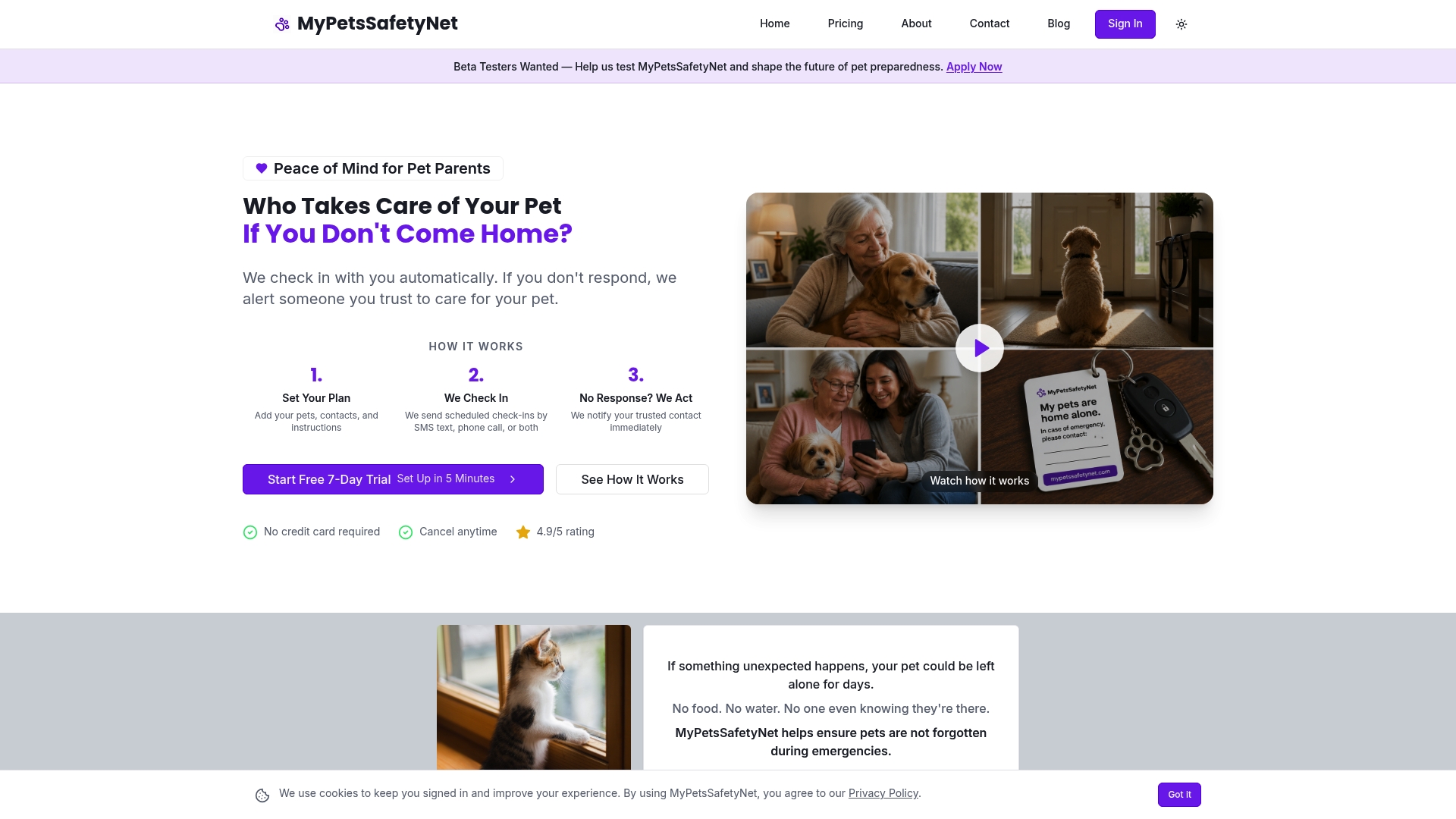
The Monthly plan is $6.99 per month, and it starts with a 7-day free trial with no credit card required. You can also look at the MyPetsSafetyNet home page to see how the service works before you sign up.
FAQ
Can a dog hold pee for 12 hours?
Some adult dogs physically can, but it isn’t a good routine. Most sources put the comfortable limit at six to eight hours, and Bark and Whiskers says dogs need a chance to relieve themselves every four to six hours. If you regularly work long days, arrange a midday break.
What type of dog can be left alone for 8 hours?
A healthy, well-exercised adult dog that is calm when alone is the best candidate, and even then eight hours is near the upper limit. Age, health, energy level and anxiety matter more than a label. Puppies, seniors and dogs with medical conditions usually need shorter stretches.
Is it okay to crate a dog while I’m at work?
Oakwood Veterinarian advises that a dog shouldn’t be crated for more than a few hours at a time, except during sleep. If your day is long, ask someone to let your dog out midday.
Can I leave my cat alone for a weekend?
A healthy adult cat can usually manage 24 hours with food, water, a clean litter box and a safe space. Beyond that, PetMD recommends a sitter visit at least once a day. Hill’s advises avoiding 48 hours alone unless absolutely necessary.
What if I live alone and can’t get home?
Name at least two caregivers, give them a key and written care instructions, and carry a wallet card with your emergency contacts. A check-in service like ours can alert those people automatically if you don’t respond.
Sources
- Alone Time for Dogs: How Much Is Too Much? (American Kennel Club)
- How Long Is Too Long to Leave Your Dog at Home Alone? (Newsweek)
- Leaving a Dog Home Alone While at Work (Oakwood Veterinarian)
- Guide to How Long a Dog Can Be Left Alone (AdoptAPet)
- How Long Is Too Long to Leave Your Dog Alone? (Bark and Whiskers)
- Separation Anxiety in Pets (AAHA)
- Tips to ease separation anxiety in pets (University of Wisconsin)
- Separation Anxiety (ASPCA)
- How Long Can You Leave a Cat Alone? (PetMD)
- How Long Can You Leave Cats Alone? (Hill’s Pet)
- Traveling (Cats) (San Francisco SPCA)
- Separation Anxiety (Ohio State Indoor Pet Initiative)
- Separation-Related Disorders (Today’s Veterinary Practice)
- Providing for your pet’s future without you (Humane Society of the United States)
- Estate Planning for Pets (Best Friends Animal Society)
- Quick Guide to Planning Ahead for Your Pets (Triage Health)
- Making a Plan for Your Pet (ASPCA)
- Build a Pet Disaster Preparedness Kit (CDC)
- Take Care of Your Pets Before Disaster Strikes (FDA)