What Happens to Your Dog Alone at Home if You Don’t Come Back?
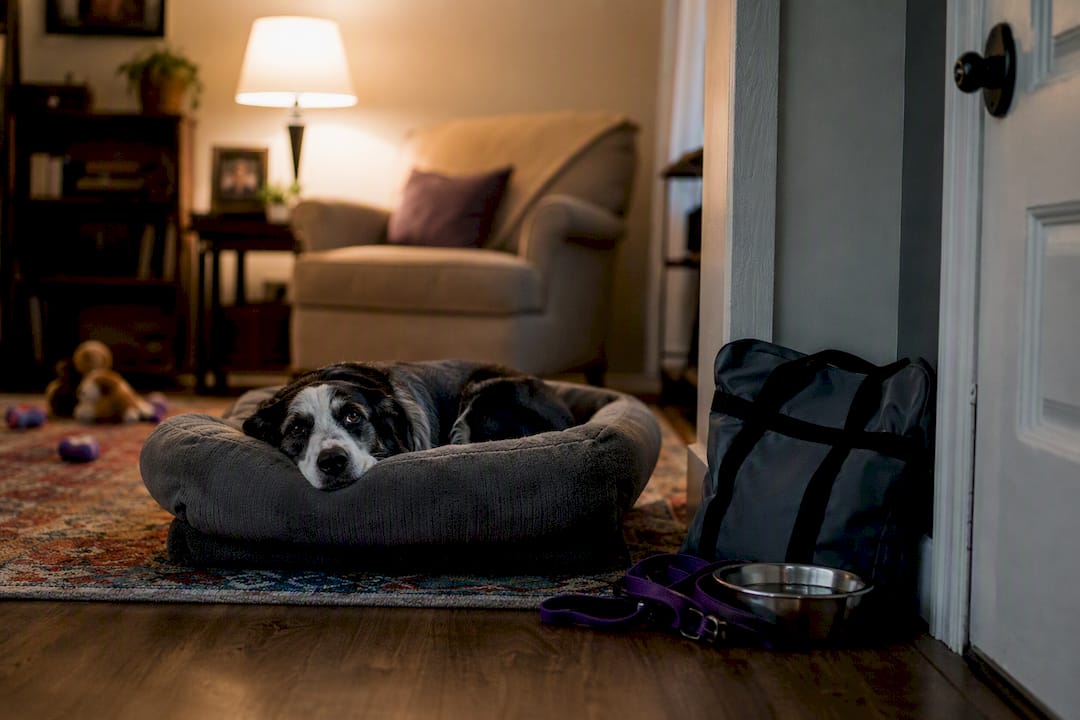
The fastest way to protect a dog alone at home when a solo owner becomes unresponsive is a daily automated wellness check-in that alerts preconfirmed contacts and activates a 72-hour response network. This single habit shrinks the gap between “something is wrong” and “someone is helping” from days down to hours.
Here’s what to do in the next ten minutes:
- Pick a daily check-in time you’ll actually stick to (morning coffee works for most people).
- Name two trusted backup contacts, not just one, in case your first choice can’t respond.
- Draft a one-page pet-care card with feeding times, medications, and vet contact info.
A written plan with named backup caregivers and clear access instructions is a best practice recommended for older adults living alone, and it works just as well for any solo pet owner, at any age.
Key Takeaways
A daily automated check-in paired with a two-tier backup caregiver network turns a multi-day detection gap into a same-day response for a dog alone at home.
| Point | Details |
|---|---|
| Set a daily check-in | Choose a consistent time and method (SMS, call, or email) so a missed response gets caught within hours. |
| Name two backup caregivers | A single contact isn’t enough; confirm a Tier 1 neighbor and a Tier 2 sitter or boarding option in advance. |
| Prepare a pet-care card and go-bag | Include meds, feeding schedule, vet contact, and three to seven days of supplies ready to grab. |
| Practice the plan quarterly | A short 10 to 15 minute walk-through catches access problems before a real emergency does. |
| Use Mypetssafetynet for automation | The service handles scheduled check-ins, escalation, and contact notification so the plan runs without manual follow-up. |
Table of Contents
- Why a Daily Check-In Matters as an Early-Warning Trigger
- Build Your 72-Hour Response Network: Tiered Caregivers and Their Roles
- Pet-Care Card and Emergency Kit: What to Prepare Now
- How to Set Up Automated Wellness Check-Ins and Escalation
- Practice, Review, and Maintain the Plan
- Understanding the Ideal Duration a Dog Can Be Left Alone
- Behavioral Signs of Stress or Anxiety When Left Alone
- Effective Training Techniques to Acclimate a Dog to Being Alone
- Safe Home Setup to Prevent Accidents or Destructive Behavior
- Mental and Physical Enrichment During Alone Time
- Guidelines for Choosing and Using Dog Monitoring Devices
- Why We Built Mypetssafetynet
- Get Your Daily Check-In and Response Network Running Today
- Sources
Why a Daily Check-In Matters as an Early-Warning Trigger
Most emergency pet plans fail for one reason: nobody finds out something is wrong in time. This is the detection lag, the stretch between when you become unable to respond and when a helper realizes it and steps in. For a dog left alone at home, that lag is the whole problem. Food and water run out. Medication schedules slip. A dog with separation anxiety spirals into panic with no idea why the routine broke.
An automated check-in closes that gap by design. You get a scheduled prompt (a text, a call, or an email) at a set time each day. If you respond, nothing happens. If you don’t, a grace period kicks in, then the system escalates to your emergency contacts automatically. Guidance on safety planning for pet owners who live alone treats this daily check-in as the mechanism that actually notifies people and gets a response moving, not just a nice idea sitting in a drawer.
The math is blunt: a missed check-in that escalates within hours means a dog gets fed and let out the same day. A plan that only gets discovered when someone happens to visit, or when mail piles up, can mean two or three days of a dog alone with no one aware.
Pro Tip: Set your grace period at two to three missed check-ins, not one. A single skipped response could just mean you were in the shower or your phone died. Two in a row is a real signal something’s wrong.
Build Your 72-Hour Response Network: Tiered Caregivers and Their Roles
One backup contact isn’t a plan. It’s a hope. A 72-hour response network gives your dog coverage across three tiers, each with a clear job:
- Tier 1: Same-day neighbor or nearby friend. This person has a key or door code and can be at your home within a few hours of an alert. Their job is simple: check on the dog, provide food and water, and report back.
- Tier 2: Local sitter or short-term boarding. If you’re unreachable for more than a day, this person or facility takes over feeding, walks, and basic care for up to a few days.
- Tier 3: Veterinary boarding. For anything longer, or if your dog has medical needs, a boarding arrangement at your vet’s office covers care until family or longer-term arrangements take over.
When you recruit each tier, ask directly and get a clear yes:
- Can you get to my home within a few hours if I don’t answer a check-in?
- Are you physically able to handle my dog (leash, lifting, size, temperament)?
- Do you have transportation if the dog needs to go to a vet or sitter?
- Are you comfortable holding a spare key or door code?
Pre-registering with a boarding facility and giving your vet a heads-up that they may need to accept your dog on short notice saves precious hours later. Tiered networks that combine a same-day neighbor, a pre-approved sitter, and veterinary boarding cover nearly every realistic scenario without overcomplicating the plan.
For access details like door codes or key locations, avoid texting them in plain language. A shared note in a password manager, or a sealed envelope given directly to your Tier 1 contact, keeps that information out of easy reach if a phone gets lost or hacked. If you want a deeper walkthrough of the legal and access steps involved, our guide on emergency pet care planning covers it in more detail.
Pet-Care Card and Emergency Kit: What to Prepare Now
A helper who shows up without instructions can still get things wrong, even with the best intentions. Your pet-care card should include:
- Pet’s name, breed, age, and weight
- Medications with vet-labeled dosing and schedule
- Feeding schedule, food brand, and any allergies
- Microchip number and ID tag details
- Vet name, phone number, and clinic address
- Primary and backup caregiver names with access notes
Pair the card with a go-bag your Tier 1 contact can grab immediately: three to seven days of food, any medications in labeled containers, a recent photo, a carrier or leash, a basic first-aid kit, and something familiar like a blanket or toy to reduce stress. The Red Cross recommends packing exactly this kind of kit along with identifying pet-friendly destinations ahead of time, not after a crisis starts.
Keep one copy of the card in your wallet, one taped near your front door, and a digital copy shared with your Tier 1 and Tier 2 contacts. Skip sensitive details like alarm codes on the door copy. Our complete guide to pet-care emergency documents has a full template you can print today.
Pro Tip: Laminate the door copy. A card that’s smudged or torn when someone actually needs it defeats the purpose.
How to Set Up Automated Wellness Check-Ins and Escalation
Setting up the actual mechanism takes less time than picking a vet. Here’s the process:
- Pick a daily check-in window. Morning works for most people because a missed response gets noticed and escalated the same day, not overnight.
- Choose your contact methods. SMS, phone call, or email, ideally more than one, so a dead phone battery doesn’t break the chain.
- Add your emergency contacts and confirm they’ve accepted the role. A contact who doesn’t know they’re on the list is worse than no contact at all.
- Attach your pet-care card and access notes to the contact profile so whoever gets the alert has everything they need immediately, not after a scramble.
- Set your grace period and escalation order, so Tier 1 gets notified first, then Tier 2 if there’s still no response.
- Run a dry test. Skip a check-in on purpose and watch what happens: does the alert arrive on time, does your contact actually see it, are they ready to act?
This is exactly the gap Mypetssafetynet was built to close. The service sends scheduled SMS, phone, or email check-ins, manages profiles for up to five pets, and automatically notifies up to three emergency contacts with full pet-care instructions if you don’t respond. It handles the escalation workflow and countdown intervals for you, so you’re not building this system from scratch with sticky notes and group texts.
Pro Tip: Test on a day when your Tier 1 contact knows it’s coming. Their reaction time during a planned test tells you a lot about their reaction time during a real one.
Practice, Review, and Maintain the Plan
A plan that never gets tested is a guess. A short walk-through beats a rare, elaborate drill because it actually validates the details that matter.
- Run a 10 to 15 minute walk-through with your Tier 1 contact. Confirm they can find the key or code, locate the food and medications, and handle your dog without either of you feeling rushed.
- Review the plan quarterly, or immediately if you change medications, switch vets, move, or your dog’s routine shifts. A quiet practice run surfaces problems, like a lock that sticks or a contact who’s moved away, before they matter.
- Store both digital and printed copies. Keep the printed card current, and limit digital sharing to the people who actually need it.
Understanding the Ideal Duration a Dog Can Be Left Alone
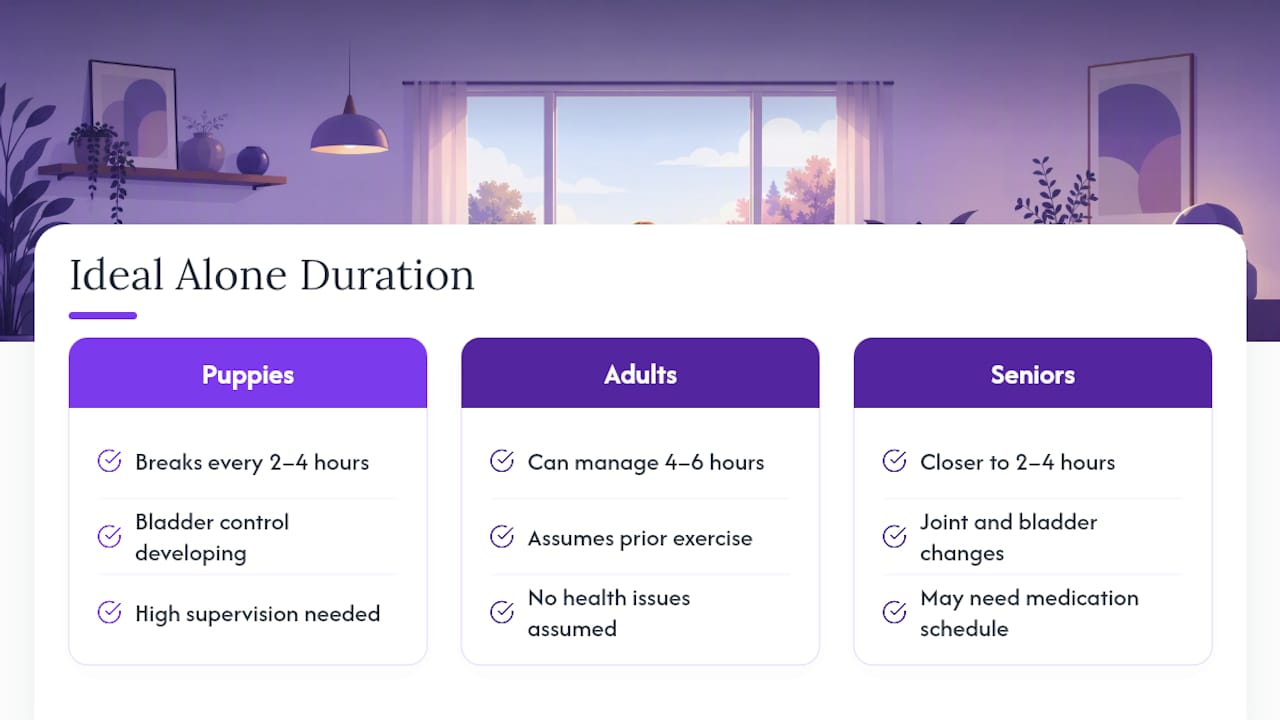
Every dog has a realistic ceiling for how long they can comfortably manage on their own, and it depends heavily on age and breed. Puppies under six months typically need a bathroom break every two to four hours since their bladder control is still developing. Adult dogs, generally between one and seven years old, can often manage four to six hours comfortably, assuming they’ve had exercise and aren’t dealing with health issues. Senior dogs tend to need more frequent breaks again, closer to the puppy range, because of joint stiffness, bladder changes, or medication schedules.
Breed matters as much as age. High-energy working breeds like Border Collies or Australian Shepherds tend to struggle more with long stretches alone than a lower-energy breed like a Basset Hound, simply because unspent energy turns into restlessness and destructive behavior faster. Brachycephalic breeds (flat-faced dogs like French Bulldogs) can also have specific needs around temperature and ventilation that affect how long they should go unsupervised, especially in warm weather.
None of this changes the core risk for a solo owner: even a dog that handles four to six hours alone just fine on an ordinary day is in a very different situation if you become unresponsive and no one knows to check. That’s where a daily check-in and a tiered response network matter more than the dog’s individual tolerance for solitude.
Behavioral Signs of Stress or Anxiety When Left Alone
Dogs can’t tell you they’re anxious, but their behavior usually does. Watch for these signs when you leave and return:
- Destructive chewing focused near doors or windows, often a sign of separation-related distress rather than simple boredom.
- Excessive barking, howling, or whining that neighbors report happens shortly after you leave.
- Accidents indoors from a dog who’s otherwise fully house-trained.
- Pacing, drooling, or panting that isn’t tied to heat or exercise.
- Self-injury from licking or chewing at paws, sometimes from stress rather than a medical issue.
These signs tend to cluster in the first 30 minutes after you leave, which is a useful detail if you’re reviewing camera footage or a neighbor’s report. A dog showing several of these signs regularly isn’t just being difficult. It’s communicating that the current routine isn’t working, and it’s worth adjusting duration, environment, or training before the pattern gets worse.
Effective Training Techniques to Acclimate a Dog to Being Alone
Building comfort with alone time works best in small, deliberate steps rather than all at once. Start with brief absences, even just stepping outside for thirty seconds and coming back in, so your dog learns that your leaving doesn’t mean you’re gone for good. Gradually stretch that time over days and weeks, only increasing duration once your dog is calm at the current length.
Desensitizing departure cues helps too. Dogs often pick up on grabbing keys or putting on shoes as a signal that anxiety-inducing time is coming. Practice those cues without actually leaving, so they lose their power to trigger stress.
Crate training, when introduced positively and never as punishment, gives some dogs a den-like space that reduces anxiety rather than increasing it. Not every dog takes to a crate, and forcing one who resists it can backfire, so watch your dog’s response closely.
Pairing departures with a high-value distraction, like a frozen treat-stuffed toy, gives your dog something to focus on besides your absence. Over time, this builds a positive association with the routine of you leaving.
Safe Home Setup to Prevent Accidents or Destructive Behavior
A dog left home alone that’s set up to succeed causes far fewer problems than one left to improvise. Start with a designated safe space, whether that’s a single room, a gated section of the house, or a crate, that removes access to anything chewable, breakable, or dangerous.
Secure trash cans, electrical cords, and anything toxic (certain plants, cleaning supplies, medications) well out of reach. Dogs left alone and bored often investigate things they’d otherwise ignore.
Temperature control matters more than most owners think. A home that gets too warm or too cold while you’re gone puts real physical stress on a dog, particularly puppies, seniors, and brachycephalic breeds mentioned earlier. A programmable thermostat set to a stable range removes the guesswork.
Fresh water access, ideally from more than one bowl in case of a spill, and a floor surface that’s easy to clean in case of an accident round out a setup that limits both mess and risk.
Mental and Physical Enrichment During Alone Time
A tired dog with a busy mind is far less likely to develop destructive habits than one left with nothing to do. Physical exercise before you leave, even a brisk 20 minute walk, burns off the energy that would otherwise go into pacing or chewing.
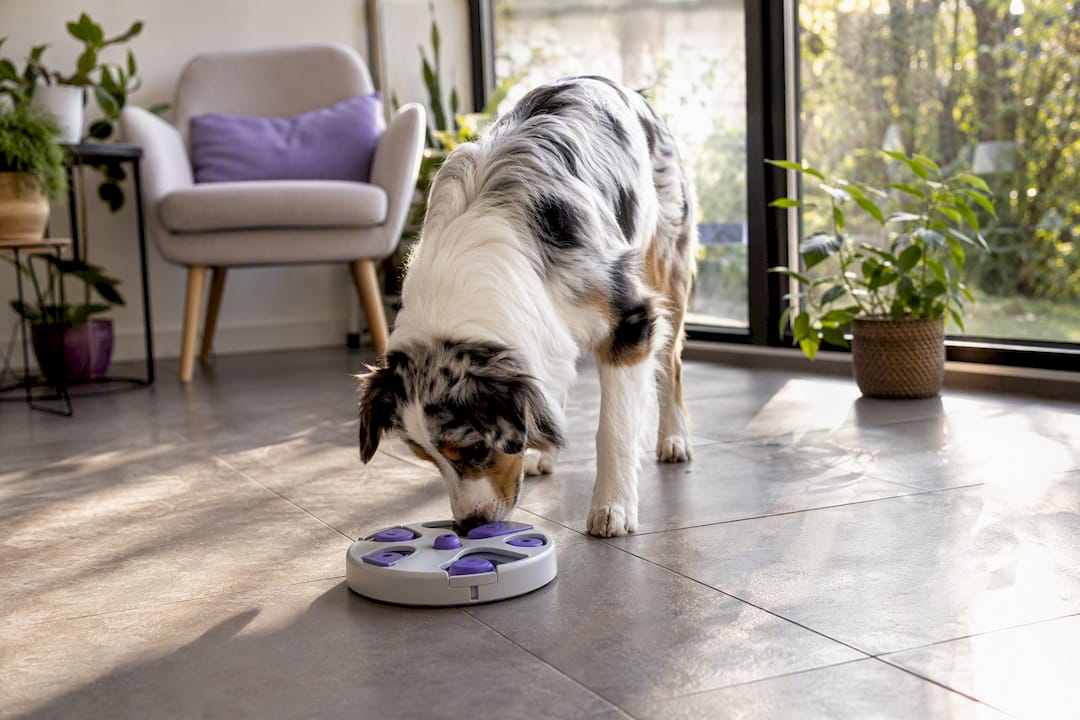
Puzzle feeders and treat-dispensing toys turn mealtime into a mental workout, slowing down fast eaters while keeping a dog occupied for a meaningful stretch of the day. Frozen Kongs work similarly, extending engagement because your dog has to work for the reward.
Background noise, like a radio or television left on low, can mask outside sounds that might otherwise trigger barking. Rotating toys weekly, rather than leaving the same three out constantly, keeps novelty in the mix, since a dog left with a fresh option tends to stay engaged longer than one bored with the familiar.
Guidelines for Choosing and Using Dog Monitoring Devices
A camera won’t feed your dog or open your front door, but it gives you visibility that a written plan alone can’t. When picking a monitoring device, prioritize two-way audio so you can speak to your dog remotely, which can interrupt anxious barking or offer reassurance during a stressful stretch.
Look for motion-triggered alerts rather than constant streaming, since a system that only notifies you when something happens saves battery and your attention for what actually matters. Night vision is worth the extra cost if your dog is ever alone after dark.
Treat-dispensing cameras add a layer of interaction, letting you reward calm behavior even from a distance. That said, a camera is a monitoring tool, not a safety net. It tells you your dog is distressed. It doesn’t get someone to your door. That’s the job of the daily check-in and tiered response network covered earlier in this guide, and the two systems work best together rather than as substitutes for each other.
Why We Built Mypetssafetynet
We started Mypetssafetynet because too many solo pet owners had no answer to a simple question: what happens to my dog if something happens to me and no one knows? A missed step, a medical emergency, a fall at home. It happens fast, and pets can’t call for help. Our check-in and alert system exists to make sure someone always finds out in time. Our emergency planning resources reflect what we’ve learned building this for solo owners just like you.
— Mypetssafetynet
Get Your Daily Check-In and Response Network Running Today
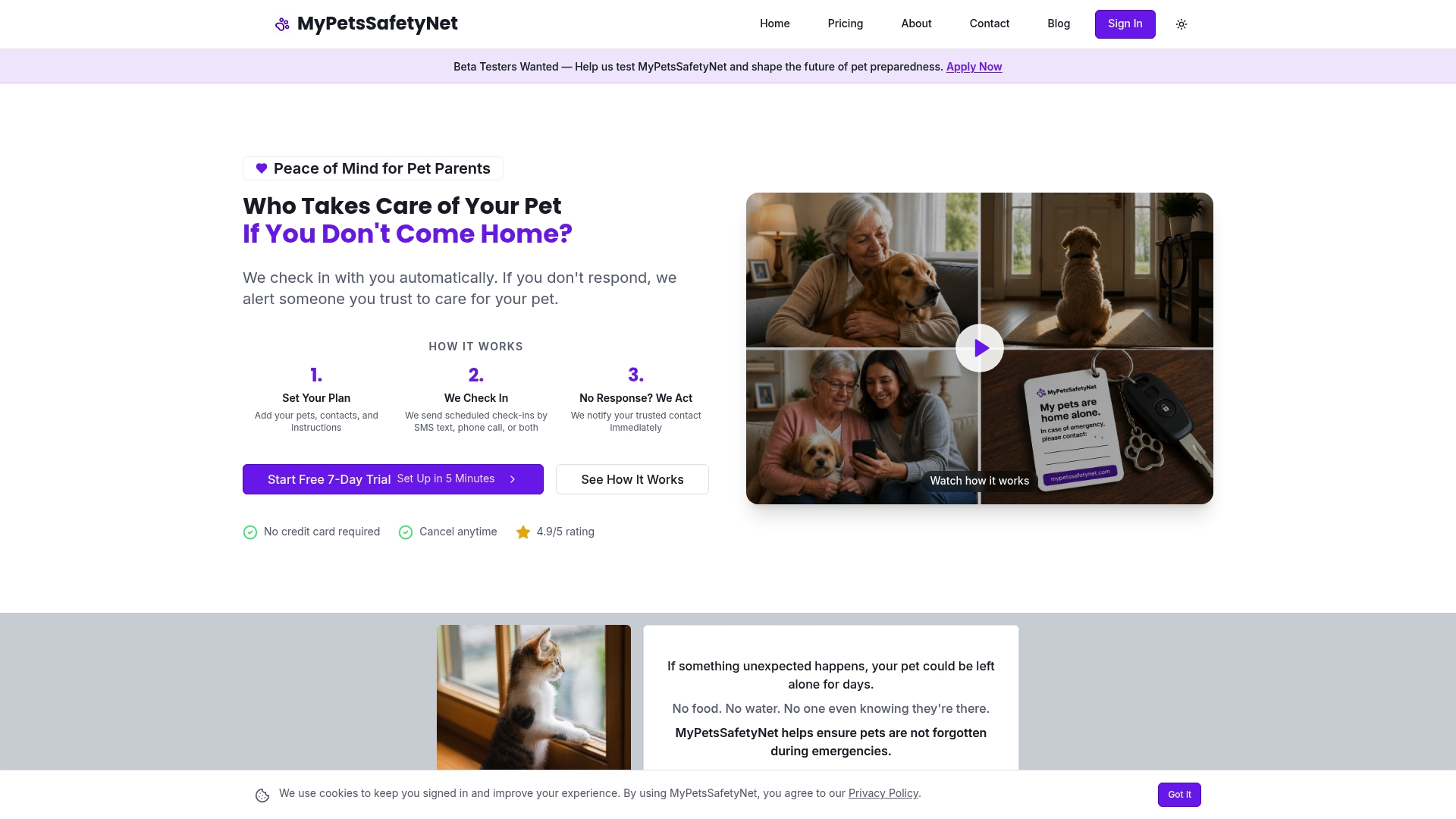
Mypetssafetynet replaces a patchwork of sticky notes and hopeful group texts with one automated system built specifically for pet owners living alone. It sends your scheduled SMS, phone, or email check-ins, manages profiles for up to five pets, and notifies up to three emergency contacts with full pet-care instructions the moment you miss a check-in, with no manual follow-up required from you.
If you’re not ready to commit to a subscription yet, start smaller: download a free pet-care card today and get your Tier 1 contact’s name and access notes written down in the next ten minutes. When you’re ready for the full automated check-in and escalation system, set up your account and confirm SMS consent to get your first daily check-in scheduled this week. If you also want visible community backup, a resource like missing-pet yard signage can complement your written plan for local awareness.
Sources
- Safety Plan for Pet Owners Who Live Alone — Snug Safety
- Pet Care Backup Plan for Older Adults | Los Angeles — All Seniors Foundation
- Pet disaster preparedness — American Red Cross
- Pet Care Plan for Emergencies: A Solo Pet Owner’s Guide — AloneAssist