Disabled Pet Owner Accommodation Tips: Practical Steps
Yes, you can absolutely keep pets as a disabled person, and U.S. law gives you real tools to secure housing accommodations when you need them. The Fair Housing Act and HUD guidance require most landlords to make reasonable accommodations for assistance animals, and the ADA protects your right to bring a trained service animal into public spaces. Three things matter most right now: solve the daily care tasks that drain your energy most (feeding, cleanup, walking), set up a tested backup plan with at least two emergency contacts, and draft a clear written accommodation request before you need it urgently.
Research shows pet ownership can reduce depression symptoms by up to 30% for people with disabilities. That’s a meaningful benefit worth protecting with a solid plan.
- Solve daily choke points first. Identify the one task that costs you the most energy and address it with a targeted product or service.
- Set up a backup plan. Name two emergency contacts, write care instructions, and test the plan before you need it.
- Prepare your accommodation request. A written, documented request is far more effective than a verbal one.
Table of Contents
- What are the best disabled pet owner accommodation tips for daily care?
- Service animals vs. emotional support animals: what rights apply where?
- How do you request a reasonable accommodation in housing?
- How do you build a reliable emergency backup plan for your pets?
- What home modifications make pet care easier for disabled owners?
- Where can you find reliable support and resources as a disabled pet owner?
- How do state laws affect your housing rights as a disabled pet owner?
- What pet policies apply in rental apartments, public housing, and assisted living?
- What does it cost to get and maintain a service or support animal?
- How do you communicate accommodation requests to landlords effectively?
- Key Takeaways
- Why planning is the most dignified choice you can make
- Mypetssafetynet keeps your pets covered when you can’t respond
- Useful sources and further reading
What are the best disabled pet owner accommodation tips for daily care?
The most common physical barriers in daily pet care are bending to floor level, managing a leash, lifting heavy food bags, cleaning waste, grooming, and giving medications. Universal-design pet products target exactly these barriers by reducing reach, grip, and repetitive motion demands. You don’t need to buy every adaptive gadget available. The smarter move is to identify your single biggest choke point and solve that one first.
Feeding
- Elevated feeders bring food and water bowls to a reachable height, eliminating the need to bend to the floor. Look for adjustable-height models if your mobility varies.
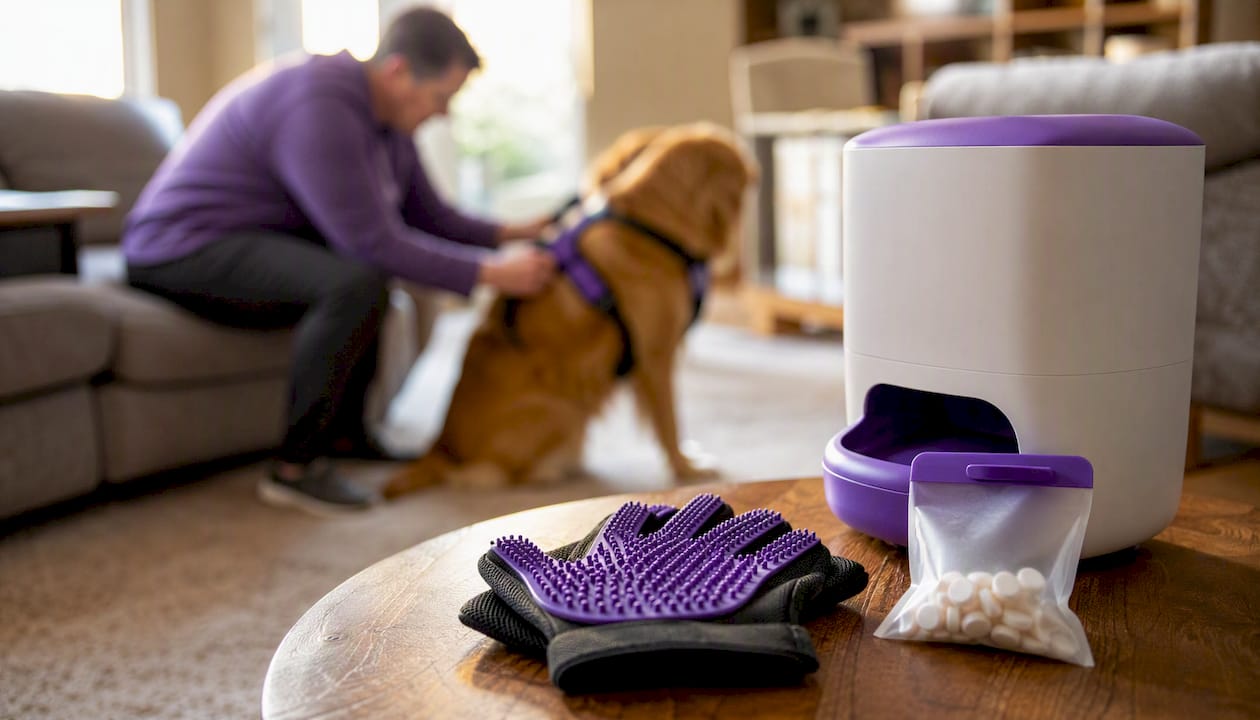
- Automatic feeders dispense measured portions on a schedule, so you’re not lifting a heavy bag or scooping daily.
- Auto-ship delivery for food and supplies removes the need to carry bulk purchases. Services like Chewy’s Autoship or Amazon Subscribe & Save let you set a delivery cadence and adjust quantities online.
Waste cleanup
67% of disabled pet owners report waste cleanup as their number one pet care challenge, and 23% have considered rehoming because of it. That’s a solvable problem.
- Professional waste removal services — with ADA-aware technicians can handle yard cleanup on a scheduled basis, some offering disability discount pricing.
Walking and leash management
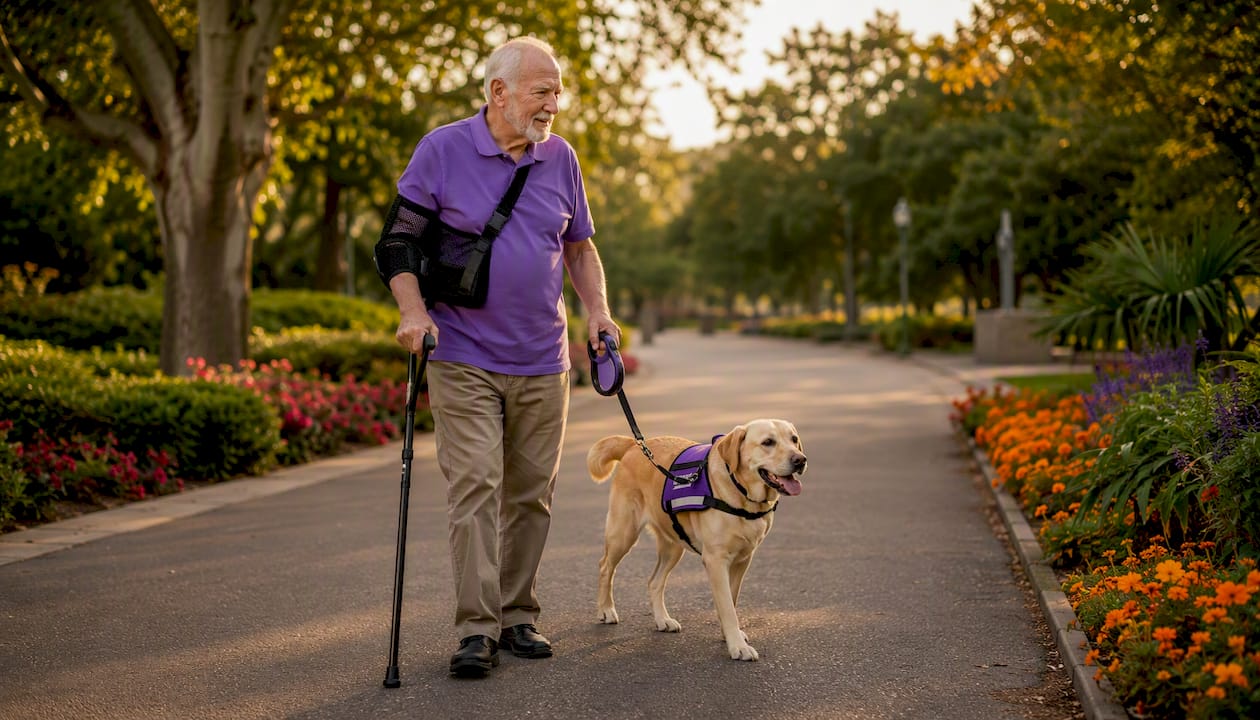
Wheelchair users have successfully mounted hands-free bicycle leash attachments to their chair frames, keeping the dog alongside while propelling the chair without holding a leash. This prevents tangling and frees both hands. For ambulatory owners with limited grip, waist-belt leash attachments distribute the pull across the hips instead of the hands.
Grooming and medication
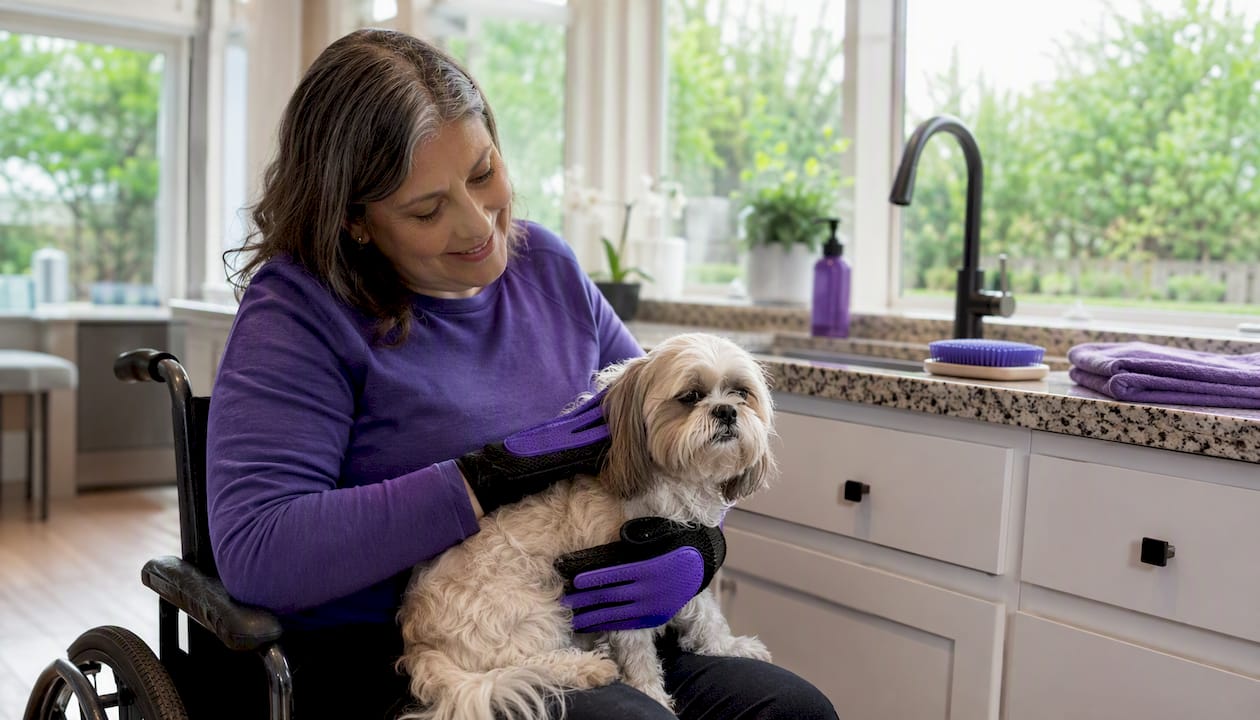
- Grooming gloves work by petting, so there’s no brush to grip or angle.
- Long-handled brushes with ergonomic grips reduce wrist strain.
- Pill pockets (soft treats with a hollow center) make medication administration a one-step process for owners with limited dexterity.
Pro Tip: Before purchasing any adaptive gear, check the return policy. Adaptive products vary significantly in fit and function depending on your specific mobility profile. A 30-day return window lets you test the item in your actual daily routine before committing.
Service animals vs. emotional support animals: what rights apply where?
These two categories carry very different legal protections, and confusing them is one of the most common mistakes disabled pet owners make when dealing with landlords or businesses.
A service animal is a dog (or, in limited cases, a miniature horse) that has been individually trained to perform a specific task directly related to a person’s disability. Examples include guiding someone who is blind, alerting someone who is deaf, or detecting an oncoming seizure. The ADA governs public access for service animals, meaning businesses, restaurants, hotels, and public transportation must allow them regardless of a no-pets policy.
An emotional support animal (ESA) provides comfort and companionship but is not trained to perform a specific task. ESAs do not have ADA public-access rights. Their primary legal protection is in housing, under the Fair Housing Act and HUD guidance.
| Service Animal | Emotional Support Animal | |
|---|---|---|
| Public access (ADA) | Yes | No |
| Housing (Fair Housing Act) | Yes | Yes |
| No-pet fees waived | Yes | Yes (reasonable accommodation) |
| Documentation landlord may request | None required under ADA; limited under FHA | Verification of disability-related need |
| Species | Dog (or miniature horse) | Any species |
A few important caveats. Landlords may ask for documentation confirming that you have a disability and that the animal provides a disability-related benefit. They cannot ask for your specific diagnosis, your medical records, or details about the nature of your disability. HUD guidance is clear that the request must be limited to confirming the functional need, not the underlying condition. When you submit your request, reference HUD’s official guidance directly to set the right expectations.
How do you request a reasonable accommodation in housing?
Submit a written request. A verbal conversation is easy to misremember or deny; a written request creates a record and starts the clock on the landlord’s obligation to respond.
What to include in your request
- A clear statement of what you are requesting (permission to keep a specific animal as an assistance animal).
- A brief statement that you have a disability (you do not need to name it).
- A statement that the animal is necessary because of your disability-related need.
- Any supporting documentation from a healthcare provider confirming the functional need (not the diagnosis).
- Your proposed timeline and any practical details (animal’s name, species, size).
Sample letter outline
Opening: State that you are a tenant at [address] and are submitting a formal reasonable accommodation request under the Fair Housing Act.
Disability statement: “I have a disability as defined under the Fair Housing Act. My disability affects [general functional area, e.g., mobility, mental health] in ways that limit one or more major life activities.”
Requested accommodation: “I am requesting permission to keep [animal name/species] as an assistance animal. This animal provides [specific benefit, e.g., emotional support, physical task assistance] that is directly related to my disability.”
Practical details: Animal’s name, breed, weight, vaccination status, and any training certifications if applicable.
Proposed timeline: “I am available to discuss this request at your convenience and ask for a response within [10–15 business days].”
Closing: Sign with your full name, unit number, and contact information.
What landlords can and cannot ask
- Can ask: Whether you have a disability, whether the animal is needed because of a disability-related need, and for documentation from a reliable third party (healthcare provider, therapist, social worker).
- Cannot ask: Your specific diagnosis, your medical history, or for the animal to be certified or registered by any particular organization.
If your request is denied
Most landlords who deny a request do so because the request was incomplete or the documentation was unclear. Resubmit with clearer documentation first. If the denial stands, you have several options:
- File a complaint with HUD — at hud.gov/fairhousing. HUD investigates Fair Housing Act violations at no cost to you.
- Consult the EEOC or a disability rights attorney — if the situation involves employment housing or a more complex discrimination claim.
Document every conversation in writing. After any phone call with your landlord, send a follow-up email summarizing what was discussed. That paper trail matters if the dispute escalates.
How do you build a reliable emergency backup plan for your pets?
A written, tested backup plan dramatically reduces the risk of your pet being rehomed if you have a health crisis. It also protects your housing accommodation status, because a pet that is cared for during your absence is far less likely to become a source of landlord complaints.
Given that pet ownership reduces depression symptoms by up to 30% for people with disabilities, the stakes of losing that relationship are real. Planning ahead is how you protect it.
Build your plan in these steps
- Name a primary emergency contact. This person should have a key to your home, know your pet’s routine, and be willing to act within hours of being notified.
- Name a secondary contact. Your primary contact may not always be reachable. A second person closes that gap.
- Write care instructions. Include feeding schedule, medication doses and timing, vet contact information, behavioral notes, and any access codes or key locations.
- Store access information securely. A lockbox with a spare key, a gate code written in your care document, and a note on where supplies are kept.
- Register with a local pet emergency registry if your city or county offers one. Some local emergency management offices maintain these lists.
- Vet any paid services you plan to use. Check for insurance, background checks, and whether staff have any disability-awareness training.
Pro Tip: Set up an automated wellness check-in service that sends you a scheduled message and notifies your emergency contacts if you don’t respond. This removes the burden of remembering to call someone and creates an automatic escalation workflow. Mypetssafetynet does exactly this, letting you store pet care instructions and contact details so your backup contacts receive everything they need the moment they’re notified.
Review and update your plan after any change in your health, medication, housing, or emergency contacts. A calendar reminder every six months is enough for most people.
For a detailed walkthrough of what to include in a hospitalization scenario, the emergency pet care planning guide at Mypetssafetynet covers the step-by-step documentation process.
What home modifications make pet care easier for disabled owners?
Universal-design pet care isn’t about retrofitting your home with expensive equipment. It’s about identifying the one or two physical barriers that cost you the most independence and removing them with targeted changes.
Low-effort changes you can make this week
- Elevated feeding stations at counter or table height eliminate floor-level bending entirely.
- Smooth paths to outdoor relief areas. If your yard has gravel or uneven surfaces, a paved or rubberized path to the relief spot reduces trip hazards and wheelchair resistance.
- Motion-activated lights in hallways and outdoor areas reduce the need to manage light switches during nighttime pet care.
- Lever-style door handles replace round knobs and are easier to operate with limited grip or a single hand.
Moderate changes worth planning for
- Threshold ramps between rooms or at exterior doors reduce the effort of moving a wheelchair or walker while managing a pet.
- Designated indoor relief areas (for small dogs or cats) with washable pads reduce the need for outdoor trips in bad weather or during health flares.
Product categories by mobility challenge
| Challenge | Product category |
|---|---|
| Limited grip | Grooming gloves, ergonomic leash handles, auto-feeders |
| Reduced reach | Long-handled scoopers, elevated feeders, top-entry litter boxes |
| Wheelchair use | Hands-free leash attachments, auto-ship delivery, elevated platforms |
| Single-arm use | Waist-belt leash, pill pockets, scoop-and-store containers |
| Visually impaired | Tactile feeding station markers, scheduled auto-feeders with audio alerts |
Pro Tip: Do a single-room audit of the space where you spend the most time with your pet. For most people, the kitchen or living room is where feeding and cleanup happen. Identify the one task in that room that takes the most physical effort and address it first before buying anything else.
Funding options to explore
Several programs may help offset the cost of home modifications:
- Medicaid Home and Community-Based Services (HCBS) waivers can cover home modifications in many states.
- Veterans Affairs (VA) Specially Adapted Housing grants are available to eligible veterans with service-connected disabilities.
- Local Centers for Independent Living (CILs) often maintain lists of local grant programs and low-cost modification services.
- State assistive technology programs (funded under the Assistive Technology Act) provide device loans and sometimes funding for adaptive equipment.
Where can you find reliable support and resources as a disabled pet owner?
Federal guidance
- ADA National Network (ada.gov): Covers public-access rights for service animals, employer obligations, and transportation rules. The DOJ’s ADA guidance is the authoritative source for what businesses must allow.
- HUD Fair Housing (hud.gov/fairhousing): Covers reasonable accommodation requests, ESA rights in housing, and how to file a complaint. HUD also publishes guidance letters that clarify what documentation landlords may request.
- Section 504 of the Rehabilitation Act: Applies to programs and housing that receive federal financial assistance. If you live in federally subsidized housing, Section 504 adds a layer of protection beyond the Fair Housing Act. The Administration for Community Living (ACL) funds research and programs supporting independent living.
- Air Carrier Access Act (ACAA): Governs service animals on commercial flights. The U.S. Department of Transportation publishes the current rules, which were updated to cover psychiatric service animals and clarify documentation requirements.
Local and community support
- Centers for Independent Living (CILs): Peer-run organizations in most U.S. cities that connect disabled people with local services, including pet care assistance.
- Volunteer dog-walking programs: Some humane societies and disability nonprofits coordinate volunteer walkers for disabled pet owners. Contact your local humane society or disability services office to ask.
- Home health aide integration: If you already receive home health aide services, ask whether pet-related tasks (feeding, litter, walking) can be added to your care plan. Some Medicaid waiver programs allow this.
- Subscription delivery services: Auto-ship programs for food, medications, and supplies reduce the physical burden of shopping and carrying.
When vetting any paid pet care service, ask specifically about insurance coverage, staff background checks, and whether technicians have any training in working with clients who have disabilities. Some services structure their offerings around ADA-aware technicians, flexible scheduling, and documentation that can support accommodation requests.
For a broader list of programs relevant to disabled and senior pet owners, the pet care resources guide at Mypetssafetynet covers funding, volunteer programs, and local service options.
How do state laws affect your housing rights as a disabled pet owner?
Federal law sets the floor. The Fair Housing Act and HUD guidance apply nationwide, but many states and cities have passed their own housing and disability laws that go further.
California, New York, and Illinois, for example, have state fair housing laws that extend protections to housing types not fully covered by the federal FHA, such as owner-occupied buildings with fewer than four units. Some states also have stricter limits on what documentation landlords may request, or shorter timelines for responding to accommodation requests.
A few practical points to know:
- State human rights commissions — handle fair housing complaints at the state level and often resolve cases faster than HUD.
The best starting point is your state’s civil rights or human rights agency. Most publish plain-language guides to fair housing rights that include state-specific rules alongside the federal framework.
What pet policies apply in rental apartments, public housing, and assisted living?
Housing type matters significantly when it comes to pet policies and accommodation rights.
Rental apartments (private market)
Most private landlords can set their own pet policies, but they cannot apply those policies to assistance animals. A no-pets building must still allow a service animal or ESA if a proper accommodation request is submitted. The landlord may not charge a pet deposit or pet fee for an assistance animal, though they can hold you responsible for any damage the animal causes.
Public housing (HUD-assisted)
Public housing authorities are subject to both the Fair Housing Act and Section 504 of the Rehabilitation Act, which means they have stricter obligations than private landlords. HUD’s own guidance explicitly states that public housing residents may keep common household pets (not just assistance animals) in most circumstances, subject to reasonable rules about size and care. For assistance animals, the accommodation process is the same as in private housing.
Assisted living and memory care facilities
This is where the rules get more complex. Assisted living facilities are regulated at the state level, and pet policies vary widely. Some facilities welcome resident pets; others allow only facility-owned animals. The Fair Housing Act does apply to most assisted living settings, so an accommodation request for an assistance animal is still a valid route. However, facility administrators may raise concerns about care capacity, and you may need to demonstrate that the animal’s care needs can be met without burdening staff. Having a written care plan and a named backup contact strengthens your position considerably.
What does it cost to get and maintain a service or support animal?
Costs vary widely depending on the type of animal and the level of training involved.
Professionally trained service dogs are the most expensive option. Training programs through accredited organizations can cost $20,000–$60,000, though many nonprofit programs provide trained dogs at no cost to the recipient through a lengthy application and waitlist process. Accreditation through Assistance Dogs International (ADI) is a reliable quality signal when evaluating programs.
Owner-trained service dogs are legal under the ADA. There is no federal requirement that a service dog be professionally trained or certified. Owner training reduces upfront cost but requires significant time and skill, and the dog must reliably perform its trained task.
Emotional support animals require no specialized training, so there’s no training cost. The primary expense is standard pet care: food, veterinary care, and supplies.
Ongoing costs for any assistance animal include:
- Routine veterinary care and vaccinations
- Food and supplies (auto-ship programs reduce per-unit cost)
- Grooming (adaptive tools reduce the need for professional grooming)
- Pet insurance, which can reduce out-of-pocket veterinary costs significantly
Financial assistance options include:
- Nonprofit service dog programs that place trained dogs at no cost (waitlists are common; apply early).
- Veterans Affairs programs for eligible veterans needing service dogs.
- State vocational rehabilitation agencies, which may fund service animal costs when the animal supports employment.
- Pet insurance through providers like Trupanion or Nationwide, which cover illness and injury costs.
How do you communicate accommodation requests to landlords effectively?
The tone and structure of your request shapes how quickly and cooperatively a landlord responds.
Lead with the legal framework, briefly. Open your letter by citing the Fair Housing Act and HUD guidance. This signals that you know your rights without being adversarial. Most landlords who understand the law will respond cooperatively once they see a properly framed request.
Be specific about the accommodation, not the disability. You don’t need to explain your medical history. State what you need and why it’s connected to a disability-related need, in plain language.
Offer practical solutions proactively. If you anticipate concerns about damage or noise, address them before the landlord raises them. Offer to provide vaccination records, note the animal’s size and temperament, and propose a check-in after 30 days. This reframes the conversation from “permission” to “partnership.”
Negotiation strategies that work:
- If a landlord is hesitant, ask what specific concern they have and address it directly in writing.
- Propose a trial period with a written agreement on what success looks like.
- If cost is raised (repairs, liability), clarify that you remain responsible for actual damage caused by the animal, just as any tenant would be.
- Keep all follow-up in writing. A quick email after a phone call (“Just confirming our conversation from today…”) creates a record without feeling confrontational.
If you’re in public housing or a HUD-assisted property, the housing authority has a formal grievance process. Use it. Filing a written grievance creates an official record and often prompts faster resolution than informal requests.
Key Takeaways
Disabled pet owners in the U.S. have clear legal rights under the Fair Housing Act and ADA, and the most effective approach combines targeted daily-care adaptations, a tested emergency backup plan, and a properly documented accommodation request.
| Point | Details |
|---|---|
| Solve your top choke point first | Identify the single most draining daily task (often waste cleanup or feeding) and address it with a targeted product or service. |
| Know your legal protections | Service animals get ADA public-access rights; ESAs get Fair Housing Act housing protections. Neither can be charged a pet fee. |
| Submit accommodation requests in writing | A written request citing the Fair Housing Act and HUD guidance is far more effective than a verbal one and creates a legal record. |
| Build and test a backup plan | Name two emergency contacts, write care instructions, and test the plan before a health crisis occurs. |
| Mypetssafetynet automates your backup | Mypetssafetynet’s automated wellness check-ins notify your emergency contacts with full pet care details if you don’t respond. |
Why planning is the most dignified choice you can make
Keeping a pet as a disabled person isn’t just possible. It’s a deeply reasonable choice backed by real mental health benefits and protected by federal law. What undermines it isn’t disability itself but the absence of a plan. When daily care becomes unsustainable or a health crisis hits without a backup in place, the pet pays the price, and so does the owner.
Planning preserves independence. A written accommodation request keeps your housing secure. A tested emergency plan keeps your pet safe when you can’t be there. And an automated wellness check-in, like the one Mypetssafetynet provides, means your emergency contacts are notified promptly with everything they need, without you having to make a phone call in a crisis.
The owners who keep their pets through difficult health periods are almost always the ones who planned ahead. Not because they had more resources, but because they took the time to put the right pieces in place before they needed them.
Mypetssafetynet keeps your pets covered when you can’t respond
Peace of mind for disabled pet owners starts with knowing someone will act if you can’t. Mypetssafetynet sends you scheduled wellness check-ins by SMS, phone, or email. If you don’t respond, your emergency contacts are notified automatically, with your pet’s full care instructions already included.
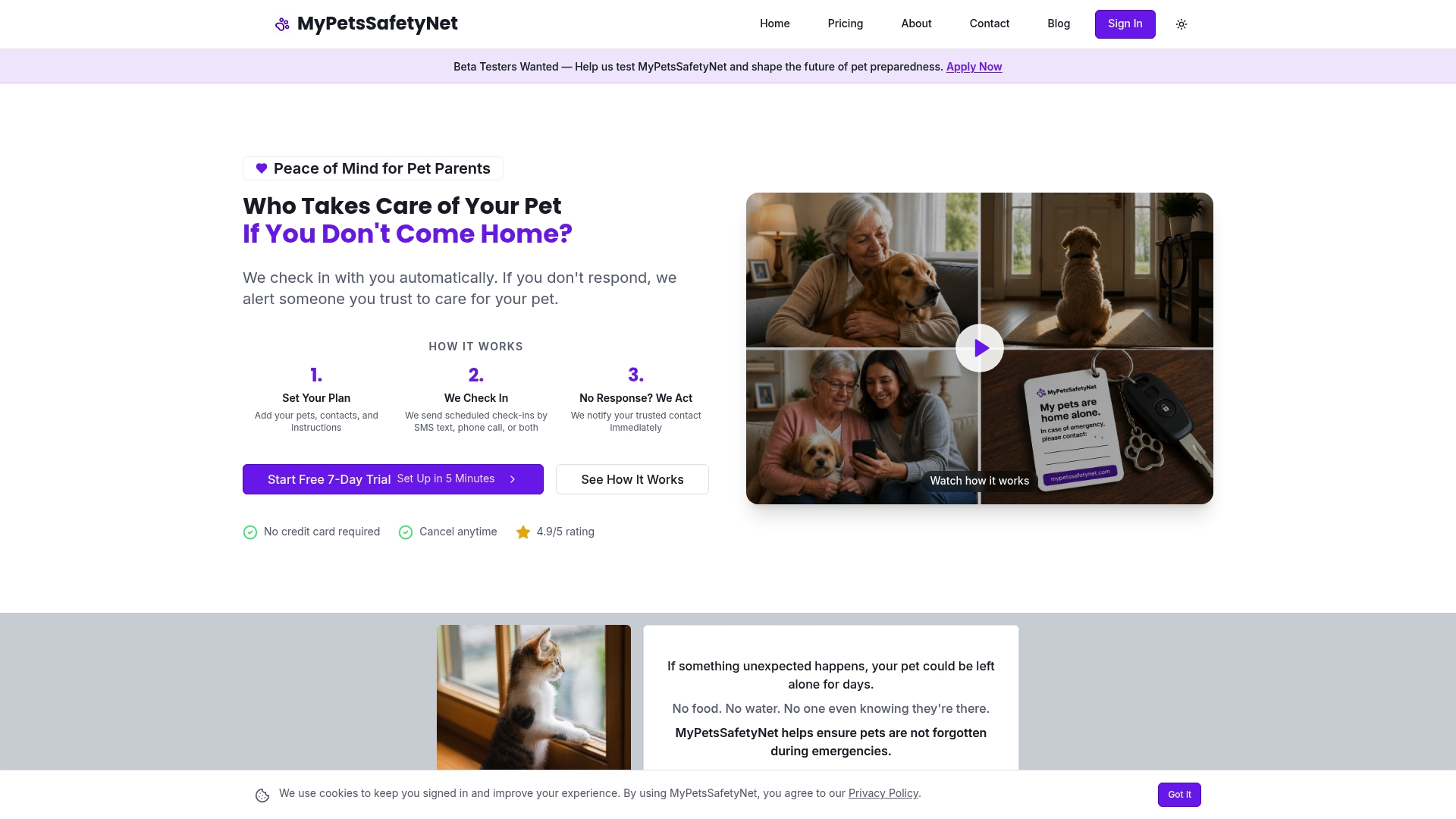
For disabled pet owners specifically, this means consistent daily monitoring, a built-in escalation workflow, and a care instruction card your contacts can access the moment they’re alerted. You can store details for up to 5 pets and 3 emergency contacts, including feeding schedules, medication notes, vet contacts, and access instructions.
Mypetssafetynet is a subscription-based service with a free trial so you can set everything up and test it before committing. Start by adding your pets, your contacts, and your care notes. Then let the system run in the background, quietly making sure your animals are never left without a plan.
Start your free trial at Mypetssafetynet and set up your first wellness check-in today.
Useful sources and further reading
The resources below are the authoritative starting points for U.S. disabled pet owners navigating housing rights, daily care adaptations, and emergency planning.
- ADA.gov: The U.S. Department of Justice’s official ADA resource. Use it to confirm public-access rights for service animals, understand what businesses must allow, and find complaint procedures.
- HUD Fair Housing (hud.gov/fairhousing): The primary source for reasonable accommodation rules, ESA housing protections, and how to file a fair housing complaint. HUD also publishes guidance letters on assistance animals that are worth reading before you submit a request.
- Administration for Community Living (ACL): Funds independent living programs and disability research across the U.S. A good starting point for finding local Centers for Independent Living and state-level support programs.
- U.S. Department of Transportation (transportation.gov): Current rules for service animals on commercial flights under the Air Carrier Access Act, including documentation requirements.
- Massachusetts Assistance Animals in Housing guide: A well-structured state-level example of how fair housing rules apply to assistance animals; useful as a model even if you’re in another state.
Mypetssafetynet internal resources:
- What happens to your pets if you’re hospitalized: Covers contingency planning and how emergency notifications mobilize pet care.
- Pet ownership during chronic illness: Practical strategies for keeping pet care sustainable through health challenges.
- Who checks on pets if the owner is hospitalized: Lists volunteer, registry, and paid-service options for pet checks.
- Solo owner pet care plan: A practical checklist for creating access instructions and scheduling coverage.
Save a copy of your accommodation request letter and your emergency care plan in a single digital file you can access from your phone. If a crisis happens, the last thing you want to be doing is searching for documents.
This article provides general information about U.S. disability and housing law. It is not legal advice. Confirm current rules with HUD, your state’s civil rights agency, or a qualified attorney before making decisions about your specific situation.