Keep Pets Safe After a Car Accident: 2 Things Every Solo Owner Must Do

The fastest way to make sure your pets are checked on if you’re incapacitated is to enroll in an automated wellness-check service, like the one we built at MyPetsSafetyNet, and confirm at least two nearby caregivers who have home access and know where your pet Go Bag is. Start today with those two moves: sign up for scheduled check-ins, then call the people you trust most.
TL;DR:
- Setting up automated check-ins aligned with your daily routine ensures timely alerts if you become unresponsive.
- Confirm that at least two nearby caregivers can access your home and are familiar with your pet’s Go Bag and routine.
- Maintain a detailed pet profile and emergency paperwork, including vet contacts and current microchip registration, in waterproof storage.
- Regularly test your automated system and update contact details, food, medication, and caregiver availability every six months.
- Prepare a list of temporary housing options and secure your home to prevent accidents or pets accessing unsafe areas during an emergency.
Table of Contents
- Act today: the checklist that matters most
- How to set up automated checks and coordinate your backup team
- Building your pet Go Bag and emergency paperwork
- Testing and maintaining the plan so it still works in six months
- Planning for pet care during a hospital stay
- Arranging temporary housing if caregivers can’t come to you
- Securing your home if you can’t get back to it
- Making sure emergency responders know pets are inside
- Publisher perspective: why automation plus a human plan is the safest path
- How MyPetsSafetyNet helps you put this plan into motion
- FAQ
- Sources
- Authoritative checklists and pages to bookmark
Act today: the checklist that matters most
A car accident or sudden hospital stay does not wait for you to finish planning, so the first few actions you take now are the ones that protect your pets later. We recommend working through these in order, ideally within the next week.
- Reach out to two trusted people who live nearby and confirm they’re willing to hold a key or know your lockbox code.
- Put a pet alert sticker on your main entrance and write a wallet card listing your emergency contacts and pet details.
- Pack a quick Go Bag with food, medication, a current photo, and your vet’s phone number.
- Set up a basic automated check-in, daily or weekly, and decide who gets contacted first if you miss one.
Each step closes a different gap. The caregivers give you hands and feet. The sticker and wallet card tell strangers what to do. The Go Bag turns a chaotic moment into a five-minute grab. The automated check is what notices you’ve gone quiet in the first place.
Pro Tip: Do the caregiver phone calls first. A sticker and a Go Bag are useless if nobody with a key knows they exist.
How to set up automated checks and coordinate your backup team
Automated wellness checks work by asking you a simple question on a schedule you choose, then escalating to your named contacts if you don’t answer. Getting this right means matching the schedule to your real life and making sure the people on your list know exactly what to do.
- Pick a cadence that fits your day: a morning check for most routines, or a longer weekly check if you travel for work.
- Set your escalation rules: how long before a missed check counts as a problem, who gets called first, and whether contacts receive a text, a call, or both.
- Write the alert message so it includes your address, the number and type of pets you have, and where the Go Bag sits.
- Build a pet profile for each animal with a photo, feeding schedule, temperament notes, vet contact, and microchip number.
- Test the whole chain once before you rely on it: trigger a missed check on purpose and watch what happens.
Before you consider the setup finished, confirm with each caregiver that they can actually get into your home and that they know where the Go Bag and feeding instructions live. Our senior pet owner alert guide walks through pairing automated notifications with a human plan in more detail, and our voice alert option covers phone-call check-ins for anyone who doesn’t use a smartphone.
Pro Tip: If you live with a health condition that makes texting difficult, choose a check-in method that calls you instead of waiting for a tap.
Building your pet Go Bag and emergency paperwork
A Go Bag only helps if it’s stocked and findable, and that means thinking past “food and a leash.” The ASPCA’s printable disaster checklist recommends a 7 to 10 day supply of food and a 10-day supply of medication, stored in labeled, waterproof containers.
- Food for 7 to 10 days and medication for 10 days, both labeled with dosing instructions.
- A current photo of each pet, plus vaccination records and microchip details.
- Vet and emergency clinic phone numbers, written down rather than only saved in your phone.
- A carrier, leash, and muzzle if your pet needs one for safe handling by someone unfamiliar.
- Basic first-aid items: gauze, saline, tweezers, and any pet-specific supplies your vet recommends.
Keep this paperwork in a waterproof folder alongside the kit, and place a duplicate Emergency Contact Sheet near your main entrance where a responder or neighbor would see it. A wallet card listing two emergency contacts and a one-line pet summary rounds out the system. Double-check that your pet’s collar tags are current and that your microchip registration matches your actual address and phone number, since an outdated chip record can delay a reunion by days.
Tell your caregivers exactly where all of this lives. A Go Bag in a closet nobody mentioned is the same as no Go Bag at all.
Testing and maintaining the plan so it still works in six months
A plan built once and never checked tends to fail quietly, usually because a phone number changed or a caregiver moved. A regular maintenance rhythm catches that before it matters.
- Monthly: trigger a simulated no-response test on your check-in schedule to confirm the escalation actually reaches your contacts.
- Quarterly: call each caregiver directly to confirm they’re still willing and still have working access to your home.
- Every six months: rotate expiring food and medication, refresh stickers and printed contact sheets, and verify your microchip registration is current.
- Ongoing: watch for the common failure points, a disconnected contact number, a caregiver who moved away, or medication that expired unnoticed.
The ASPCA’s guidance on making a plan for your pet recommends this kind of quarterly no-response drill specifically because it exposes gaps before a real emergency does. Log what happened each time, even briefly. A short note like “contact reached in 4 minutes, key worked” tells you the system is sound.
Pro Tip: Set your maintenance checks on the same calendar reminder as a bill you never miss, like rent or a car payment, so they actually happen.
Planning for pet care during a hospital stay
A car accident that puts you in the hospital creates a specific problem: your pets need care for days or weeks, not just the first few hours. This is where your written instructions earn their keep. ASPCA guidance notes that one of the most common failures in pet emergency plans is treating a temporary check as the same thing as full guardianship, when they require very different arrangements.
Separate your written instructions into two tiers. The first is a short-term access plan, the caregiver who can get in today, feed your pets, and hold things together for 48 to 72 hours. The second is a longer guardianship plan for an extended hospital stay, naming who takes over daily care, how they’ll be reimbursed for supplies, and when you expect to resume care yourself.

Keep both documents in your Go Bag folder, dated and signed if possible. If your hospitalization stretches past a week, your short-term caregiver may need to hand off to the guardianship plan, and having it written down removes the guesswork. Mention any ongoing vet appointments, medication refills, or behavioral needs your pet has, since a caregiver stepping in for the first time won’t know your pet’s routine the way you do.
Update these documents whenever your pet’s health or medication changes. A plan written two years ago with an old prescription dose can do more harm than good.
Arranging temporary housing if caregivers can’t come to you
Sometimes your named caregivers are willing but genuinely unable to get to your home, out of town, sick themselves, or without transportation. Your plan needs a second branch for exactly this.
List at least one boarding kennel, pet-friendly hotel, or veterinary clinic with overnight boarding that you’ve confirmed in advance will accept your pet on short notice. Many veterinary clinics offer boarding specifically for situations like this, and calling ahead, even once a year, to confirm they still take walk-in emergency boarding saves critical time. Keep that phone number in the same folder as your vet’s contact information.

If you have a second-tier caregiver, someone a bit farther away who could pick up your pet and bring them to their own home, note their address and any transportation they’d need, such as a secure carrier left in your entryway. For multi-pet households, think through whether animals need to move together or can be split between two temporary caregivers without added stress.
Write these options down in the order you’d want them tried. A responder or caregiver working from a clear list moves faster than one trying to improvise, and your pet spends less time in an unfamiliar, stressful situation. Review this list during your quarterly caregiver check-ins, since boarding availability and contact details change.
Securing your home if you can’t get back to it
If you’re incapacitated, your home itself becomes part of the problem: doors left unlocked, a stove on, or a pet with access to an area that isn’t safe for them unsupervised. A few preparations reduce that risk before it ever becomes relevant.
Make sure your caregivers know how to fully secure the home once they’ve checked on your pet, not just unlock the door and leave. That includes confirming windows are closed, appliances are off, and any other pets or exits are accounted for. If you use a GPS-based containment system instead of a physical fence, share the access details with your caregiver so they can confirm your pet stays within a safe boundary while you’re away. Resources like this guide to GPS dog fence setup cover how these systems work if you’re deciding whether one fits your yard and routine.
Keep a spare key in a lockbox rather than relying solely on a caregiver’s personal copy, in case that caregiver is unreachable when needed. Note any specific hazards in your home, a chemical cabinet, a pool, a balcony, so a caregiver unfamiliar with your layout doesn’t need to guess. If your pet has a temperament that makes them nervous around strangers, let your caregiver know in advance so the handoff goes smoothly rather than turning into a second emergency.
Making sure emergency responders know pets are inside
First responders arriving at your home for a medical emergency have no way to know pets are present unless something tells them, and that gap has real consequences for an animal left behind. NYC Emergency Management’s Ready New York guidance points to visible home alerts as a vital backup specifically because responders often cannot know pets are inside without them.
A pet alert sticker placed at eye level on your front door, and a second on a back entrance if you have one, tells anyone arriving to check for an animal before they leave. Include the number and type of pets on the sticker itself when space allows. Update that information every six months, since a sticker listing a dog you no longer have does more harm than good by sending responders looking for the wrong animal.
Pair the sticker with the wallet card in your own pocket or wallet, listing your pets and your two emergency contacts. Responders routinely check for this kind of identification when treating someone who can’t speak for themselves, and it gives them a direct line to someone who can act on your pet’s behalf within minutes rather than hours.
Publisher perspective: why automation plus a human plan is the safest path
We built MyPetsSafetyNet because a locked phone and a missed check-in shouldn’t mean a pet goes a day without food or water. Automation is the part that notices something is wrong and starts the clock. It cannot turn a key or scoop a litter box, and that’s exactly why the human side of this plan, a caregiver who shows up, matters just as much as the alert that reaches them.
Start small if the whole plan feels like too much at once: confirm one caregiver, run one test alert, and build from there.
— MyPetsSafetyNet
How MyPetsSafetyNet helps you put this plan into motion
Setting up automated wellness checks on your own is possible with reminders and a shared spreadsheet, but it’s slower and easier to let slip than a system built for exactly this purpose. Our service handles the scheduling, the escalation, and the pet-specific details so your caregivers get a complete picture the moment they’re notified, not just a vague “something’s wrong.”
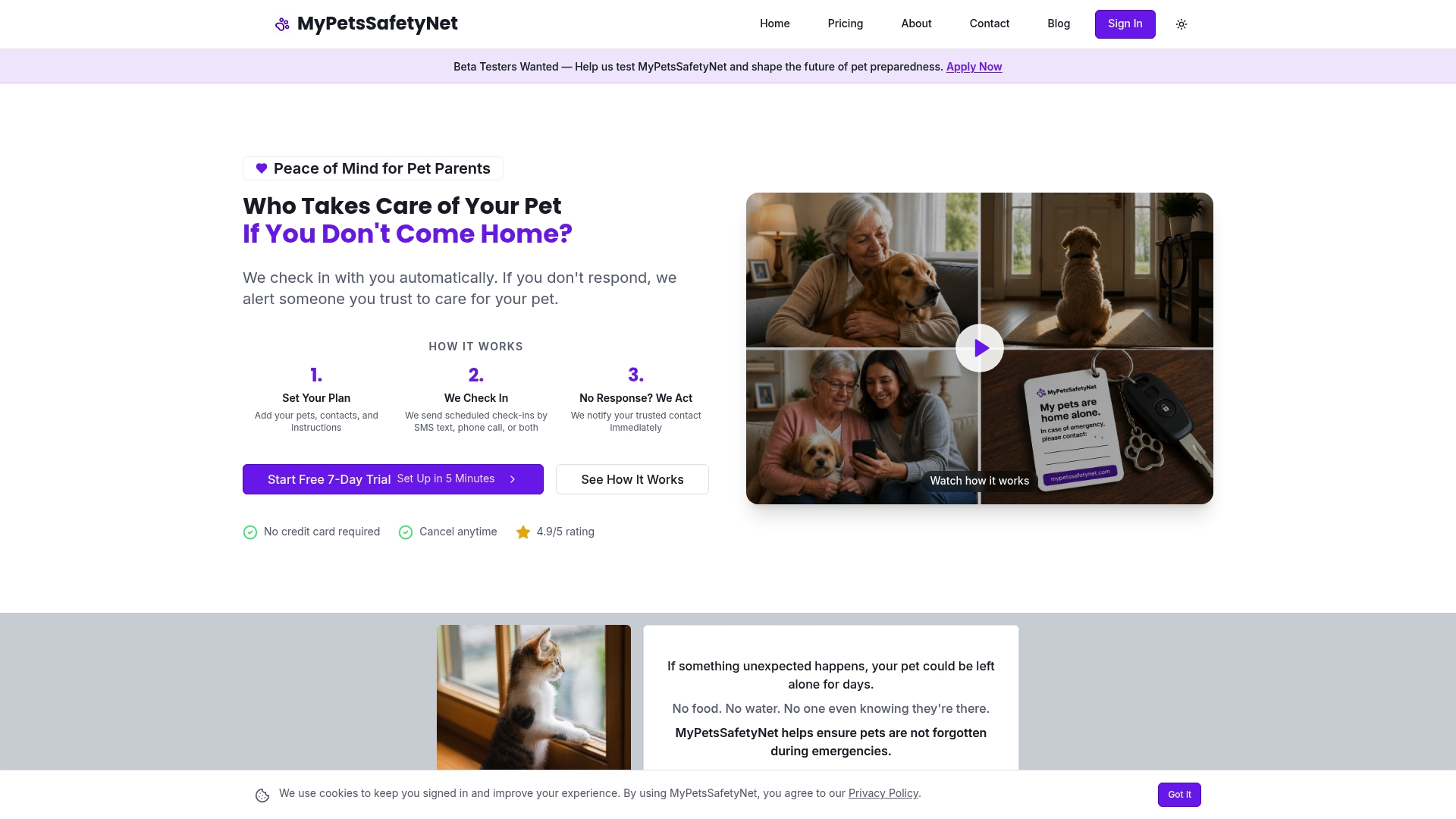
Here’s what’s included:
- Scheduled wellness checks by SMS, phone call, or email, so no smartphone is required.
- An escalation workflow that contacts your named caregivers in the order you choose if you miss a check.
- Pet profiles covering feeding schedules, medication, and vet contacts for up to 5 pets.
- Contact management for up to 3 emergency contacts, each notified with the care details they need.
As we state on our own site, setup takes less than 10 minutes, and because the system works over SMS or phone calls, you never need a smartphone or app to use it. You can try the full service with our 7-day free trial, no credit card required, and our Monthly plan runs $6.99 per month after that. Visit our pricing page to get your first check-in scheduled today.
FAQ
What’s the first step if I live alone with pets?
Start by confirming at least two caregivers who have access to your home and know your pet’s routine, then set up an automated wellness check so someone is notified quickly if you don’t respond. These two pieces work together: the caregivers provide hands-on care, and the check-in system is what alerts them in the first place.
How much food and medication should a pet Go Bag include?
The ASPCA recommends packing a 7 to 10 day supply of food and a 10-day supply of medication, stored in labeled, waterproof containers. Keep this alongside a current photo and your vet’s contact information so a caregiver can act without guessing.
How do I let emergency responders know a pet is home alone?
A visible sticker at eye level on your main entrance is the backup emergency management guidance points to, since responders often have no other way to know a pet is inside. Pair it with a wallet card listing your pets and emergency contacts for extra certainty.
Does MyPetsSafetyNet require a smartphone to use?
No. Our check-ins work over SMS or phone calls, so anyone with a basic phone can use the service without downloading an app. Setup takes less than 10 minutes, and you can try it with our 7-day free trial before choosing a Monthly plan.
How often should I test my pet emergency plan?
Run a simulated no-response test monthly to confirm your escalation reaches your contacts, and check in with each caregiver quarterly to confirm they’re still available and have working home access. The ASPCA’s planning guidance recommends this kind of regular drill specifically because it catches outdated contact details before an emergency does.
Sources
- Ready New York: Pets (NYC Emergency Management)
- ASPCA pet disaster kit (printable checklist)
- Red Cross pet disaster preparedness
- Ready
Authoritative checklists and pages to bookmark
- Ready New York: Pets
- Ready
- ASPCA pet disaster kit checklist
- Red Cross pet disaster preparedness
- ASPCA: making a plan for your pet